
Attracting high-ticket clients isn’t simply a matter of charging more or finding companies with bigger budgets. Larger deals usually involve more scrutiny, more stakeholders, greater perceived risk, and a buyer who has already done considerable research before your first conversation.
In fact, 6sense’s 2025 B2B Buyer Experience Report found that 94% of buying groups ranked their shortlist before speaking with sellers. The vendor buyers preferred before that first conversation ultimately won nearly 80% of the time.
That changes the job.
To attract high-ticket clients consistently, your business needs to become credible before the sales call, target problems valuable enough to justify the investment, reach the right people with relevant messaging, qualify aggressively, and give buyers enough confidence to choose you over alternatives.
This guide walks through that complete process, from identifying the right prospects to turning successful engagements into renewals and referrals.
Key Takeaways
- High-ticket clients buy confidence and business outcomes, not simply more features or hours.
- Buyers often form vendor preferences before contacting sales, so positioning, content, proof, and reputation matter early.
- Better qualification protects sales time and prevents teams from confusing activity with opportunity.
- The best acquisition system combines targeting, authority, outbound, qualification, sales execution, and retention.
- Winning a premium client is only the beginning. Long-term value comes from delivery, expansion, renewal, and referrals.
What Are High-Ticket Clients?
A high-ticket client is a customer whose contract value or potential lifetime value is large enough to require a more deliberate buying and selling process. There is no universal dollar amount that makes a deal “high-ticket.” A $10,000 engagement can be significant for one company while another business may not consider an opportunity high-value until it exceeds six figures.
What matters is the relative economic importance of the purchase. When the investment becomes meaningful, buyers tend to ask harder questions:
- Can this company actually solve our problem?
- What evidence do they have?
- How difficult will implementation be?
- What happens if this doesn’t work?
- Will the business impact justify the investment?
- Who internally needs to approve the decision?
- Is there a safer alternative?
Key Characteristics of High-Ticket Clients
- Focus on ROI and outcomes: They do not buy a commodity or a simple task; they invest in solving a major business challenge or achieving a significant personal or professional breakthrough.
- High trust and proof requirements: Because the financial commitment is large, they require strong brand authority, credible case studies, transparency, and social proof before deciding.
- Deliberate decision-making: Unlike low-ticket impulsive buyers, high-ticket clients go through a slower, more structured evaluation process that often involves multiple stakeholders, consultations, or approval layers.
- Expectation of white-glove service: They demand personalized attention, active communication, and tailored support during and after the transaction.
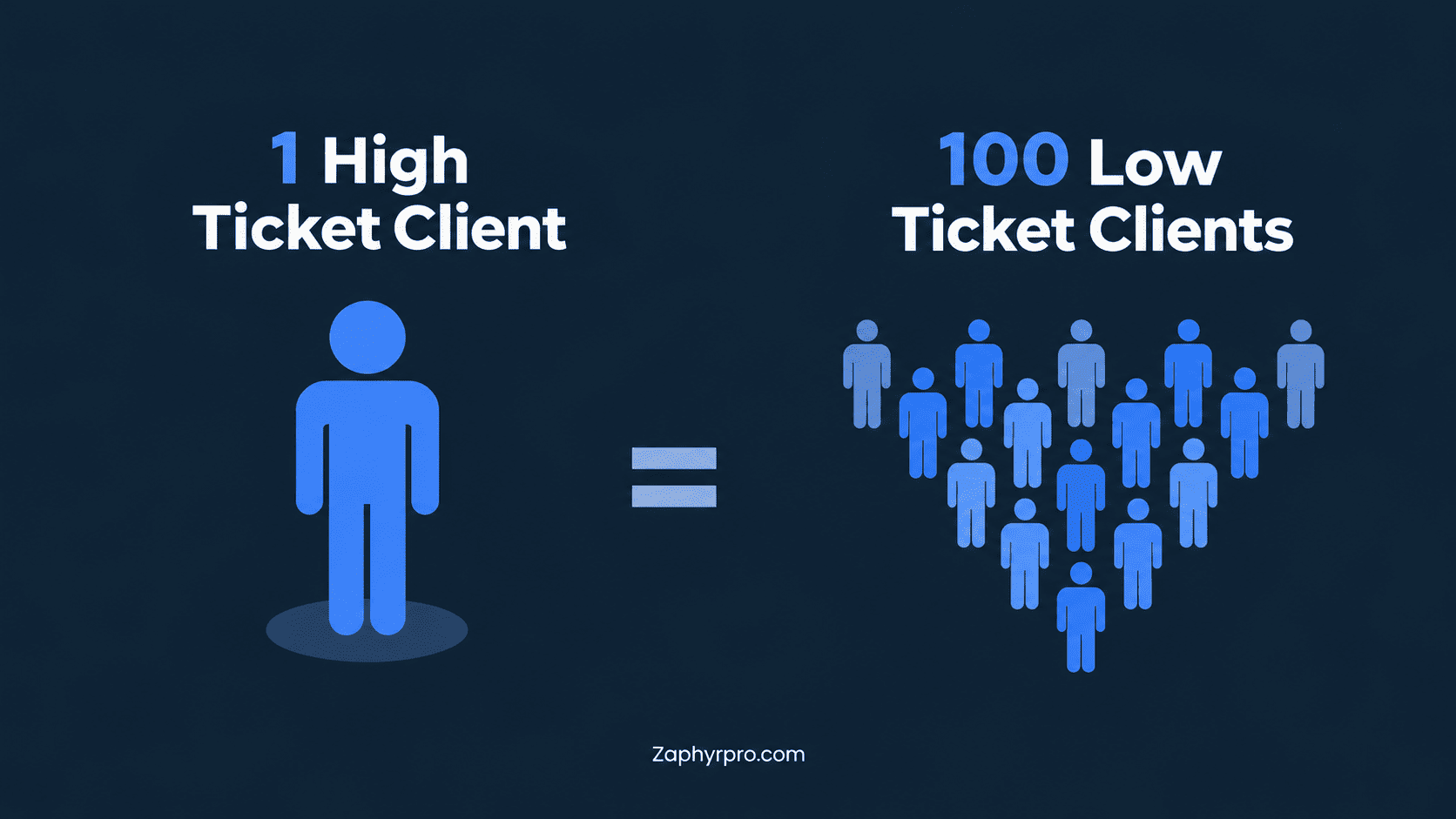
Low-Ticket vs. High-Ticket Clients: What's the Difference?
| Feature | Low-Ticket Customers | High-Ticket Clients |
|---|---|---|
| Price Point | Usually under $1,000 | Typically $3,000 to $25,000+ |
| Decision Speed | Fast and impulsive | Slower and more deliberate |
| Trust Level Needed | Low proof required | High authority and credibility required |
| Decision Makers | Single end-user | Multiple stakeholders or C-suite |
| Support Expectations | Basic or self-serve support | Dedicated, personalized service |
Common Examples of High-Ticket Offers
- B2B and enterprise software: Large-scale SaaS deployments or custom integration packages.
- Consulting and agency retainers: Monthly strategic guidance, marketing management, or operational overhaul packages ($5,000 to $25,000 per month).
- Executive and business coaching: Intensive one-on-one mentorship or transformation programs.
- Specialized manufacturing or equipment: Heavy industrial machinery or specialized technical infrastructure.
Why Are High-Ticket Clients Harder to Win?
High-ticket clients are harder to win because larger purchases expose buyers to greater financial, operational, and professional risk. Gartner reported in 2026 that B2B buyers used an average of seven information sources during a recent purchase, while 45% used generative AI to research vendors and products.
Your sales representative is no longer the buyer’s only source of information. Before speaking with your team, a prospect may already have:
- Reviewed your website
- Compared competitors
- Read articles and case studies
- Searched for reviews
- Asked an AI assistant about your category
- Checked your leadership
- Reviewed LinkedIn profiles
- Discussed vendors internally
That is particularly important when several people influence the purchase.
The 2025 Edelman-LinkedIn B2B Thought Leadership Impact Report cites research showing that more than 40% of B2B deals stall because of misalignment within the buying group. It also found that less-visible stakeholders actively consume and evaluate thought leadership when forming opinions about vendors.
So, winning the visible decision-maker isn’t always enough.
You may also need to satisfy a finance leader who cares about economic impact, an operational leader concerned about implementation, a technical stakeholder evaluating compatibility, or an executive asking why this investment deserves priority.
What Do High-Ticket Clients Look for Before They Buy?
High-ticket clients generally look for evidence that your company understands their situation, can produce a meaningful outcome, and can deliver with less risk than the available alternatives. That expectation is becoming even more important as buyers conduct more independent research.
Here are the key factors high-ticket buyers evaluate before making a decision:
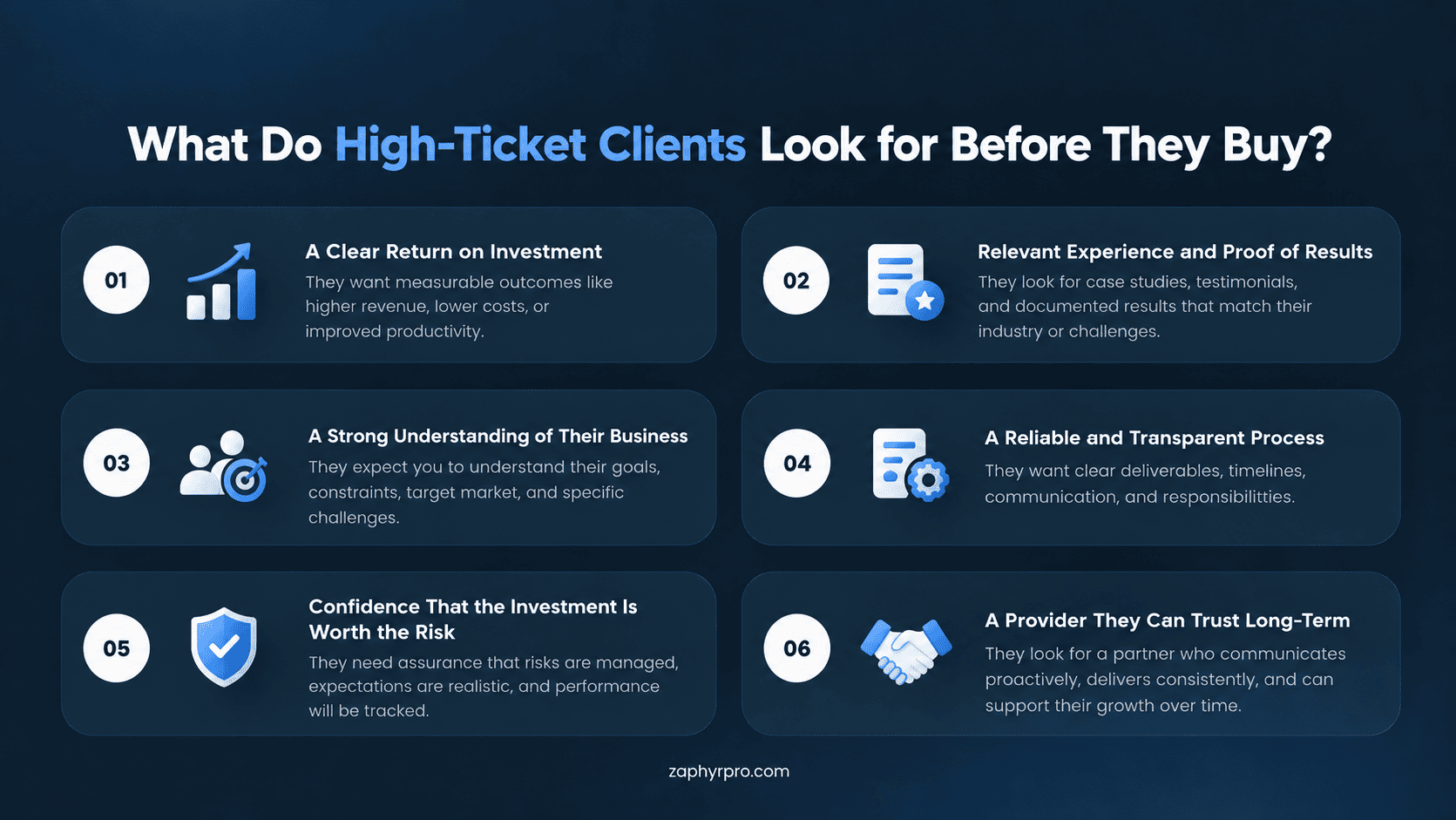
1. A Clear Return on Investment
Premium buyers need a business case for spending more. They want to understand how your solution could increase revenue, reduce operating costs, improve productivity, or solve a problem that is holding their business back.
Explain the expected outcomes in measurable terms. For example, a B2B lead generation provider can demonstrate how better-qualified prospects may help a sales team spend less time on unproductive conversations and focus more effort on opportunities with genuine buying potential.
2. Relevant Experience and Proof of Results
High-ticket buyers look for evidence that you can deliver what you promise. Relevant case studies, client testimonials, industry experience, and documented results help establish credibility.
Show examples that reflect the buyer’s industry, business model, or specific challenge. A case study that explains the original problem, the approach taken, and the resulting business impact is generally more persuasive than broad claims about expertise.
3. A Strong Understanding of Their Business
Premium clients expect providers to understand their goals, constraints, target market, and current challenges. They are less likely to respond to generic pitches that could apply to almost any business.
Research each prospect before reaching out. Identify a relevant business problem, explain why it matters, and connect your proposed solution to the outcome the prospect wants to achieve.
4. A Reliable and Transparent Process
Buyers want to know what happens after they sign an agreement. Unclear deliverables, unrealistic promises, and vague timelines can create doubts about whether a provider can manage the work effectively.
Explain the scope of work, implementation stages, communication process, reporting methods, and responsibilities of both parties. Clear expectations make it easier for buyers to assess the partnership and understand how progress will be measured.
5. Confidence That the Investment Is Worth the Risk
A larger purchase often carries greater financial and operational consequences. Buyers may worry about implementation delays, inconsistent service, poor results, or the difficulty of changing providers later.
Address these concerns directly. Set realistic expectations, explain how performance will be tracked, and clarify how issues will be handled. Where appropriate, offer a phased engagement or a clearly defined initial scope to help buyers evaluate the relationship before making a larger commitment.
6. A Provider They Can Trust Long-Term
High-ticket clients are not always looking for a one-time transaction. They may need a provider who can adapt as their business grows, communicate proactively, and maintain consistent performance over time.
Build trust through timely responses, honest recommendations, clear reporting, and consistent delivery. Avoid promising outcomes you cannot control. Buyers are more likely to consider a long-term relationship when they understand what you can deliver and believe you will follow through.
How to Attract High-Ticket Clients in 8 Steps
Attracting high-ticket clients starts with understanding which buyers can benefit most from your services and what would motivate them to invest in a premium solution. You need a clear offer, a focused prospecting strategy, and a sales process that builds confidence throughout the buying journey.
The following eight steps can help you attract better-fit prospects, start more relevant conversations, and turn qualified opportunities into long-term client relationships.
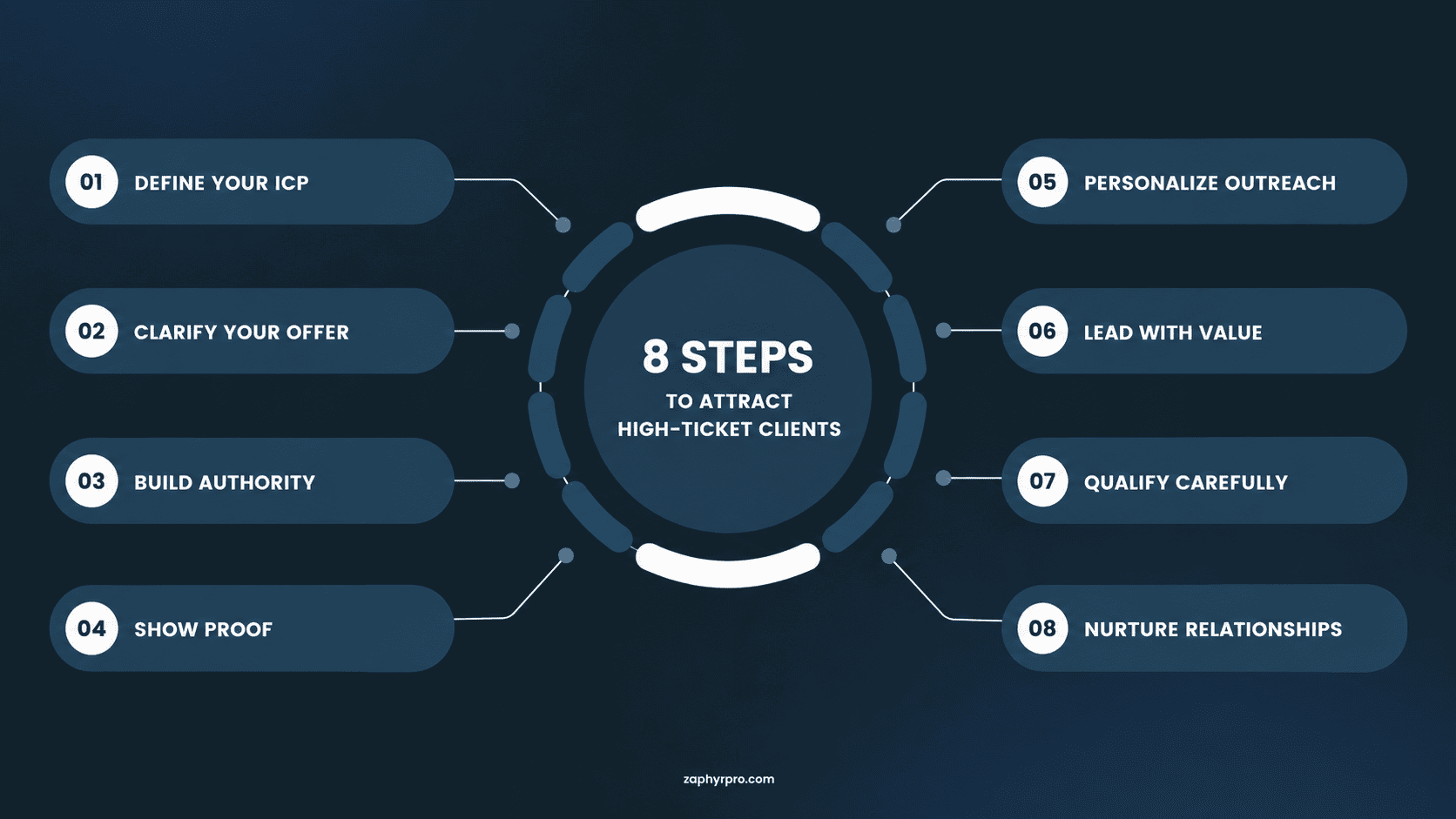
1. Define Your Ideal High-Ticket Client
Before investing time in outreach or marketing, identify the businesses most likely to need your solution and have the budget to pay for it. Targeting every business with purchasing power wastes resources on prospects who may not value your offering.
Build an ideal customer profile (ICP) around factors such as:
- Industry and business model: Focus on sectors where your solution addresses a recurring, high-value problem.
- Company size and revenue: Identify businesses with the resources and operational needs to support your pricing.
- Decision-makers: Determine who influences or approves the purchase, such as founders, CEOs, or department heads.
- Business challenges: Look for problems your services can address, including inefficient processes, missed revenue opportunities, or limited internal capacity.
- Buying signals: Watch for expansion, new leadership, product launches, or other changes that may create demand for your solution.
2. Build a High-Value Offer Around Specific Outcomes
High-ticket clients need a compelling reason to choose your business over less expensive alternatives. A list of services rarely provides that reason on its own. Your offer should explain the problem you solve, the value you provide, and what clients can expect from working with you.
Start by identifying the most expensive or time-consuming problem your target audience faces. Then connect your service to a meaningful business outcome.
For example, rather than promoting email outreach as a standalone service, a lead generation provider could position its offer around helping B2B sales teams reach qualified decision-makers and create more sales opportunities.
A strong offer should clarify:
- The specific problem you address.
- The audience you serve best.
- The process you use to deliver the service.
- The expected outcomes and how progress is measured.
- What differentiates your approach from competing options.
Keep your claims realistic and support them with relevant evidence. High-ticket buyers are more likely to consider an offer when they understand its business value and how it addresses their particular needs.
3. Establish Credibility Before Approaching Prospects
Premium buyers often research a provider before agreeing to a sales conversation. If your website, professional profiles, and marketing materials fail to demonstrate expertise, prospects may hesitate to engage, even when your offer is relevant.
Build a credible online presence that answers the questions buyers are likely to ask. Your website should clearly explain your services, target audience, approach, and business value. Add case studies, client testimonials, relevant credentials, or documented results wherever available.
You can also demonstrate expertise through:
- LinkedIn posts addressing specific customer challenges.
- Detailed articles that explain practical solutions.
- Case studies showing the problem, process, and outcome.
- Industry insights supported by reliable research.
- Useful resources that help prospects make informed decisions.
Focus on evidence rather than exaggerated claims. If you are still building your portfolio, demonstrate your expertise through original analysis, sample deliverables, and a transparent explanation of your process.
4. Find High-Ticket Prospects Through Targeted Research
Once you know your ideal client and have a clear offer, identify businesses that match your criteria. A carefully researched prospect list is generally more useful than a large database filled with companies that have little reason to buy.
Use sources such as LinkedIn outreach, company websites, industry directories, professional networks, and relevant business databases to identify potential clients.
For each prospect, research:
- Their products, services, and target markets.
- Their current business priorities and growth plans.
- The decision-makers responsible for the problem you solve.
- Signs of an existing challenge or an upcoming need.
- Any relevant connection between their goals and your offer.
Look for buying signals that provide a genuine reason to reach out. A company expanding into a new market, for example, may need additional sales capacity or a more effective prospecting process.
Organize your findings in a CRM or prospecting spreadsheet. Record the reason each account fits your ICP, the relevant decision-maker, and the most appropriate next step. This gives your outreach a clear purpose and makes follow-up easier to manage.
5. Use Personalized Outreach to Start Relevant Conversations
High-ticket buyers receive sales messages from businesses competing for their attention. Generic emails and connection requests often fail because they focus on the sender’s services rather than the recipient’s priorities.
Personalized outreach should connect a specific observation about the prospect’s business to a relevant problem you can help solve. A practical outreach message includes three elements:
- A relevant observation: Mention a business development, challenge, or priority that relates to your offer.
- A clear connection: Explain briefly why that observation may create a need for your service.
- A low-pressure next step: Ask a relevant question or invite the prospect to discuss the issue.
6. Qualify Prospects Before Investing in the Sales Process
Not every interested prospect is a good fit for a high-ticket offer. Some lack the budget, others have no immediate need, and some cannot approve the purchase. Qualifying prospects early helps you prioritize opportunities with a realistic chance of progressing.
Evaluate each prospect against a consistent set of criteria:
- Need: Does the prospect have a problem your service can solve?
- Budget: Can the business reasonably afford the proposed investment?
- Authority: Are you speaking with the decision-maker or someone who influences the decision?
- Timing: Is the prospect prepared to address the problem within a reasonable period?
- Fit: Can your team deliver the required outcomes within the agreed scope?
You can explore these factors through discovery questions. Ask about the prospect’s current process, the challenges they face, the impact of those challenges, and their plans for addressing them.
For complex purchases, map the other stakeholders involved in the decision. A qualified opportunity should have a clear business need, a plausible path to approval, and a reasonable fit with your capabilities.
7. Demonstrate Value Through Consultative Sales Conversations
Once a prospect is qualified, focus the sales conversation on understanding their situation and determining whether your solution is appropriate. High-ticket buyers need more than a polished presentation. They need a clear connection between their business priorities and the investment you are proposing.
Start by exploring the problem, its consequences, and the outcomes the buyer wants to achieve. Then explain how your approach addresses those needs.
A productive sales conversation should cover:
- The prospect’s current challenges and existing solutions.
- The business impact of leaving the problem unresolved.
- The outcomes that would make an investment worthwhile.
- Your proposed scope, delivery process, and responsibilities.
- The evidence supporting your approach.
- The next steps required to evaluate the proposal.
Use relevant case studies and examples to make your recommendations credible. Explain pricing in relation to the scope and value of the work, but do not promise a guaranteed return when results depend on factors outside your control.
If the solution is not a good fit, be transparent about that. Honest recommendations can strengthen your credibility and prevent unsuitable engagements.
8. Follow Up Consistently and Build Long-Term Relationships
High-ticket deals can involve multiple stakeholders, internal approvals, and extended evaluation periods. A prospect who does not respond immediately may still have a genuine need, so a structured follow-up process helps maintain communication without creating unnecessary pressure.
After a sales conversation, send a concise recap covering the prospect’s priorities, the proposed solution, and any agreed next steps. Follow up according to the timeline discussed, and provide additional information that helps the buyer evaluate the decision.
Effective follow-up practices include:
- Recording conversations, objections, and agreed actions in your CRM.
- Sharing relevant case studies or answers to outstanding questions.
- Addressing concerns about cost, implementation, or expected outcomes.
- Setting a mutually agreed date for the next conversation.
- Respecting the prospect’s timing and communication preferences.
Your work should continue after the contract is signed. Set clear expectations during onboarding, communicate progress, measure agreed performance indicators, and address problems promptly. Satisfied clients may renew, expand their engagement, or introduce you to other potential buyers.
How Do You Communicate Value Without Competing on Price?
When high-ticket clients compare providers, the lowest price does not always win. Buyers may be willing to pay more when they understand how a solution addresses their business challenges, reduces risk, or delivers better long-term results. The challenge is to make that value clear before the conversation turns into a negotiation over cost.
Here are six ways to communicate your value without relying on discounts to win high-ticket clients:
- Connect your offer to a business problem: Explain the problem your service solves rather than listing features. Show buyers how your solution addresses their challenges and improves business outcomes.
- Show the potential return on investment: Explain how your solution could increase revenue, reduce costs, improve productivity, or lower risk. Use relevant data, cost comparisons, or client results to support your case.
- Differentiate your offer beyond its features: Highlight what makes your approach a better fit for the client’s needs. This could include industry expertise, a stronger qualification process, better reporting, or a delivery model that saves time.
- Use case studies and evidence to build trust: Support your claims with client testimonials, case studies, and measurable results. Show the original challenge, your approach, and the outcome achieved.
- Explain the cost of staying with the current approach: Help buyers understand what their existing problems cost in time, revenue, and operational efficiency. Comparing these costs with your proposed solution makes the investment easier to evaluate.
- Present pricing with clear scope and expectations: Clarify what the investment covers, including deliverables, timelines, responsibilities, and performance indicators. A transparent proposal helps buyers understand exactly what they are paying for.
How Do You Build Trust Before a High-Ticket Sales Call?
Trust is increasingly built through what buyers find before they ever meet your salesperson. According to 6sense’s 2025 research, buyers had previous experience with at least one shortlisted vendor in 97% of cases, and 85% reported prior experience with the vendor that ultimately won. Familiarity matters. That doesn’t mean newer businesses can’t win. It means they need to deliberately create confidence.
1. Optimize Your Digital First Impression
- Audit your profiles: Prospects will check your LinkedIn profile, website, and social channels before speaking with you. Ensure your bio focuses on their problems rather than just listing your own achievements.
- Make expertise visible: Publish clear, tangible evidence of your work (such as case studies, data breakdowns, and process overviews) rather than generic claims of excellence.
- Reduce uncertainty upfront: Address common buyer questions directly on your website so prospects do not have to guess your methodology, scope, or background.
2. Lead With Education Instead of Pitching
- Teach for free: Share valuable insights, frameworks, or micro-lessons via content marketing (articles, newsletters, videos, or podcasts) to prove your capability without asking for a commitment first.
- Shift from “me” to “we”: Focus your pre-call content on helping the prospect diagnose their own bottlenecks so they view you as an advisor rather than a salesperson.
- Build pre-call familiarity: Repeated exposure through helpful content lowers psychological resistance and transforms a cold outreach into a warm connection.
3. Deploy Trust Signals and Social Proof
- Use specific testimonials: Feature results-driven case studies and peer reviews that validate the exact transformation you promise.
- Leverage structured spaces: Use pre-call resources like digital sales rooms or curated onboarding docs to give prospects a transparent look at what working together entails.
- Set clear expectations: Communicate the agenda, time commitment, and structure of the upcoming call clearly so the prospect feels safe and in control.
Need a More Predictable Way to Reach the Right Buyers?
High-ticket client acquisition gets difficult when your content, targeting, outbound activity, and sales follow-up operate as separate systems. Zaphyre helps B2B companies connect those pieces through market research, list building, content, outbound execution, appointment setting, and sales support.
How Do You Retain High-Ticket Clients After the Sale?
Winning a high-ticket client is only the beginning of the relationship. Retaining that client requires consistent delivery, clear communication, and evidence that your service continues to justify the investment. If clients struggle to see progress or feel uncertain about what happens next, they may reconsider the partnership when renewal time arrives.
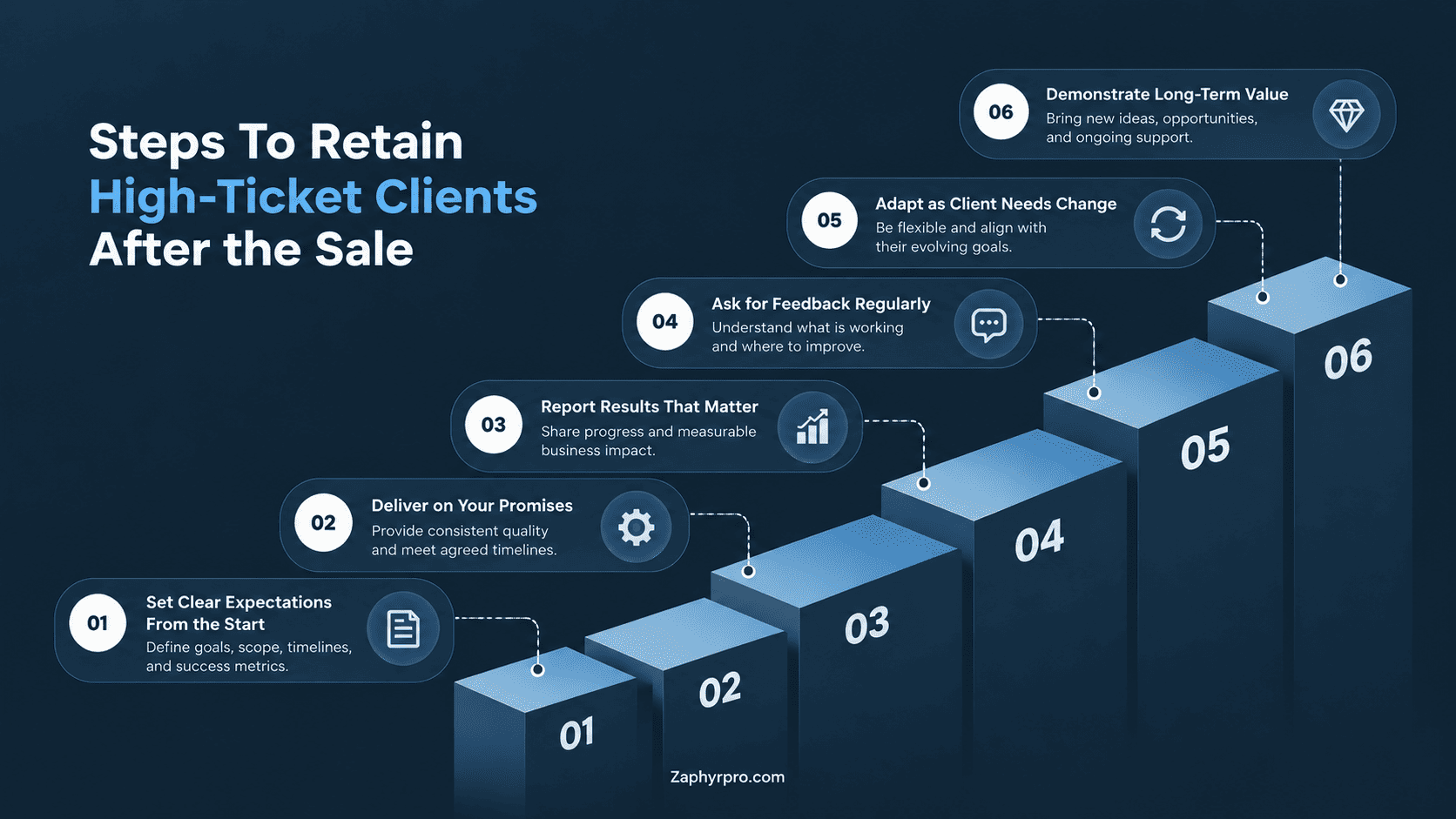
A strong retention strategy focuses on delivering the agreed value, addressing concerns early, and helping clients achieve meaningful results over time. Here are six ways to retain high-ticket clients after the sale:
- Set clear expectations from the start: Agree on deliverables, timelines, responsibilities, and success metrics during onboarding. Clear expectations prevent misunderstandings and give both sides a shared definition of success.
- Deliver on your promises: Meet agreed deadlines, maintain quality standards, and address problems promptly. Consistent execution builds confidence and gives clients fewer reasons to reconsider the partnership.
- Report results that matter: Focus reports on outcomes rather than activity alone. Show how your work contributes to the client’s goals through relevant metrics, completed milestones, or measurable improvements.
- Ask for feedback regularly: Schedule check-ins to understand what’s working and where clients see room for improvement. Address concerns early, before small issues affect the relationship.
- Adapt as client needs change: Revisit the client’s priorities as their business evolves. Adjust your approach when necessary, and recommend additional services only when they address a genuine need.
- Demonstrate long-term value: Use periodic business reviews to compare results against the original objectives. Highlight progress, identify remaining opportunities, and agree on priorities for the next phase.
What Mistakes Repel High-Ticket Clients?
High-ticket clients expect providers to understand their needs, communicate clearly, and justify the investment. Certain sales and marketing mistakes can undermine that confidence before a deal even reaches the negotiation stage.
1. Focusing on Price Instead of Value
Leading with discounts or competing solely on price makes it harder to differentiate your offer. Explain the business problem you solve and why your approach is worth the investment.
2. Using Generic Sales Pitches
Broad claims and copy-paste messages give prospects little reason to engage. Tailor your outreach to the buyer’s industry, priorities, and likely challenges.
3. Making Promises You Cannot Support
Guaranteed results, exaggerated claims, and unrealistic timelines damage credibility. Set achievable expectations and support your claims with relevant evidence.
4. Failing to Qualify Prospects
Pursuing every interested lead wastes time on buyers who lack the budget, authority, urgency, or need for your service. Qualify prospects before investing heavily in the sales process.
5. Pushing for a Decision Too Early
Repeated follow-ups, aggressive closing tactics, and pressure to sign can make buyers question your intentions. Give prospects room to evaluate the offer and address their concerns without forcing a commitment.
6. Neglecting the Client Experience
Poor communication, missed deadlines, and inconsistent delivery can damage a relationship even after a successful sale. Maintain clear expectations and follow through on your commitments.
Build a Repeatable System for Winning Better Clients
Attracting high-ticket clients becomes more manageable when you have a clear process for identifying the right prospects, communicating your value, qualifying opportunities, and building lasting relationships. Rather than relying on occasional referrals or inconsistent outreach, create a system that helps your team reach suitable buyers and move them through each stage of the sales process.
Start by reviewing your current approach. Identify where promising prospects drop off, which channels generate the strongest opportunities, and what prevents qualified buyers from moving forward. Use those insights to refine your targeting, messaging, and follow-up strategy.
If you need help building a more consistent pipeline of qualified prospects, Zaphyre can help you explore a lead generation approach suited to your business goals. Schedule a consultation to discuss your target audience, current challenges, and opportunities to improve your client acquisition process.
Frequently Asked Questions
The timeline depends on your industry, offer, pricing, and target audience. Some businesses generate qualified conversations within weeks, while complex B2B sales may take several months to close. Building credibility, reaching the right decision-makers, and securing internal approval all influence the process. Track qualified opportunities and sales-cycle length to establish realistic expectations for your business.
The most effective channels depend on where your ideal buyers research solutions and engage with providers. LinkedIn, targeted email outreach, search engine optimization, industry events, and referral networks can all help attract premium clients. Rather than using every channel, start with the options that best match your audience, budget, and sales process. Measure qualified inquiries and conversions to identify what works.
Payment plans can make a substantial investment easier to manage, particularly when a project involves several delivery stages. However, they should support a sound purchasing decision rather than compensate for unclear value. Define payment milestones, contractual obligations, and delivery terms before agreeing to a schedule. Consider your cash flow and the client’s payment reliability when deciding which arrangements are practical.
Start by understanding the concern behind the objection. A prospect questioning your price may be uncertain about the return, comparing different scopes, or working within a fixed budget. Ask a clarifying question, address the specific concern with relevant evidence, and explain your offer clearly. If the solution does not fit their requirements, acknowledge that rather than forcing the conversation toward a sale.
There is no universal number because prospect quality, deal size, conversion rates, and sales capacity vary by business. A company selling complex enterprise services may need fewer, carefully researched prospects than one offering a standardized B2B service. Estimate your monthly pipeline requirements using your revenue target, average deal value, and historical conversion rates. Refine your outreach volume as reliable performance data becomes available.
Yes. A smaller business can compete by demonstrating specialized expertise, understanding a specific audience, and providing credible evidence of its capabilities. Detailed proposals, relevant work samples, client references, and transparent processes can help reduce buyers’ uncertainty. Focus on a clearly defined niche where your business can deliver meaningful results. You do not need widespread brand recognition to establish credibility with the right prospects.
Measure both pipeline performance and business outcomes. Useful indicators include qualified leads generated, discovery calls booked, proposal-to-close rate, customer acquisition cost, average contract value, and sales-cycle length. Client retention and repeat revenue also reveal whether your acquisition strategy attracts suitable buyers. Review these metrics regularly to identify weak stages in the process and allocate resources to the channels producing the strongest opportunities.
Consider stepping back when a prospect consistently demonstrates poor fit, lacks a genuine need, cannot meet your essential requirements, or repeatedly declines further engagement. A delayed decision alone does not necessarily mean the opportunity is lost. Agree on a reasonable follow-up timeline, clarify the next step, and record the outcome. Respect explicit requests to stop contacting them, and redirect your attention to better-fit opportunities.