
Building a high-performing marketing or sales engine is one of the most consequential decisions a leader makes. Historically, the choice was binary: do you hire internally or outsource to an agency or freelancer?
However, as growth demands have evolved, a new category has emerged to fill the gap: Execution Service Partners (ESPs). This hybrid approach focuses on driving high-level output without the overhead of full-time headcount.
Choosing the right GTM execution model requires looking beyond the surface to compare cost, scalability, and long-term flexibility. There is no “perfect” choice, but the one that fits your company’s current stage and the operational complexity you can realistically manage.
In this post, I’ll break down the four primary paths: In-house, Agencies, Freelancers, and ESPs, so you can evaluate the strengths of each and choose the strategy that fits your growth goals.
Understanding the GTM Execution Models
Recent 2025 hiring benchmarks from Employ show that it now takes an average of 63.5 days to fill a single GTM position. When you factor in the U.S. Department of Labor’s estimate that a bad hire can cost 30% of their first-year salary, the ‘safe’ internal route often carries the highest unmeasured risk.
In-House Teams
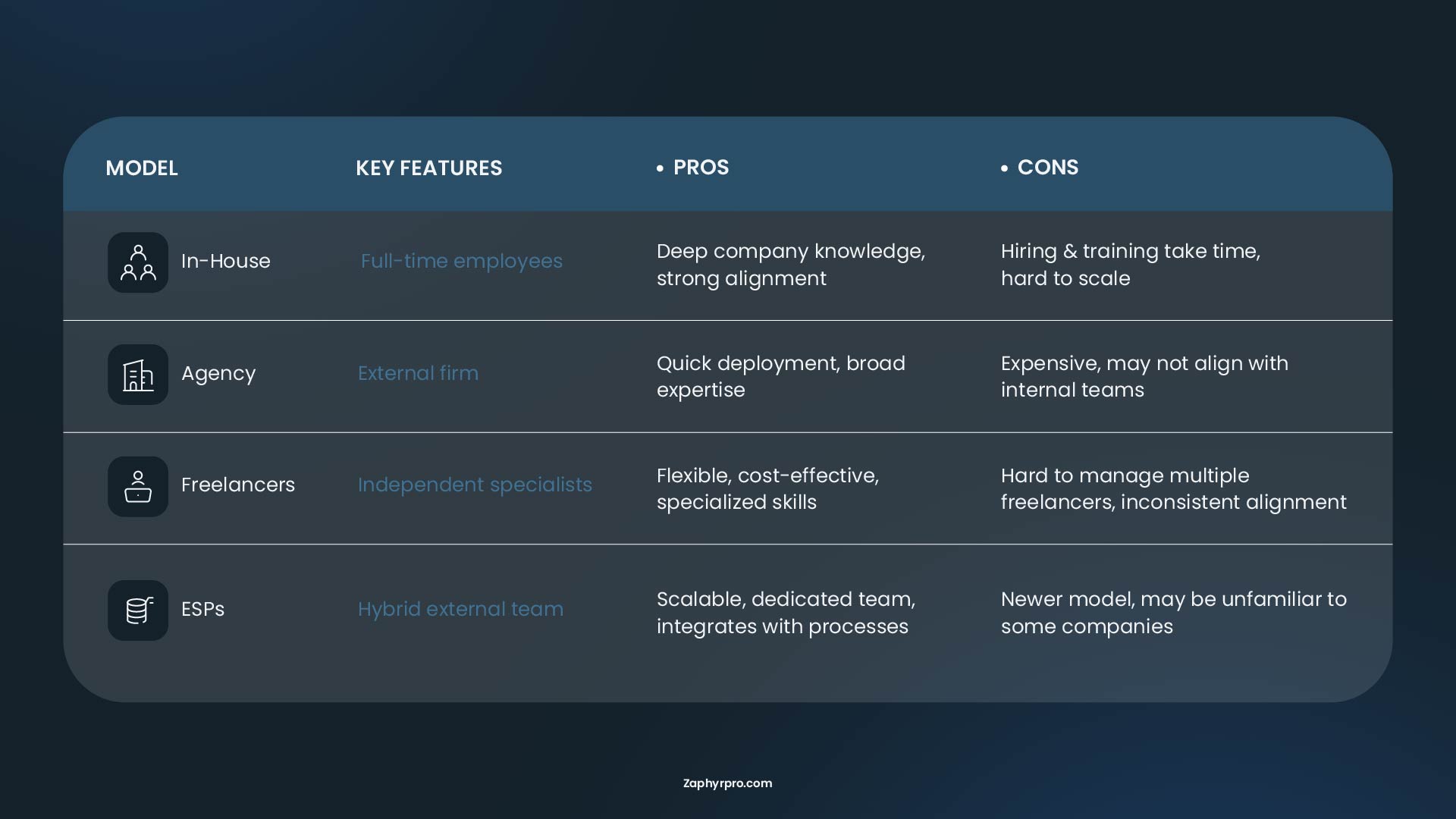
An in-house GTM execution model consists of full-time employees dedicated exclusively to your brand. This model offers the highest level of cultural alignment and compounding institutional knowledge. However, it is the most rigid option, requiring significant time to hire and train.
- Best suited for: Technical products with long sales cycles, companies requiring total control over brand positioning, and organizations building for multi-year stability.
- Not ideal when: You need to pivot quickly, your budget is variable, or you cannot wait the $3$ to $6$ months required for a new hire to reach full productivity.
Agencies
An agency-based GTM execution model provides immediate access to a specialized workforce with pre-built processes. They are excellent for “renting” expertise you don’t want to build internally, but they often struggle with deep product integration due to managing multiple clients.
- Best suited for: High-intensity product launches, specialized technical projects (like SEO audits or creative production), and companies requiring immediate market entry.
- Not ideal when: You need daily, granular collaboration or a partner who understands the “why” behind your product as deeply as your founders do.
Freelancers
The freelancer GTM execution model is modular and highly flexible. It is the most cost-effective way to solve specific, short-term problems. The trade-off is the “Management Tax” as someone internally must act as the project manager to ensure their work connects to the broader strategy.
- Best suited for: One-off deliverables (landing pages, email copy), testing a single new channel, or small teams with the bandwidth to manage individual contributors.
- Not ideal when: You are running complex, multi-channel campaigns that require cross-functional coordination and long-term consistency.
Execution Service Partners (ESPs)
Execution Service Partners represent a hybrid GTM execution model designed to bridge the gap between agencies and in-house hires. ESPs embed themselves into your existing tools and workflows, providing the scalability of an agency with the dedicated focus of an internal team.
- Best suited for: Scale-ups that need dedicated hands but want to avoid the overhead of full-time headcount, and companies with documented processes ready for external execution.
- Not ideal when: Your internal processes are entirely undefined or you only require assistance with a single, short-term tactical task.
Evaluating Your GTM Execution Model: The 5-Pillar Framework
Most leaders choose a GTM execution model based on the monthly invoice alone. This logic is how companies end up overpaying for a “prestige” agency they barely use, or burning out while managing five separate freelancers.
The smarter move? Be honest about where you actually stand before committing. Every model has trade-offs, and the right one depends on three things you only have so much of: time, money, and mental bandwidth.
Use this 5-pillar framework to determine which model actually fits your 2026 growth goals:
1. The Cost of Ownership (CapEx vs. OpEx)
Budgeting for your GTM execution model requires looking past the monthly invoice to the total financial impact on the balance sheet. A truly cost-effective model accounts for both direct expenses and the indirect costs of inefficiency, turnover, and technical overhead.
In-House = Fixed CapEx Structure
Represents a high-stakes, long-term commitment. Beyond base salary, factor in a 25–35% burden for benefits and taxes. The primary risk is under-utilization; you carry 100% of the cost regardless of active workload.
Agencies = High OpEx with Contract Lock-In
This model carries the highest per-hour rate to cover the agency’s internal overhead and profit margins. Long-term contracts often create a financial liability that is difficult to shed quickly if market conditions shift suddenly.
Freelancers = Variable Micro-OpEx
While the initial hourly rate is low, the administrative cost of this GTM execution model is high. Tracking multiple invoices and managing disparate contracts creates a hidden cost that often erodes the initial projected savings.
ESPs = Structured Variable OpEx
This approach operates on a middle-market rate with predictable pricing. It provides a consistent cost structure with fewer contractual hurdles than an agency, making it easier to align spending directly with your active project volume.
2. Time-to-Value (Strategic Urgency)
The choice of a GTM execution model is often dictated by your specific deadline for revenue generation or market feedback. Strategic urgency requires a balance between the speed of deployment and the long-term sustainability of the chosen output.
In-House = Long Ramp, Long Horizon
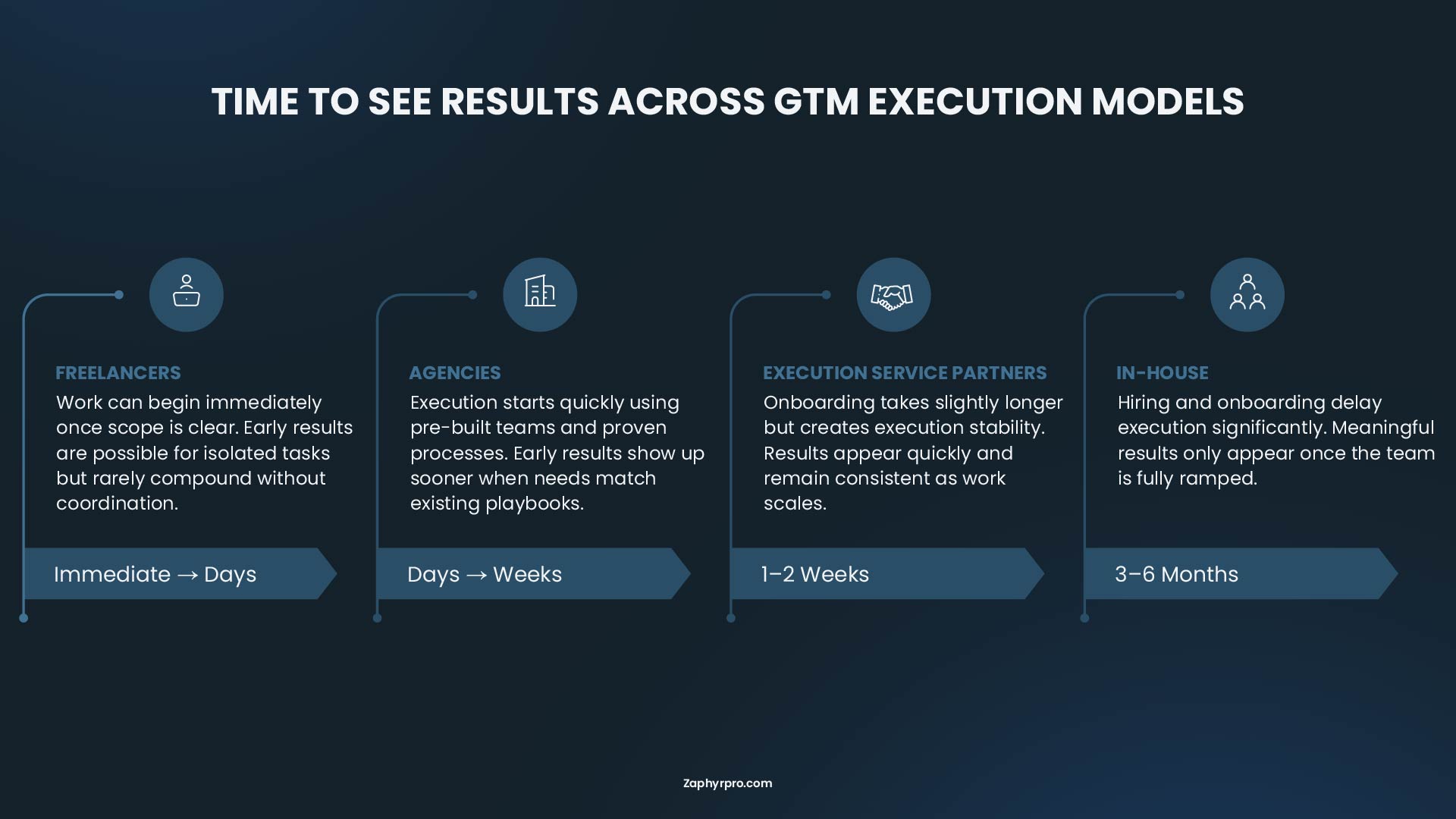
Expect 90 to 180 days before a new hire reaches full productivity. This includes the recruitment cycle, cultural onboarding, and technical training. Use this only if your primary launch deadline is at least six months away.
Agencies = Immediate Deployment
Agencies provide the fastest path to execution because they bring a pre-configured team to the table. You are essentially paying a premium to eliminate the hiring lag inherent in building an internal department.
Freelancers = Fast but Dependent on Clarity
Freelancers can often start within 48 hours, but only if the scope of work is already perfectly defined. If your strategy is still fluid, this GTM execution model typically stalls during the initial briefing phase.
ESPs = Accelerated Integration
Deployment typically occurs within a 14-day window. They provide a strategic middle ground, offering the rapid startup speed of a freelancer combined with the structured onboarding and process documentation of a professional agency.
3. The Management Tax (Internal Oversight)
Management bandwidth is a finite executive resource. Every GTM execution model consumes a different amount of leadership energy, and choosing the wrong one can turn a high-level director into a low-level project coordinator.
A 2026 report on Performance Marketing found that 85% of B2B leaders spend more than half their time fixing operational problems like cleaning data or troubleshooting campaigns rather than creating new ones.
Let’s compare the different models and explore how transitioning to a managed approach like an ESP can help reclaim up to 50% of leadership bandwidth:
In-House = High Leadership Involvement
Requires active people management, including performance reviews, conflict resolution, and career pathing. This model frequently drains time away from high-level strategy and shifts it toward maintaining internal team harmony and daily output.
Agencies = Relationship Management
Oversight is limited to weekly or monthly strategic reviews. However, you must monitor the relationship closely to ensure your account isn’t handed off to junior staff once the initial contract has been signed by senior partners.
Freelancers = Coordination Overhead
This is the most taxing GTM execution model for leaders. You must act as the primary project manager and quality control lead, serving as the communication bridge between several independent contractors who do not collaborate.
ESPs = Managed Execution with Strategic Input
A dedicated point of contact manages the specialists on your behalf. You provide the high-level objectives, while the partner manages the task-level execution, track KPIs, internal coordination, and quality assurance of the final deliverables.
4. Knowledge Depth vs. Breadth
Assess whether your competitive advantage comes from deep technical specialization or broad market execution when selecting your GTM execution model. The goal is to ensure that institutional knowledge is preserved rather than lost during transitions.

In-House = Compounding Institutional Knowledge
In-house teams accumulate institutional knowledge over time. By working closely with your data and customer feedback every day, they develop a deep understanding of your product and culture that external partners rarely match. This creates a long-term moat of proprietary business insight.
Agencies = Cross-Market Perspective
Agencies bring valuable data and trends from other clients and industries. They are highly effective for standardizing growth playbooks but often lack the granular depth required for highly technical or niche B2B sales environments.
Freelancers = Specialized but Isolated Expertise
Ideal for siloed, technical tasks such as specific coding projects or ad platform audits. They offer deep skills in one specific area but generally lack visibility into how their work impacts your overall business strategy.
ESPs = Embedded but Externalized Knowledge
This GTM execution model functions as a seamless extension of your internal team. They execute your existing processes, meaning the knowledge stays within your documentation rather than disappearing when a specific external contract ends or expires.
5. Elasticity (The Ability to Pivot)
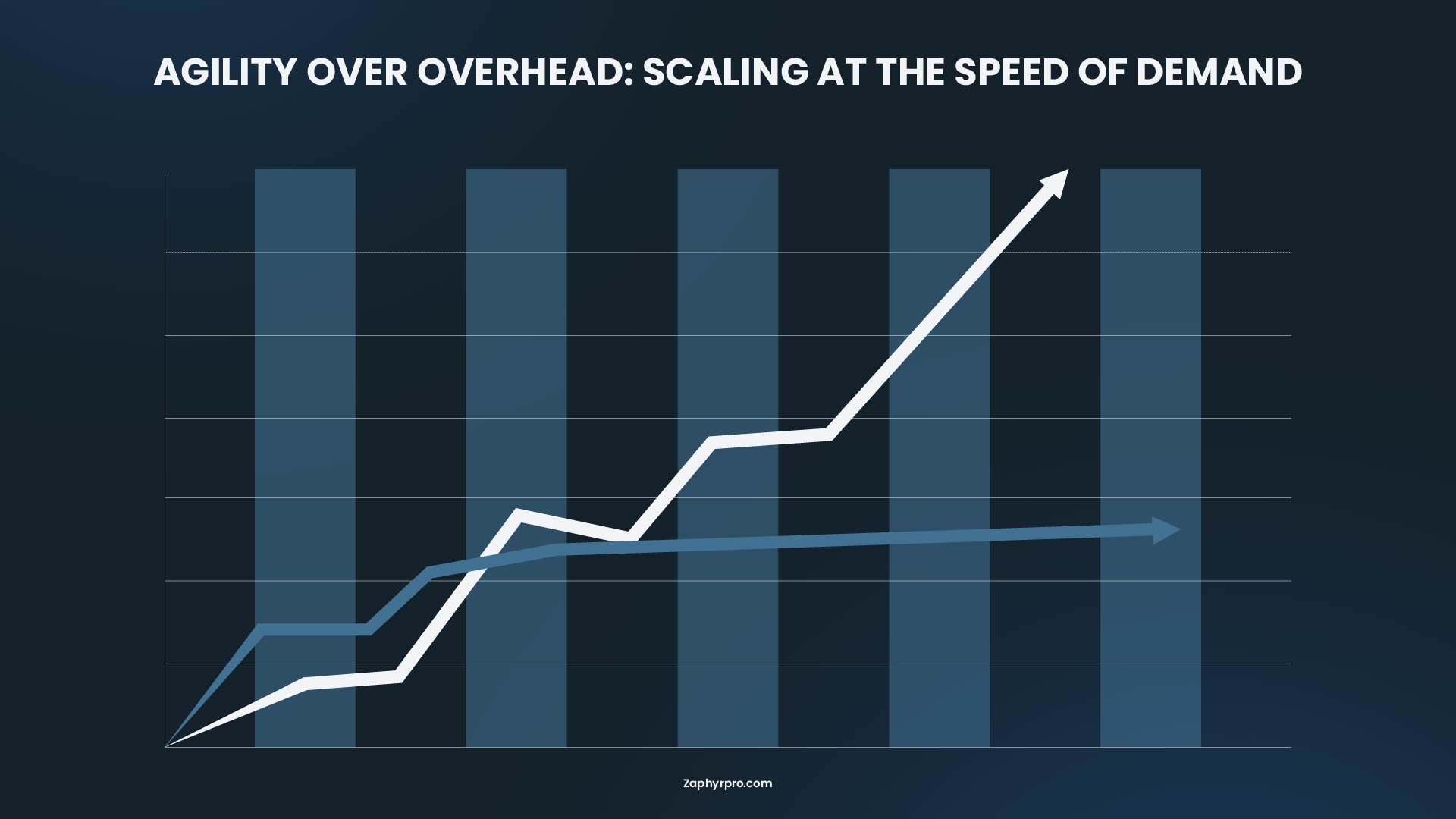
GTM strategy must be capable of rapid adjustment based on real-time performance data. Your chosen GTM execution model determines how fast you can pivot resources without incurring significant operational or financial penalties.
In-House = Low Elasticity
Scaling down requires layoffs, which damage internal morale and your external employer brand. Conversely, scaling up requires another 3–6 month hiring cycle, making it difficult to respond to sudden market opportunities or shifts.
Agencies = Structured Elasticity
Changes to project scope or team size usually require formal contract amendments and 30-to-60-day notice periods. While they are more stable than internal hires, they are often slow to reorganize around new objectives.
Freelancers = Tactical Elasticity
Highly flexible in theory, but the best talent is rarely available on short notice. If you pause a project, you risk losing that specific expertise to another client, making it difficult to restart the initiative later.
ESPs = Operational Elasticity
As a GTM execution model, ESPs are specifically designed for fluctuation. You can scale hours or specialist roles up or down based on current requirements without the friction of new contracts, layoffs, or long-term commitments.
Emerging Trends in GTM Execution Model for 2026 and Beyond
To remain competitive through 2026 and beyond, companies must adapt how they execute their go-to-market strategies. The shift is moving from “volume” to “precision,” where the GTM execution model is treated less like a static plan and more like a dynamic operating system that evolves with the market.
What worked two years ago no longer works the same way today, and what works now will likely need to change again by 2027.
1. The Rise of Agentic GTM Orchestration
Historically, AI was utilized as a “writer” to generate content; however, in 2026, it has transitioned into an “operator,” with Gartner forecasting that 40% of enterprise applications will integrate task-specific AI agents by year-end (up from under 5% today).
Modern execution models now leverage Agentic Workflows, such as autonomous systems capable of conducting deep account research, prioritizing leads based on multi-layered intent signals, and triggering personalized outreach without human intervention.
Consequently, this reduces “human latency” in the revenue cycle, allowing sales teams to focus exclusively on high-value closing conversations rather than manual prospecting.
2. Lead Scoring to Signal-Based Engineering
The traditional reliance on “lead scores” is being replaced by Signal-Based Selling. Instead of waiting for a prospect to fill out a form, a modern GTM execution model triangulates “dark social” signals, peer review interactions, and job-change data to identify when and why to engage. As a result, companies are increasingly hiring GTM Engineers specialized roles that bridge between Ops and Engineering to build the automated data pipelines required to turn these fragmented signals into immediate sales actions.
3. The "Outcome-as-a-Service" Pricing Pivot
As buying committees become more risk-averse, the standard seat-based SaaS model is coming under fire. Emerging trends suggest a shift toward Performance-Based Tiers where pricing is tied directly to the realization of value. Therefore, a successful GTM execution model must now include real-time verification systems that prove product impact. If the software does not deliver the promised business outcome, the contract logic automatically adjusts, fundamentally aligning the vendor’s incentives with the customer’s success.
4. Convergence of Search: SEO to GEO/AEO
Because B2B buyers now use private AI engines (like ChatGPT or Perplexity) to research vendors, traditional SEO is no longer sufficient. Businesses are consequently shifting toward Generative Engine Optimization (GEO). This evolution in the GTM execution model focuses on “feeding the models” by ensuring brand authority is cited in the datasets AI uses to make recommendations. Consequently, being “discoverable” in 2026 means optimizing for AI citations and peer-to-peer sentiment rather than just ranking for specific keywords on a search results page.
5. Transition to "Core + Variable" Hybrid Teams
In response to market volatility, the most resilient organizations are adopting a Hybrid GTM Architecture. They maintain a small, elite “Core” of in-house strategic leaders while outsourcing the “Variable” execution layers to specialized partners or ESPs. By doing so, they achieve maximum operational elasticity, allowing them to burst capacity for a new product launch or scale back during a market dip without the trauma of internal restructuring or layoffs.
Ready To Scale Your GTM Execution?
Every business eventually hits a “bottleneck.” Usually, it’s one of three things: you’re out of time, you’re short on people, or your current processes just aren’t working.
Building a team is a big deal. You might think your only choices are to hire an expensive full-time team or hand everything over to a distant agency. But at the end of the day, you really just want one thing: results without the headache.
If you’re tired of managing a dozen different freelancers or waiting months to hire the “perfect” person, we can help. As an Execution Service Partner (ESP), we don’t just give you advice and leave. We jump right into your current systems and start doing the work with you as an extra engine for your business that you can plug in whenever you need more power.
Let’s have a conversation. We can look at where you’re stuck and see if our GTM execution model is the right fit to help you grow faster in 2026.
Frequently Asked Questions
The most cost-effective model is usually the Execution Service Partner (ESP). Unlike in-house teams with high fixed salaries or agencies with expensive monthly retainers, an ESP offers a “variable” cost. You only pay for the work you need, which saves money while giving you professional-grade results without the hiring “tax.”
The “Management Tax” is the time leaders spend managing people instead of strategy. In-house teams and freelancers have the highest tax because you have to supervise every task. ESPs and Agencies have the lowest tax because they manage themselves, freeing you up to focus on big-picture growth.
Elasticity is your ability to scale your team up or down instantly. In a fast-changing market, a GTM execution model like an ESP is vital because it isn’t “stiff.” You can add more power for a big product launch and scale back during quiet months without having to fire anyone.
An agency usually works outside your business and provides high-level strategy and reports. An ESP works inside your company. They use your Slack, your CRM, and your specific processes. This makes them feel like a part of your actual team rather than a distant vendor.
In-house teams and ESPs are the best at keeping knowledge inside your company. While agencies keep their “secrets” to themselves, an ESP documents everything inside your systems. This ensures that if the partnership ever ends, your company keeps all the data, processes, and “how-to” info.