




















Zaphyre | Execution Service Partner – ESP

B2B SEO Content Built for Visibility and Demand.

SEO content should do more than place keywords on a page. Zaphyre maps buyer intent, search demand, topical authority, internal linking, and conversion paths into content that can help the right buyers discover you and move forward.

Search Intent
Topic Authority
AI Visibility
Demand Capture
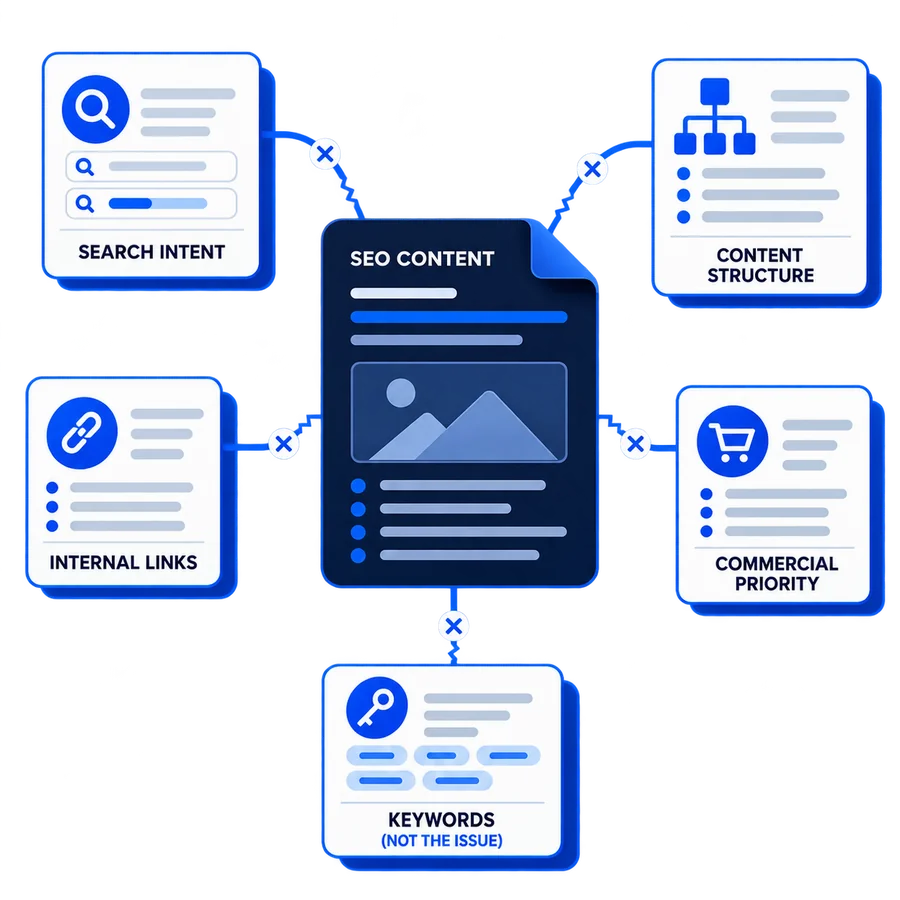
Diagram of SEO content connecting search intent, content structure, internal links, keywords, and commercial priority

Most SEO Content Does Not Fail Because It Lacks Keywords.

It fails because keywords, buyer intent, content structure, internal links, and commercial priorities are treated as separate tasks instead of one search system.

Ranking becomes the goal. Traffic becomes the report. But the content
never becomes part of the path from search to a meaningful buying decision.

The result: a growing library of pages that may attract impressions but do not build enough authority, relevance, or buyer progression.

Built for Teams That Need Search Content to Create Business Value.

The gap is usually not access to keywords. It is having the strategy, content architecture, writing capacity, optimization, and ownership to turn search demand into useful buyer-focused content.

Search Backlog

High-Value Search
Opportunities Stay
Unbuilt.

Priority queries, service pages, refreshes, and supporting content stay planned but unfinished because execution capacity cannot keep pace.

Traffic Without Value

Topic Authority Is Not
Translating Into
Buyer Progression.

Pages attract broad traffic without enough alignment to the commercial questions, services, and decisions that matter to qualified buyers.

Fragmented Search Execution

Too Many Pieces of SEO Live
in Separate Workflows.

Keyword research, writing, on-page optimization, internal linking, AEO, and conversion often sit with different owners, leaving nobody accountable for the full search-content system.

SEO Content That Connects Intent, Authority, and Demand.

The strongest B2B search content is not built around keyword volume alone. Each page should have a clear role inside your topic architecture, buyer journey, authority system, and commercial path.

01
Search intent

Search Intent

Map content to the
queries, questions, and
commercial intent that
matter to the buyers you
actually want to reach.

Intent segmentation
Buyer questions
Commercial queries
Journey mapping
02
Topic authority

Topic Authority

Build depth around priority topics so related pages reinforce one another instead of competing as isolated pieces.

Topic clusters
Entity coverage
Supporting content
Authority depth
03
Search and AI visibility

Search + AI Visibility

Structure useful, expert-led content for traditional search, answer engines, and AI-assisted research without sacrificing clarity for buyers.

Answer-first structure
Entity clarity
Expert evidence
Citation-worthy depth
04
Content architecture

Content Architecture

Connect search pages,
supporting articles, proof, and service content so authority and buyer progression move through one architecture.

Internal links
Hub and spoke paths
Content consolidation
Conversion paths

Structured Enough to Scale. Focused Enough to Rank With Purpose.

We use the same execution rhythm across search content: diagnose the opportunity, prioritize what matters, execute the content architecture, and use live search and buyer signals to improve each cycle.

01

Diagnose

Review your ICP, existing rankings, priority services, query footprint, content gaps, internal links, and pages already competing for attention.

02

Prioritize

Prioritize queries and content around business relevance, buyer intent, ranking opportunity, authority gaps, and the pages your GTM motion actually needs.

03

Execute

Run query research, briefs, writing, on-page optimization, internal linking, content refreshes, and publishing support under one operating rhythm.

04

Optimize

Use rankings, impressions, qualified traffic, conversion paths, content decay, and buyer behavior to shape the next search-content cycle.

Start With the Search Content Gap. Expand From There.

You may need stronger keyword architecture, more search-led pages, better internal linking, a refresh program, or clearer topic ownership. We start with the gap limiting visibility and buyer progression.

Keyword and intent architecture
Research

Keyword & Intent Architecture

Map queries, intent, commercial themes, buyer questions, and existing rankings into a focused search-content architecture.

Topic cluster content
Authority

Topic Cluster Content

Build supporting articles around priority themes so related content strengthens topical depth instead of competing in isolation.

SEO service and landing pages
Buyer Journey

SEO Service & Landing Pages

Create search-led service and landing pages that align the offer, buyer intent, proof, and conversion path around commercially relevant queries.

Search-led content briefs
Expert Input

Search-Led Content Briefs

Turn query research, competitor patterns, SERP intent, buyer questions, internal expertise, and content requirements into briefs that guide execution.

Content refreshes and consolidation
Optimization

Content Refreshes & Consolidation

Refresh aging pages, resolve cannibalization, consolidate overlapping content, improve structure, and strengthen search and buyer alignment.

Internal linking and content paths
Conversion

Internal Linking & Content Paths

Connect clusters, service pages, proof, and supporting content so authority can flow through the site and buyers have a logical next step.

Because You Do Not Need Another SEO Content Vendor to Manage.

The execution problem is rarely solved by handing keywords to a writer. Query strategy, content architecture, writing, optimization, internal linking, refreshes, and conversion still need one accountable owner.

Traditional SEO content setup

Traditional SEO Content Setup

Keyword-First Content

Pages are created around keywords without enough connection to buyer intent, service priorities, or the broader content system.

Separate SEO and Writing

SEO owns research while writers own drafts, leaving your team to translate strategy across handoffs.

Isolated Pages

Each page is optimized individually while topic relationships, internal links, and authority flow are treated as secondary.

Traffic-Only Reporting

Success is reduced to impressions and sessions without enough attention to buyer quality, conversion paths, or commercial relevance.

Reactive Refreshes

Pages are updated only after rankings decline rather than managed as part of an ongoing search-content system.

Recommended

Zaphyre Search Content Execution

Intent-Led Architecture

Queries, topics, buyer stages, service priorities, and internal links are planned as one connected architecture.

Connected SEO + Content Execution

Research, writing, optimization, linking, and refreshes move under one managed execution rhythm.

Authority-Led Content

Useful expert perspective, topical depth, and clear entity relationships strengthen both buyer confidence and search relevance.

Buyer + Search Measurement

Search performance is interpreted alongside engagement, progression, conversion, and the commercial role of the page.

One Search Content Owner

Zaphyre manages priorities, delivery, optimization, content decay, internal links, and the next execution cycle.

Built for execution.
Not just strategy

Search Content Should Help Buyers Move From Query to Decision.

Different search pages have different jobs. Together, they should help buyers find the
right answer, understand the issue, validate your fit, and take the next meaningful step.

Discover

Help the right buyers find
you through relevant
queries, topic coverage,
and AI-assisted research.

Educate

Answer the questions and
implications buyers need to
understand as they move from broad research toward specific options.

Validate

Use expert depth, service
content, comparisons, and proof to reduce uncertainty and help buyers validate your relevance.

Convert

Guide qualified visitors toward the service page, proof, resource, or conversation that matches their intent.

From relevant search to confident buying decisions.

Search Visibility Matters When
It Supports Business Outcomes.

We do not treat rankings or traffic as the finish line. The useful question is whether search content improves qualified discovery, strengthens authority, supports conversion paths, and helps buyers progress.

XX%
Replace with a verified
search, visibility, or
qualified traffic outcome.
XX%
Replace with a verified
search, visibility, or
qualified traffic outcome.
XX%
Replace with a verified
search, visibility, or
qualified traffic outcome.
XX%
Replace with a verified
search, visibility, or
qualified traffic outcome.
Zaphyre gave us a content
system that finally connected
search, sales, and execution
instead of treating every asset
like a separate project.
VP Of Growth
B2B SaaS Company
Trusted By 2,000+ Clients Worldwide

Answers Before the Conversation Starts.

Everything a B2B team should know before deciding how to structure SEO content execution.

01

B2B SEO content writing services combine search research, buyer intent, content architecture, writing, optimization, and internal linking to create pages that can improve relevant visibility while supporting the broader buying journey.

02

Regular content may focus primarily on the message or topic. SEO content writing also accounts for query intent, topic relationships, search-result expectations, internal linking, page structure, and how the content fits into a broader authority system.

03

No. Search-led execution can include service pages, landing pages, comparison content, supporting articles, refreshes, topic clusters, guides, and other content formats based on the role the page needs to play.

04

Yes. Content can be structured for traditional search, answer engines, and AI-assisted research while maintaining strong buyer relevance, topical clarity, useful evidence, and sound SEO fundamentals.

05

Yes. Existing content can be reviewed for decay, outdated information, cannibalization, weak intent alignment, missing internal links, thin topical coverage, and opportunities to consolidate overlapping pages.

06

Yes. Zaphyre can operate alongside your internal team or existing specialists, adding execution capacity across research, content creation, optimization, internal linking, refreshes, and ongoing search-content operations.

07

Priorities can be based on buyer questions, commercial relevance, search opportunity, sales needs, category authority, content gaps, existing performance, and the expertise your team is best positioned to own.

08

Measurement depends on the role of the page. Relevant indicators can include rankings, impressions, qualified organic traffic, click-through rate, content decay, conversions, service-page progression, assisted conversions, and contribution to broader pipeline goals.

What Search Content Priority

Keeps Getting Pushed?

Maybe the keyword roadmap is ready but nobody owns execution. Maybe rankings exist but qualified buyers are not progressing. Maybe high-value service pages, internal links, or refreshes keep getting pushed behind new publishing work.

We will help you identify what should move first and what the execution system should look like.

A direct conversation about what is not working, what needs to move, and whether Zaphyre is the right execution partner to run it.

Scroll to Top