

GTM Engineer is one of the fastest growing technical roles in tech right now. And most companies hiring for it are not even using the right name.
Some call it a Growth Engineer. Others say Revenue Ops Engineer. A few just post it as Engineer, but read the description and you are basically working with the sales team all day.
The role is not new. People were doing this work for years. But nobody had a name for it until Clay coined the term in 2023. After that, hiring took off fast.
And here is what makes it worth paying attention to: this is one of the few technical roles where your work ties directly to revenue. You build a system, it generates pipelines, the company makes money. The link is that short.
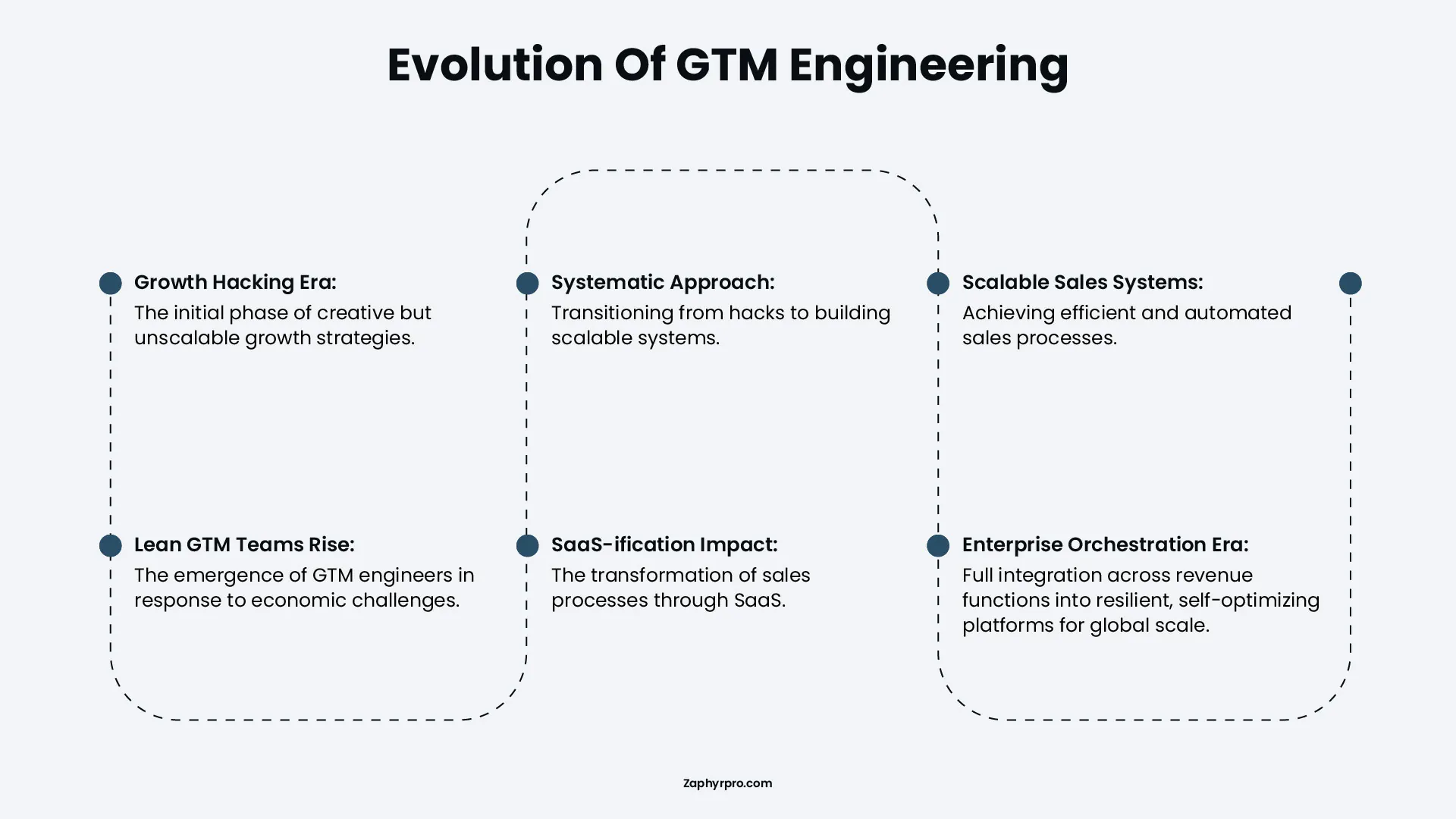
GTM Engineers build automated systems that directly generate revenue. Salaries range from $120K to $250K or more depending on experience. Demand exploded in 2024 and 2025 thanks to AI tools and keeps growing. This guide covers what the role pays, the skills you need, and how to break in.
What is a GTM Engineer and Why is the Role Important?
A GTM Engineer, or Go-To-Market Engineer, is a technical professional who builds the systems a company uses to find, engage, and convert customers, enabling smooth and scalable go-to-market execution across sales and marketing teams.
They work closely with sales and marketing teams, providing the tools, data, and processes needed to bring in customers consistently.
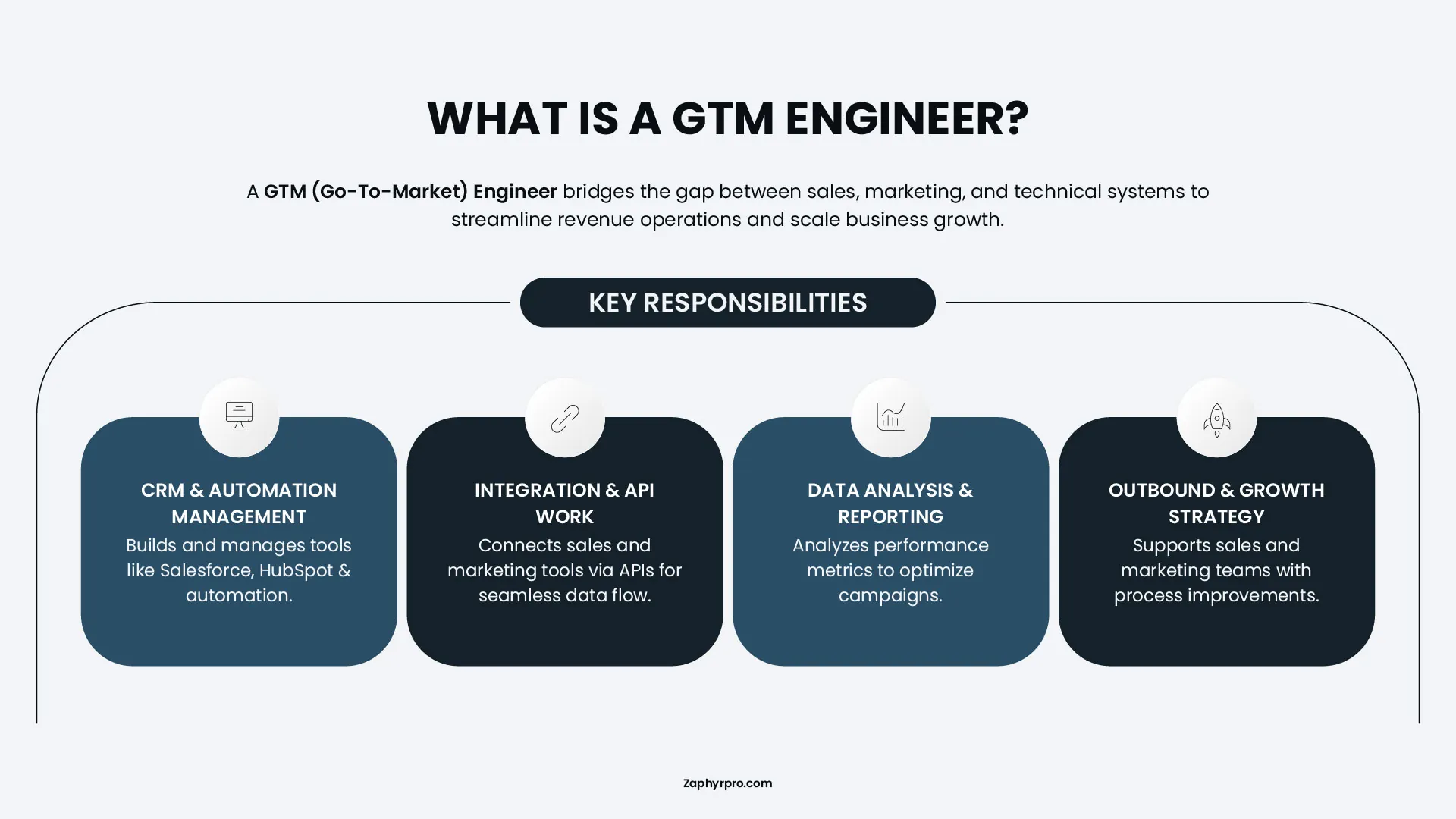
The role requires three things: technical skills to automate repetitive work, creativity to identify what approaches actually produce results, and business knowledge to measure success accurately.
GTM Engineers became common in 2023 and 2024. As AI tools and automation platforms improved, one person could handle work that previously required an entire team.
We put together a detailed self-assessment that scores your current skills against what GTM Engineer job postings actually require. Takes five minutes and tells you exactly where to focus.
Why the GTM Engineer Role is Emerging
In January 2026, LinkedIn listed over 3,000 open GTM engineer positions. A year earlier, most people had never heard of the role. Demand has doubled in less than a year, making it one of the fastest-growing jobs in sales lead generation and marketing.

If you are a Series A or Series B company without at least one, you are probably behind. Here is why the demand keeps growing:
1. Shifted Buyer Behavior
Customers now research products online, compare options, and expect fast, relevant experiences. They don’t wait for sales reps to guide them. This shift has made sales more reactive and data-driven. Teams have to track interactions, understand what buyers are doing, and respond quickly. These changes in buyer behavior have created new demands within revenue organizations.
2. Evolving Growth Models
Startups are increasingly using subscription pricing, product-led growth, and usage-based models. These approaches require constant testing and learning to see what drives adoption and retention. Traditional sales structures move too slowly to keep up. The shift in business models has naturally created roles to support this faster, more flexible way of growing revenue.
3. Experiment-Driven Revenue Teams
Revenue teams now run tests on messaging, conversion flows, and customer interactions all the time. This continuous experimentation is very different from how sales teams operated in the past. It has revealed gaps in existing team structures and processes, which has contributed to the emergence of new roles.
4. AI and Automation Boom
Platforms like ChatGPT, Claude, and other AI solutions allow teams to personalize outreach, prioritize leads, forecast results, and even predict churn. But these tools only deliver value when someone sets them up correctly, integrates them with existing platforms, and monitors their output. GTM engineers make this possible.
5. Investor Push for Efficiency
Investors now reward measurable results rather than bigger budgets. Companies are under pressure to scale efficiently and show clear returns. This shift has made teams more focused on performance, data, and process, which in turn has driven the need for technically aware roles.
GTM Engineers vs. Other Growth Roles
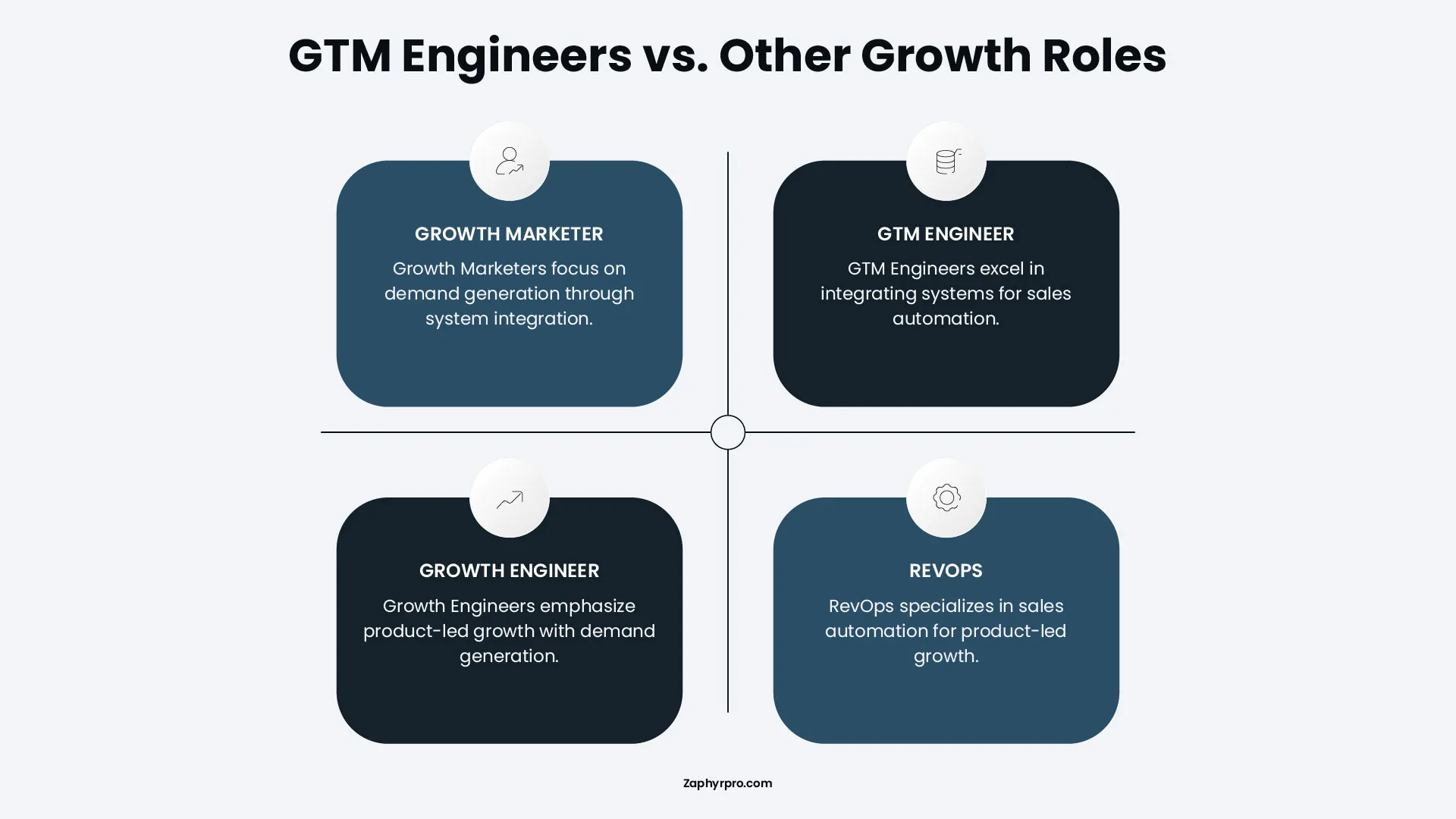
It is common to see these titles used interchangeably, but they are not the same. If you are looking at job descriptions, understanding the nuance between these roles is critical to knowing what you are actually signing up for.
The easiest way to distinguish them is to look at their “Primary Domain.” While all three roles deal with growth, they operate at different layers of the business.
| Role | Primary Focus | Primary Goal |
|---|---|---|
|
GTM Engineer |
Revenue Systems |
Build the tech stack that automates pipeline generation. |
|
Growth Marketer |
Campaign Strategy |
Craft messaging, test channels, and drive conversion. |
|
RevOps Manager |
Process & Policy |
Optimize team alignment, CRM hygiene, and reporting. |
|
Growth Engineer |
Product Iteration |
Manipulate product features or UI to drive user retention. |
The Key Differences
- GTM Engineer vs. Growth Marketer: The GTM Engineer builds the automated lead scoring and email sequencing infrastructure. The Growth Marketer uses that infrastructure to run A/B tests, write high-converting copy, and decide who to target. The Growth Marketer is often the primary “customer” of the GTM Engineer’s work.
- GTM Engineer vs. RevOps Manager: A RevOps Manager is the “strategist” defining the sales process and policy. A GTM Engineer is the “builder” that creates the API integrations, data pipelines, and automation scripts that make those processes execute automatically.
- GTM Engineer vs. Growth Engineer: Growth Engineering usually happens inside the product (e.g., changing the onboarding flow or adding a viral loop feature). A GTM Engineer focuses on the external motion such as getting prospects into the funnel and nurturing them before they ever reach the product.
GTM Engineer vs. General Software Engineer: A Software Engineer builds the product the company sells. A GTM Engineer builds the infrastructure used to sell it. While a SWE works in the product’s codebase, a GTM Engineer works in the “revenue codebase” (CRMs, middleware, and automation platforms like Clay or n8n).
What Does a GTM Engineer Actually Do?
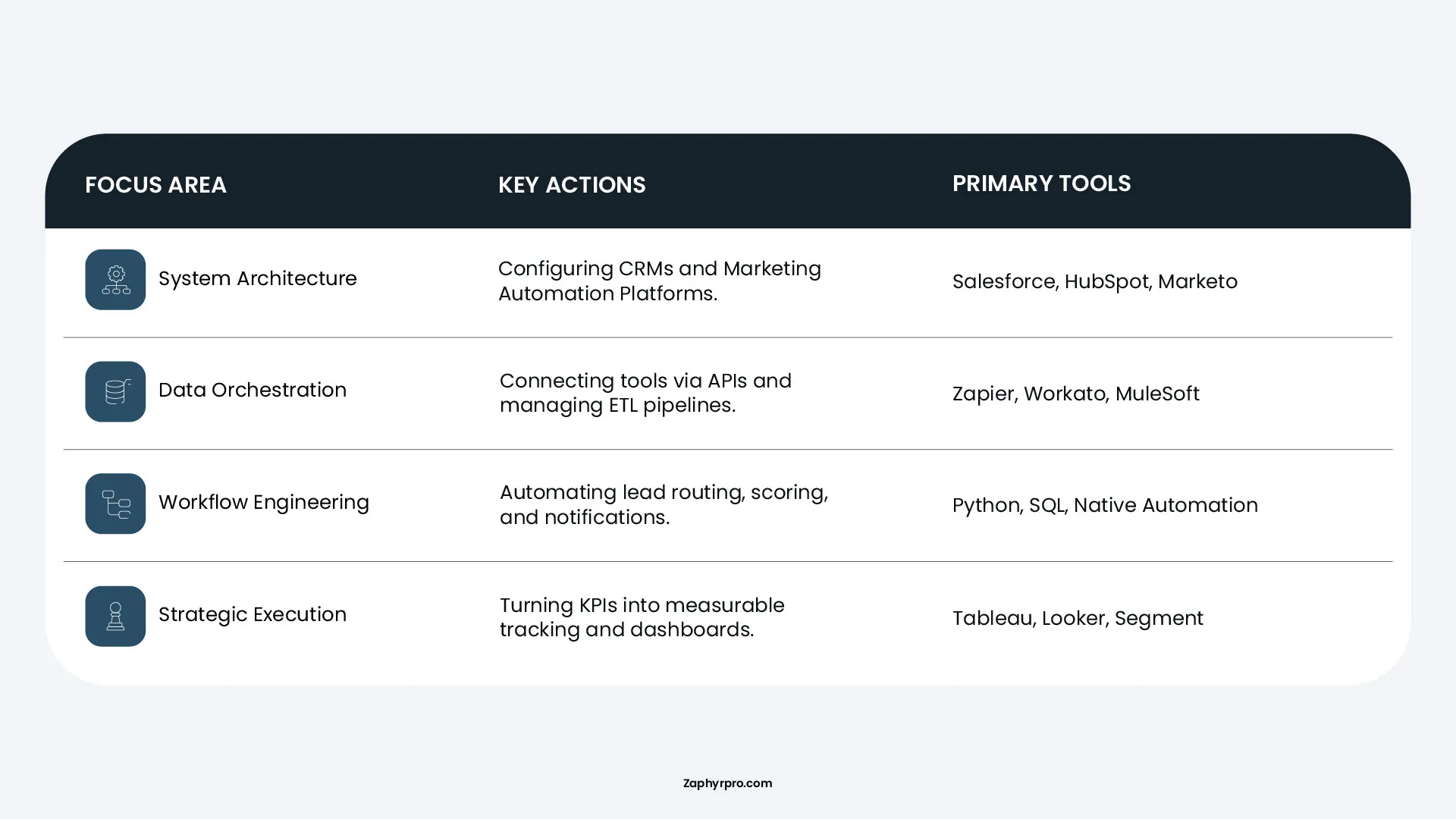
Here is what that looks like day to day:
1. System Architecture
GTM Engineers configure and maintain core platforms like CRMs (Salesforce, HubSpot), marketing automation (Marketo, Pardot), customer data platforms (CDPs), and sales enablement systems. They set up custom objects, workflows, validation rules, and triggers so systems mirror business processes and capture data reliably.
2. Data Orchestration
Modern GTM ops generate data across multiple systems. Engineers integrate them using APIs, middleware (Zapier, Workato, MuleSoft), and ETL pipelines to create a single source of truth. They clean, structure, and normalize data for accurate reporting, lead scoring, segmentation, and predictive insights to link sales, marketing, and product analytics.
3. Workflow Engineering
Repetitive tasks such as lead assignment, multi-step nurturing campaigns, email triggers, and scoring models are automated to reduce errors and save time. Automated workflows allow teams to focus on strategy, customer engagement, and decision-making rather than manual processes.
4. Strategic Execution
The role transforms business objectives into measurable technical operations. This includes implementing tracking for campaigns, building A/B testing frameworks, configuring dashboards to track KPIs, and creating scoring models to prioritize high-value leads. By doing so, GTM Engineers help companies implement a repeatable GTM execution model, ensuring strategies are not only measurable but also scalable across teams.
5. Ongoing Optimization
Monitoring KPIs, analyzing system performance, and identifying bottlenecks are continuous tasks. Workflows and data pipelines are refined, and infrastructure is scaled to handle growth, whether that means more leads, more campaigns, or increasingly complex customer journeys. The goal is to maintain reliability and operational efficiency as the organization expands.
A Few Examples of GTM Engineer Projects
- Lead Scoring and Routing System: A system that scores leads based on behavioral signals, product usage, and firmographic data, then routes high-value prospects to the right sales rep automatically.
- Automated Personalized Outreach: Workflows that use AI to write and send tailored emails triggered by specific events, like a company closing a funding round or a prospect visiting a pricing page.
- Product Signal Triggers: A connection between product usage data and the CRM that alerts sales and success teams when a user hits a key milestone, like inviting ten team members, or starts showing signs of dropping off.
- ABM Campaign Orchestration: Multi-channel campaigns built to target specific high-fit accounts across email, LinkedIn, and paid ads at the same time, with consistent messaging across every channel.
- Win/Loss Analysis Engine: An automated system that collects sales data, identifies patterns behind won and lost deals, and updates CRM fields so future campaigns are built on real outcomes, not assumptions.
- Real-time Dashboards & Reporting: Data visualizations that track conversion velocity, pipeline health, and campaign performance across the full funnel, giving leadership a clear picture at any point in time.
Skills and Experience Required to Become a GTM Engineer
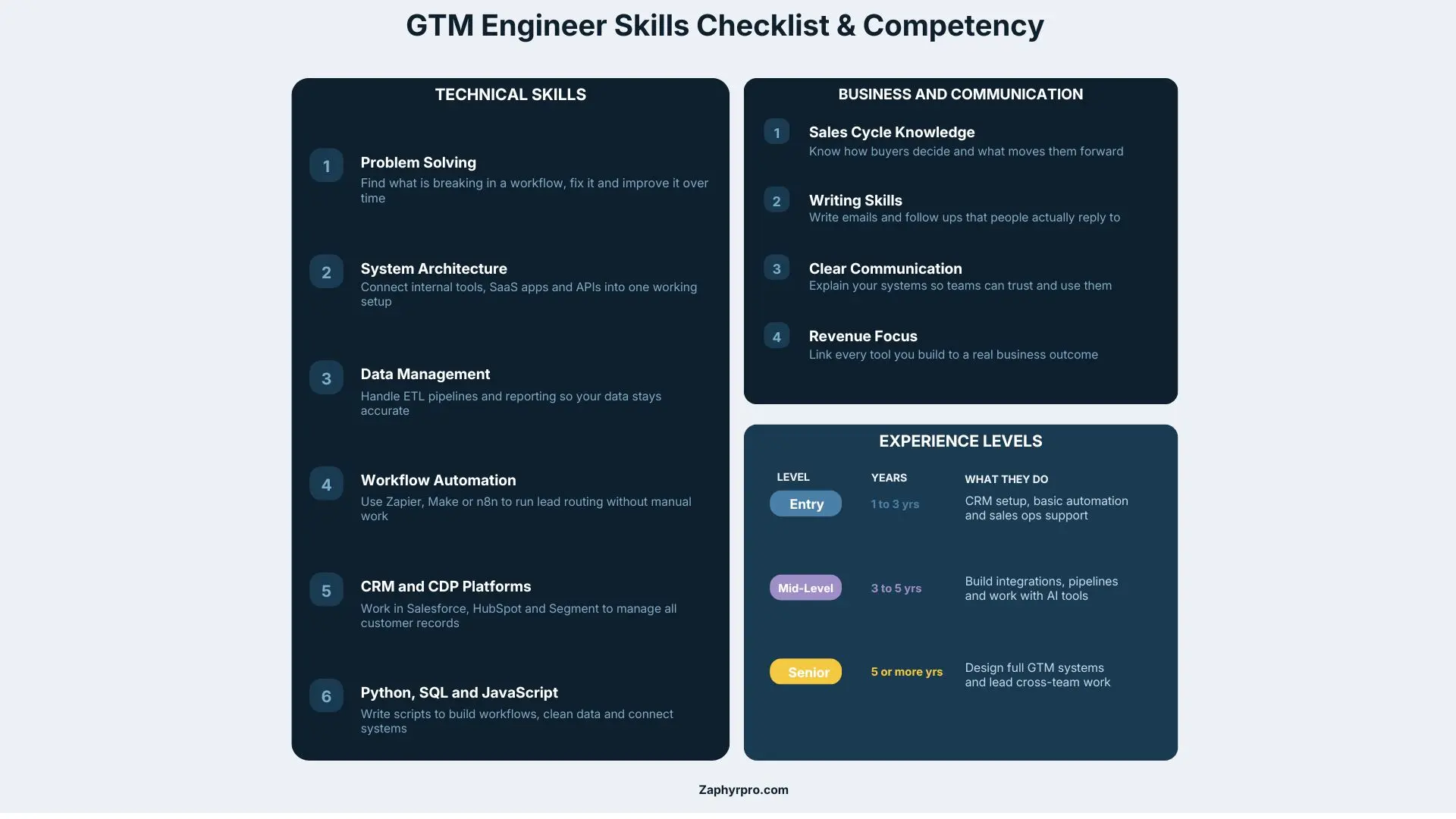
Anyone can sign up for Clay or run a few experiments with Claude. The barrier to getting started is low. But becoming someone a company actually pays $180,000 or more to hire is a different thing entirely.
Here is what separates people who dabble from people who get hired.
Technical Skills
- Programming and Scripting: Proficiency in languages like Python, SQL, or JavaScript to build workflows, automate data pipelines, and integrate systems.
- CRM and CDP Mastery: Deep knowledge of platforms such as Salesforce, HubSpot, or Segment to manage and connect customer data.
- Workflow Automation Tools: Experience with tools like Zapier, Workato, or custom scripts to streamline sales, marketing, and customer success processes.
- Data Management and Analytics: Understanding of ETL processes, data modeling, and reporting to ensure clean and actionable data.
- System Architecture and Integrations: Ability to design robust integrations between internal systems, SaaS tools, and AI platforms to support GTM operations at scale.
- Problem-Solving Mindset: Aptitude for diagnosing workflow bottlenecks, troubleshooting integrations, and optimizing automation efficiency.
Business and Communication Skills
Technical ability alone is not enough. The best GTM Engineers also understand how customers think, how sales cycles work, and how to write copy that actually converts. If someone asked you to write a cold email today, you should be able to write a good one. The same goes for landing pages and outbound sequences.
Stakeholder communication matters too. You will be building systems that sales and marketing teams rely on. If you cannot explain what you built and why it works, it will not get used.
Experience Levels
| Level | Years | What you are doing |
|---|---|---|
|
Entry |
1 to 3 years |
Supporting CRM workflows, basic automation, and marketing or sales ops tasks |
|
Mid |
3 to 5 years |
Building integrations, managing reporting pipelines, working with AI and predictive tools |
|
Senior |
5 or more years |
Designing full multi-platform GTM systems, leading cross-functional initiatives, and scaling automation across the org |
The skill gap in this role is still wide. Most people can use the tools. Far fewer can build a system that runs independently and ties directly to revenue. That gap is exactly where the salary premium lives.
We put together a complete interview preparation spreadsheet with 40 questions, model answers, and scoring criteria based on hiring processes. Free to download.
What are some of the tools GTM engineers use
GTM Engineers use tools across five categories: data enrichment, workflow automation, CRM, outreach sequencing, and intent signals. The stack varies by company, but these categories appear in almost every GTM Engineering role.
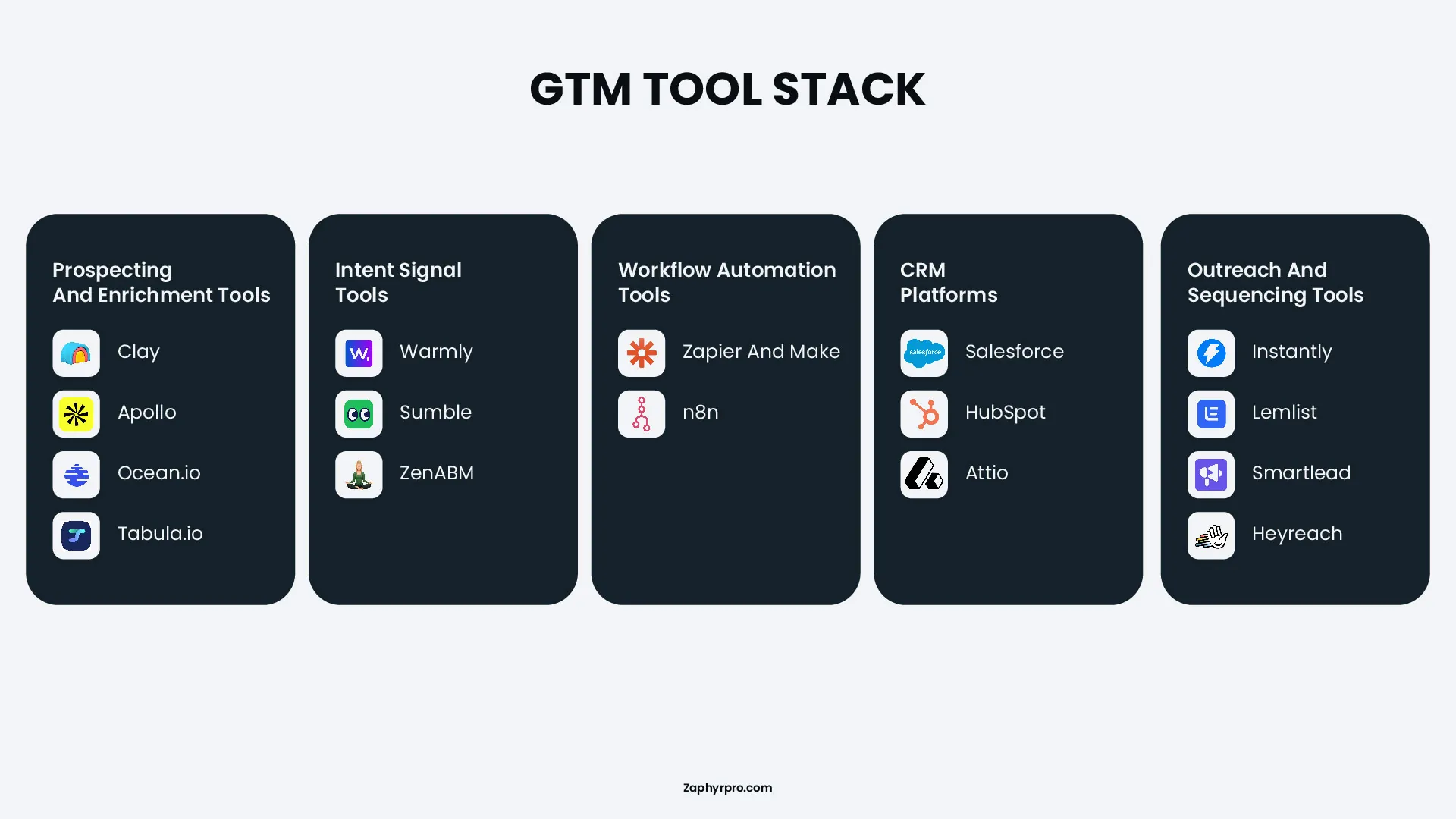
1. Prospecting and Enrichment Tools
- Clay is the most widely used enrichment platform among GTM Engineers. It pulls data from over 75 sources, runs AI research on prospects, and outputs enriched lead lists ready for outreach. Most GTM Engineer job postings list Clay as a required or preferred skill.
- Apollo is a lower cost alternative for contact and company data. Best suited for teams building their first outbound system or working with tighter budgets.
- Ocean.io identifies lookalike companies based on an existing customer list. GTM Engineers use it primarily for account-based outbound and LinkedIn ad targeting.
- Tabula.io takes a workflow-based approach to enrichment. Instead of spreadsheet-style cells, it runs enrichment steps sequentially across multiple providers, making the logic easier to audit and reuse.
2. Intent Signal Tools
Intent signal tools identify accounts showing buying behavior before a sales rep makes contact.
- Warmly identifies website visitors in real time and surfaces buying signals based on engagement patterns. GTM Engineers use it to help sales teams focus outreach on accounts already showing interest rather than cold lists.
- Sumble provides technographic data. If you need to find accounts running a specific software product, this is where most GTM Engineers look first.
- ZenABM tracks which companies engage with LinkedIn ads. GTM Engineers use it to build outreach lists from warm account activity rather than guessing at intent.
3. Workflow Automation Tools
Workflow automation tools connect platforms, move data, and execute multi-step logic without manual input.
- Zapier and Make handle lightweight data movement and simple workflow logic. Both are good starting points for GTM Engineers early in their journey.
- n8n is the more advanced option. It supports complex branching logic, memory, and multi-step automations that Zapier and Make cannot handle cleanly. Most experienced GTM Engineers move to n8n once their workflows grow beyond basic triggers.
4. CRM Platforms
CRM platforms store customer data and give sales teams a central place to manage pipeline and activity.
- Salesforce is the most widely used CRM in enterprise and mid-market companies. It offers deep customization but has a steep learning curve and high administration overhead.
- HubSpot is the most common choice for startups and growing teams. Easier to set up and maintain than Salesforce, with strong native marketing automation built in.
- Attio is a newer CRM built for flexibility. It supports webhook-based workflows natively and has a cleaner interface than legacy platforms. It recently raised $52 million and is growing quickly among early-stage companies.
5. Outreach and Sequencing Tools
Outreach tools manage the sending, timing, and tracking of sales communication at scale.
- Instantly, Lemlist, and Smartlead are the three most commonly used email sequencing platforms. All three handle automated sequences, follow ups, and reply tracking. Post spam filter crackdowns in 2024, domain warming and sending infrastructure have become as important as the sequences themselves.
- Heyreach is the primary tool for LinkedIn outreach campaigns. GTM Engineers typically pair it with intent signal data to focus LinkedIn outreach on accounts already showing buying behavior.
📌 PRO TIP: My honest advice is to get good at Clay, pick a CRM and learn it well, and build enough comfort with automation tools that you can connect any two platforms on your own. That skill set alone will put you ahead of most people applying for these roles.
How to Actually Become a GTM Engineer
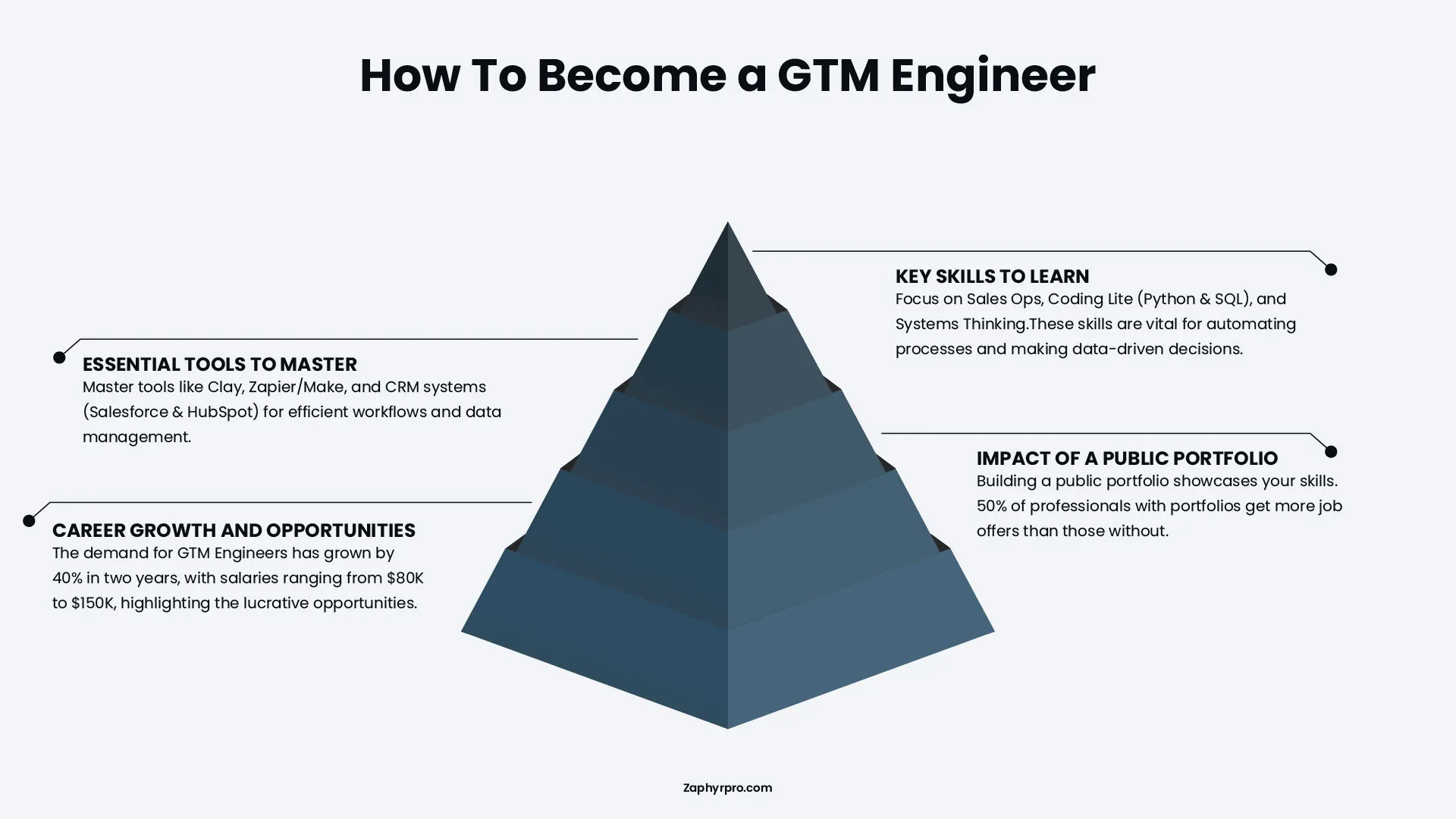
There’s no amount of reading, courses, or advice that will magically turn you into a GTM Engineer. Mastering these skills takes time, and it requires you to take full ownership of your own learning.
This role is far too hands-on for anyone to hold your hand through it. What actually works is building things, breaking them, and figuring out why.
Here is the most practical path based on what people already doing this job have found to work.
- Start by fixing something real: Before any course or certification, pick a small problem at your current job and solve it. Automate the report someone pulls manually every Monday. Build a basic lead list in Clay and clean it up. The point is not to build something impressive. It is to go through the full cycle of breaking something and fixing it. That process teaches you more than any structured curriculum.
- Learn Clay before anything else: Clay University is free and widely considered the best starting point for this role. Most GTM Engineer job postings list Clay as a required or preferred skill. The courses are practical from the first lesson and cover data enrichment and workflow automation in a way that mirrors actual on-the-job work. Start here before picking up any other tool.
- Learn SQL before Python: Most people jump to Python because it sounds more technical. In practice, the majority of daily GTM work involves pulling lists, checking enrichment accuracy, and cleaning records. SQL gets you there faster. Analyses of over 1,000 GTM Engineer job postings show SQL and Python listed as required skills at nearly identical rates (both around 38%). Hiring managers notice when a candidate can answer data questions independently without filing a request to the data team.
- Read Predictable Revenue by Aaron Ross: A large part of GTM Engineering is making outbound systematic and repeatable. This book, first published in 2011, is still the foundation most modern outbound thinking builds on. Understanding the principles behind it makes every automation you build more intentional. It is old enough to be inexpensive and still relevant enough to matter.
- Take a Small Freelance Project Before Applying Full Time: Platforms like Toptal and Upwork regularly post GTM automation work from small companies. Taking one project for a few hundred dollars gives you a real outcome to talk about in interviews. Saying “I built an automated lead enrichment workflow that reduced research time by four hours a week for a five-person sales team” lands differently than “I have been learning Clay for three months.
- Document everything you build: Write down the logic behind every workflow you create. What it does, why you built it that way, and what results it produced. This habit does two things. It forces you to think in systems rather than tasks, and it builds a portfolio that hiring managers can actually evaluate. Most candidates cannot show their work. The ones who can stand out immediately.
GTM Engineer Salary in 2026
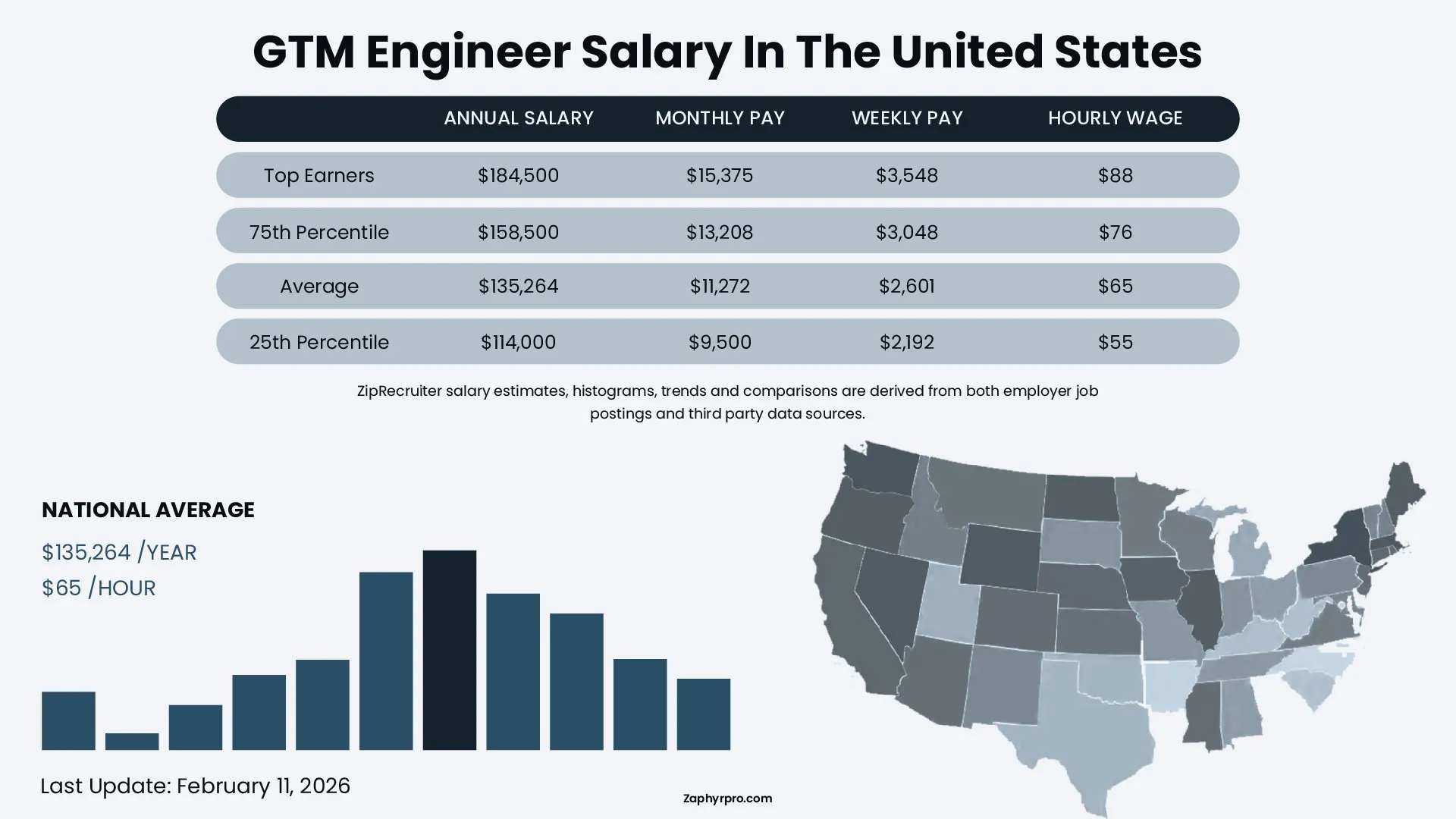
According to Glassdoor data from February 2026, the average GTM Engineer in the US earns $182,412 per year. That is not a number you see for most sales or ops roles. The range runs from $137,000 at the lower end to well above $330,000 for the strongest performers at top tier companies.
What Top Companies Are Paying
OpenAI and Vercel are posting roles above $250,000. Ramp targets $184,000 in total comp and LILT AI came in at $221,500. These numbers reflect what the market is willing to pay for someone who can build and run a full GTM system on their own.
For context, the RevOps median lands between $118,000 and $129,000. The technical depth this role requires shows up directly in the pay, which is a big reason so many ops professionals are moving in this direction right now.
Outside the US
In Western Europe and the UK, salaries typically run 30 to 50 percent below US rates. In Southeast Asia, Latin America, and Eastern Europe, monthly rates fall between $2,000 and $5,000. That gap explains why around 45 percent of GTM Engineers in those regions work through agencies or as independent consultants rather than full time in-house roles.
The salary range is wide because the skill gap is wide. Most people can use the tools. Very few can own the entire revenue tech stack independently. The closer you are to that, the closer you get to the top of that range.
Where to Look for GTM Engineer Roles
Most GTM Engineer jobs are not labeled as GTM Engineer jobs. That is the first thing to understand before you start searching. If you only search for that exact title, you will miss the majority of available roles.
Here is where to look and what to look for.
LinkedIn is still the most reliable place to find GTM Engineer roles. As of early 2026, there are over 3,000 open positions listed under the GTM Engineer title. But searching adjacent titles will surface significantly more opportunities.
Search terms that return GTM Engineering work:
- GTM Engineer
- Growth Engineer
- Revenue Operations Engineer
- Marketing Operations Engineer
- Sales Automation Engineer
- Revenue Engineer
- Growth Operations
Filter by company stage. Series A and Series B companies are currently the most active hirers. They have enough revenue to justify the role and enough growth pressure to make it urgent.
Company Career Pages
Many of the best GTM Engineering roles never get posted to job boards. Companies like OpenAI, Clay, Ramp, and Vercel post roles directly on their own career pages before syndicating them elsewhere. If there are ten companies you want to work at, check their career pages directly once a week.
Clay's Job Board
Clay maintains a dedicated job board for GTM Engineering roles at companies already using Clay in their stack. These companies understand the role, know what they are hiring for, and are further along in building their GTM infrastructure. It is one of the highest signal places to find relevant opportunities.
Cold Outreach to Hiring Managers
This is the approach most candidates ignore and the one most likely to work. If a company is actively using GTM tools, running outbound campaigns, or publishing content about their growth systems, they probably need someone to own that infrastructure.
Find the Head of Growth, Head of Revenue Operations, or CTO at companies you want to work for. Send a short, direct email explaining what you have built and what you would build for them.
What to look for in a job description
Since the title varies, look for these signals in the description instead:
- Building or owning the GTM tech stack
- CRM integration and automation
- Outbound system design
- Clay, n8n, or similar tools listed as requirements
- Cross-functional work with sales and marketing
- Metrics tied to pipeline or revenue
If the job description asks you to build systems that generate pipeline, regardless of what they call the role, that is a GTM Engineering job.
Top GTM Engineer Courses & Certifications
There is no official GTM Engineer certification yet. The role is too new for that. But there are specific courses, programs, and resources that hiring managers actually recognize and that teach skills directly applicable to the work.
Here is what is worth your time.
Clay University
Clay University is the closest thing to a standard GTM Engineering curriculum that exists right now. It is free, practical from the first lesson, and covers the tool most GTM Engineer job postings require. Courses cover data enrichment, workflow building, AI research automation, and outbound system design. If you only do one thing on this list, do this one first.
Where to find it: university.clay.com
HubSpot Academy
HubSpot Academy offers free certifications across CRM management, marketing automation, sales operations, and revenue operations. The certifications are widely recognized by hiring managers and show up frequently in GTM Engineer job requirements. The Revenue Operations certification in particular covers systems thinking and data management in a way that maps directly to GTM Engineering work.
Where to find it: academy.hubspot.com
Salesforce Trailhead
For companies running Salesforce, Trailhead is the standard learning platform. It covers CRM configuration, workflow automation, data management, and system administration through short practical modules. The Salesforce Administrator certification is one of the most recognized credentials in revenue operations and GTM roles.
Where to find it: trailhead.salesforce.com
Zapier Learn
Zapier offers free courses on workflow automation fundamentals. For GTM Engineers earlier in their journey, it builds a solid foundation in automation logic before moving to more advanced tools like n8n. The courses are short, practical, and free.
Where to find it: zapier.com/learn
Maven GTM and Growth Courses
Maven hosts cohort-based courses taught by practitioners currently working in GTM and growth roles. The quality varies by instructor but the best ones offer direct access to people doing the work at high-growth companies. Look for courses specifically covering outbound systems, growth engineering, or GTM operations.
Where to find it: maven.com
SQL and Python Foundations
These are not GTM-specific courses but they show up constantly in GTM Engineer job requirements. For SQL, Mode Analytics SQL Tutorial and SQLZoo are both free and practical. For Python, Automate the Boring Stuff with Python by Al Sweigart teaches scripting through real automation tasks, which maps directly to GTM Engineering work. It is available free online.
Where to find them: mode.com/sql-tutorial and automatetheboringstuff.com
Pavilion
Pavilion is a membership community for revenue professionals that also offers structured courses in revenue operations, sales leadership, and GTM strategy. It is more expensive than the other options on this list but the network access and peer learning are worth it at a senior level. Many GTM Engineers cite Pavilion as where they made the connections that led to their next role.
Where to find it: joinpavilion.com
The Future of GTM Engineering
Five years from now, GTM Engineer will be as common a job title as Product Manager or Data Scientist. We are still early. Most companies are just figuring out this role exists.
But the direction is clear. Every year the tools improve. AI gets more capable. The leverage one technical person can create keeps growing. Work that took a team of ten in 2020 takes one person today. What takes one person today will likely take an afternoon in 2028.
The people who can build these systems will be some of the most valuable hires in tech. The supply has not caught up to demand yet.
Every founder, every VP of Sales, every growth leader says the same thing: we desperately need someone who can do this and we cannot find them. Get in while it is still early, while you can help define what this role even means.
Is Your GTM Stack Built to Win?
Most companies know they need this. Few have actually built it. The gap between knowing and executing is exactly where pipeline stalls, good leads go cold, and growth slows down despite the tools being right there.
If you’re a founder or revenue leader who sees the opportunity but doesn’t yet have the right person to build it, that’s exactly the gap we help close.
We work with companies as an execution service partner, building the systems, connecting the stack, and getting your GTM infrastructure running so you don’t have to wait until you find the perfect hire. If that sounds like where you are, we’d love to have a conversation.
Learn More
Frequently Asked Questions
A GTM Engineer is a technical professional who builds the systems that help companies find, engage, and convert customers. They automate the manual work that slows sales and marketing teams down, connect the tools those teams rely on, and build the infrastructure that generates pipeline with minimal human effort.
Most people with a background in sales operations, marketing operations, or software engineering can transition into a GTM Engineer role within six to twelve months of focused learning and building. The fastest path is to start building real projects immediately, learn Clay first, and take a small freelance project before applying full time.
Not necessarily, but it helps. Most GTM Engineering work can be done with SQL, no-code tools like Zapier and Make, and platforms like Clay. Python becomes valuable as workflows grow more complex. Analyses of over 1,000 GTM Engineer job postings show SQL and Python listed as required skills at around 38 percent each, meaning roughly half of roles do not require either.
RevOps focuses on aligning teams, managing processes, and making revenue predictable. GTM Engineering focuses on building the technical systems that make those processes run. RevOps optimizes what exists. A GTM Engineer builds what does not exist yet.
As of early 2026, LinkedIn lists over 3,000 open GTM Engineer positions. The most active hirers are Series A and Series B startups. Companies like OpenAI, Clay, Ramp, and Vercel are among the highest-paying employers, with some roles exceeding $250,000 in total compensation. The role also appears under titles like Growth Engineer, Revenue Operations Engineer, and Sales Automation Engineer.