Each year, an estimated 30,000 new consumer products enter the global market. Most fail to gain meaningful traction, not because the products are poor, but because they lack a clear path to the right customers.
In 2026, the way people discover and evaluate products has changed dramatically. AI driven citations, zero click searches, and algorithm based feeds mean that buyers often form opinions before they even visit your website or speak with your sales team. Much of the decision process now happens independently, making visibility and alignment more challenging.
This makes a go to market strategy more critical than ever. In many teams, this shift has also led to new roles such as GTM engineers, who focus on connecting data, tools, and execution across the strategy.
In the next few minutes, you will learn:
- What a go-to-market strategy is and when to use it
- How to build a GTM strategy step by step
- How to execute your strategy using best GTM templates for 2026
Key Takeaways
- A Go-to-Market (GTM) strategy is a clear plan that shows exactly who your customers are, what problem you solve for them, and how you will reach and sell to them. It helps turn a new product or idea into actual revenue.
- Companies that create a written GTM strategy are about one third more likely to hit their revenue goals compared to those that don’t. It reduces wasted money, aligns your team, and increases your chances of successful launch.
- You can build a strong GTM strategy in 4–8 weeks by following 8 simple steps: research your market, define your ideal customer, create your value proposition, choose the right channels and pricing, prepare your team, and then launch while measuring real results like customer acquisition cost and revenue retention.
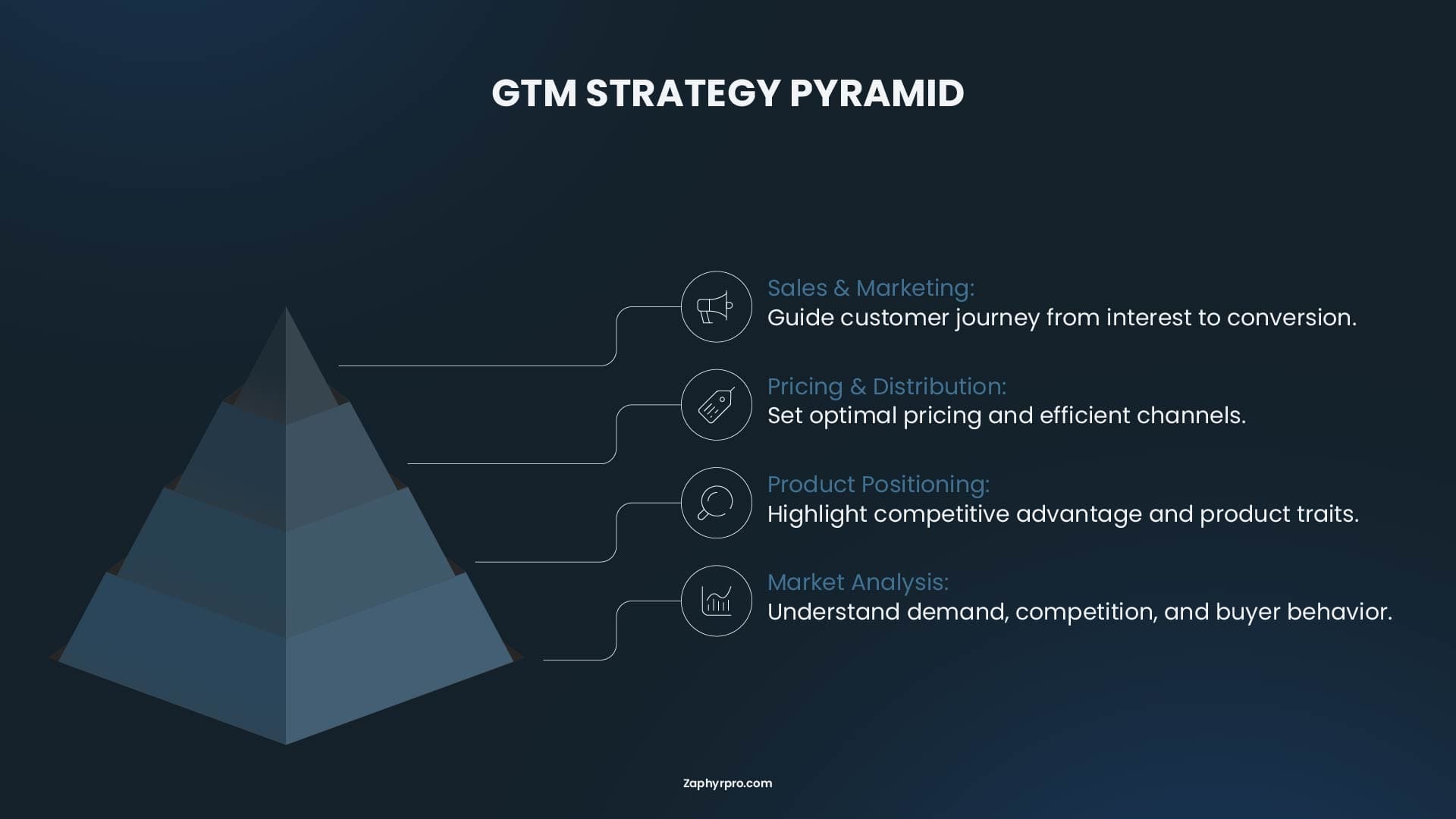
What Is a Go-to-Market (GTM) Strategy?
A go-to-market (GTM) strategy is a tactical action plan that outlines how a company will launch a product to a specific target audience and win a competitive advantage. It outlines exactly who you are selling to, what problem you solve for them, and how you will reach them.
A GTM strategy answers four core questions:
- Who: Your target audience and ideal customer profile.
- What: The problem you solve and your value proposition.
- Where: The channels (direct sales, partners, online) you’ll use.
- How: The sales and marketing motions to reach buyers.
You need a GTM strategy when launching a new product, entering a new market, or repositioning an existing product . Its purpose is to reduce risk by ensuring you don’t waste time and money selling to the wrong people in the wrong way.
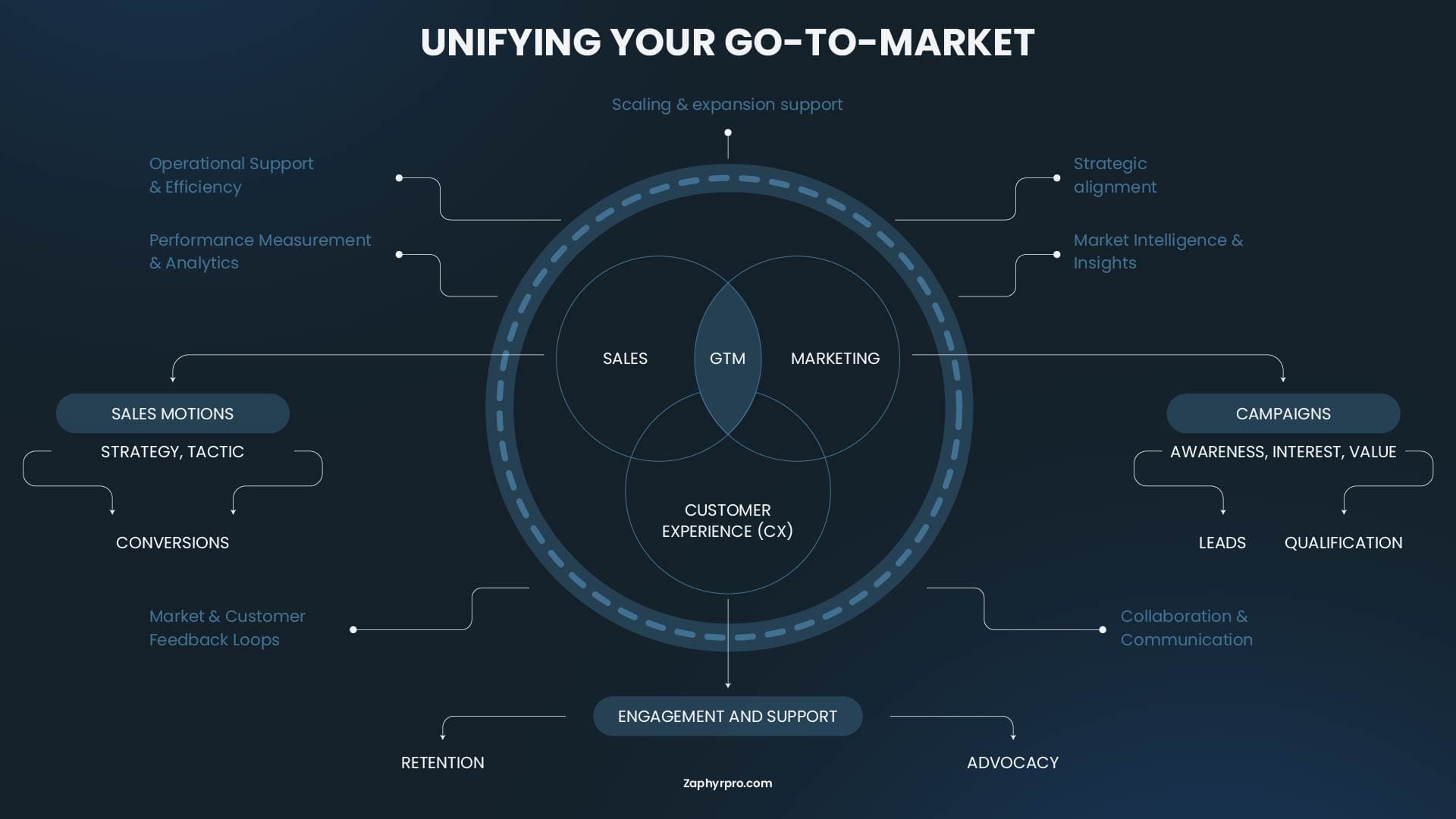
Key Reasons Why a GTM Strategy is Important
A Go-To-Market (GTM) strategy is critically important because it is the blueprint that turns a product into a profitable business. Without it, companies risk wasting resources on the wrong audiences or failing to communicate why their product matters.
Here is why every business needs a GTM strategy:
- Organizational Alignment: It breaks down silos by ensuring that product, marketing, sales, and customer success teams are unified behind the same goals, messaging, and timelines.
- Risk Mitigation: A structured strategy includes market research and customer validation, which helps businesses avoid costly mistakes like targeting the wrong audience or entering an oversaturated market.
- Faster Revenue Growth: By identifying the most effective sales and marketing channels from the start, companies can generate leads and close deals more quickly, accelerating adoption and income streams.
- Resource Optimization: It allows businesses to allocate limited time, money, and personnel to the highest-impact activities, preventing “scattershot” execution and wasted budget.
- Competitive Advantage: Through deep competitive analysis and clear value propositions, a GTM strategy helps a product stand out and stay ahead of rivals.
- Enhanced Customer Experience: By mapping the buyer’s journey from the outset, companies can design a more seamless and satisfying experience, leading to higher retention and loyalty.
GTM Strategy vs. Marketing Strategy
These two terms are frequently used interchangeably, and the confusion has real operational costs. A marketing strategy is the ongoing, portfolio-wide framework through which a company builds brand awareness, sustains audience relationships, and generates demand over time. It is designed to be durable and continuously refined.
A GTM strategy is purpose-built for a specific launch event, with its own audience definition, messaging architecture, channel mix, and timeline. It draws on the brand guidelines established by the marketing strategy but operates at a fundamentally different level of focus.
| Dimension | GTM Strategy | Marketing Plan |
|---|---|---|
|
Scope |
Focuses on bringing one product to one market within a defined timeframe. |
Covers brand awareness, lead generation, and customer retention across multiple products. |
|
Time Horizon |
Ends when the product is successfully launched and adopted. |
Continuous (12+ months). Rolls forward year after year. |
|
Primary Focus |
Getting the product into customers’ hands and generating initial revenue. |
Building brand equity, nurturing relationships, and driving repeat business. |
|
Teams Involved |
Product, marketing, sales, customer success, operations, finance, and often external partners. |
Primarily marketing, with input from sales and product. |
|
Key Outputs |
Launch timeline, channel strategy, pricing model, sales enablement, success metrics. |
Content calendar, campaign budget, brand guidelines, lead nurturing workflows. |
When sales and marketing teams are tightly aligned, which defines the outcome of a well-executed GTM strategy, companies can see 36 percent higher customer retention rates and 38 percent higher sales win rates. The GTM framework is specifically designed to produce that alignment across the sprint of a launch, which is why it generates outcomes that ongoing marketing activity alone cannot replicate.
When Should You Build a GTM Strategy?
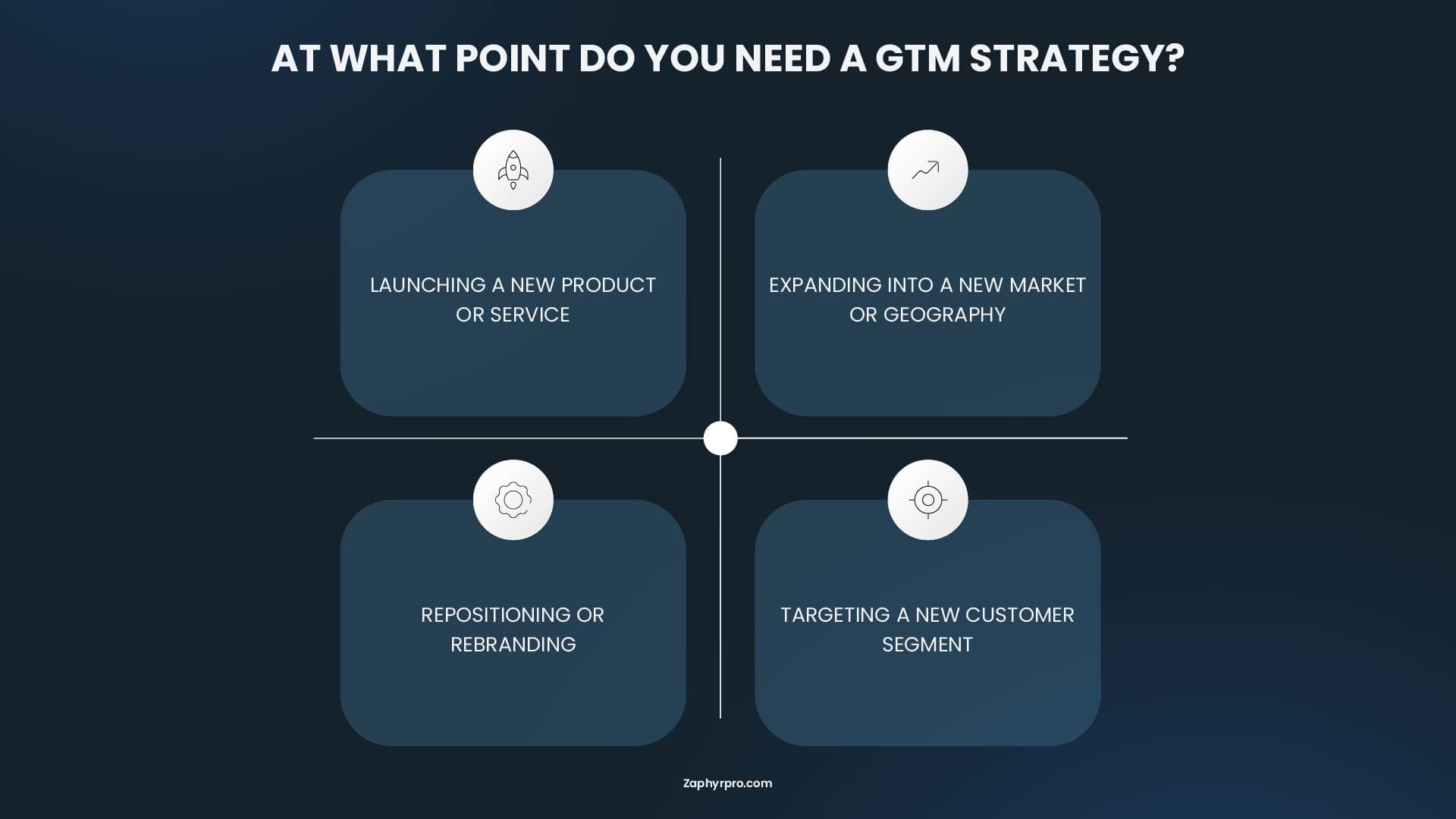
A GTM strategy is not exclusively a startup tool for first product launches. It is relevant any time a business introduces meaningful change that requires coordinated external action. Each of the following situations warrants a dedicated go to market plan.
Launching a new product or service
Any net-new offer entering the market for the first time requires a GTM strategy. This includes standalone products, significant feature releases that change a product’s value proposition, and new service lines. The more your intended audience differs from your existing customer base, the more important a purpose-built plan becomes.
Expanding into a new market or geography
Entering a new vertical or region is not simply a matter of translating existing materials. Buyer behavior, competitive dynamics, pricing expectations, and channel preferences often differ substantially. A GTM strategy ensures those differences are mapped and addressed rather than assumed away.
Repositioning or rebranding
When a company changes its messaging, pricing, or competitive positioning, every customer-facing team needs to communicate the change consistently and credibly. A GTM plan provides the framework for making that transition coherent, coordinated, and measurable.
Targeting a new customer segment
The same product sold to a different type of buyer often requires a fundamentally different value proposition, channel mix, and sales approach. A GTM strategy for the new segment prevents the team from defaulting to assumptions and assets built for a different audience.
In 2018, The New York Times reorganized into cross functional mission teams inspired by technology companies. These teams combined journalism, product, design, and data to support its GTM model by aligning how it created, delivered, and captured value in digital. This shift helped grow digital only subscribers from about 1.9 million at the end of 2017 to nearly 3 million by the third quarter of 2018, while online subscription revenue increased by 18 percent to around 400 million dollars annually.
The Eight Core Components of a GTM Strategy
A GTM strategy is only as strong as the completeness of its components. Each element below serves a specific structural function. Skipping one creates a blind spot that typically surfaces during execution at the worst possible moment.
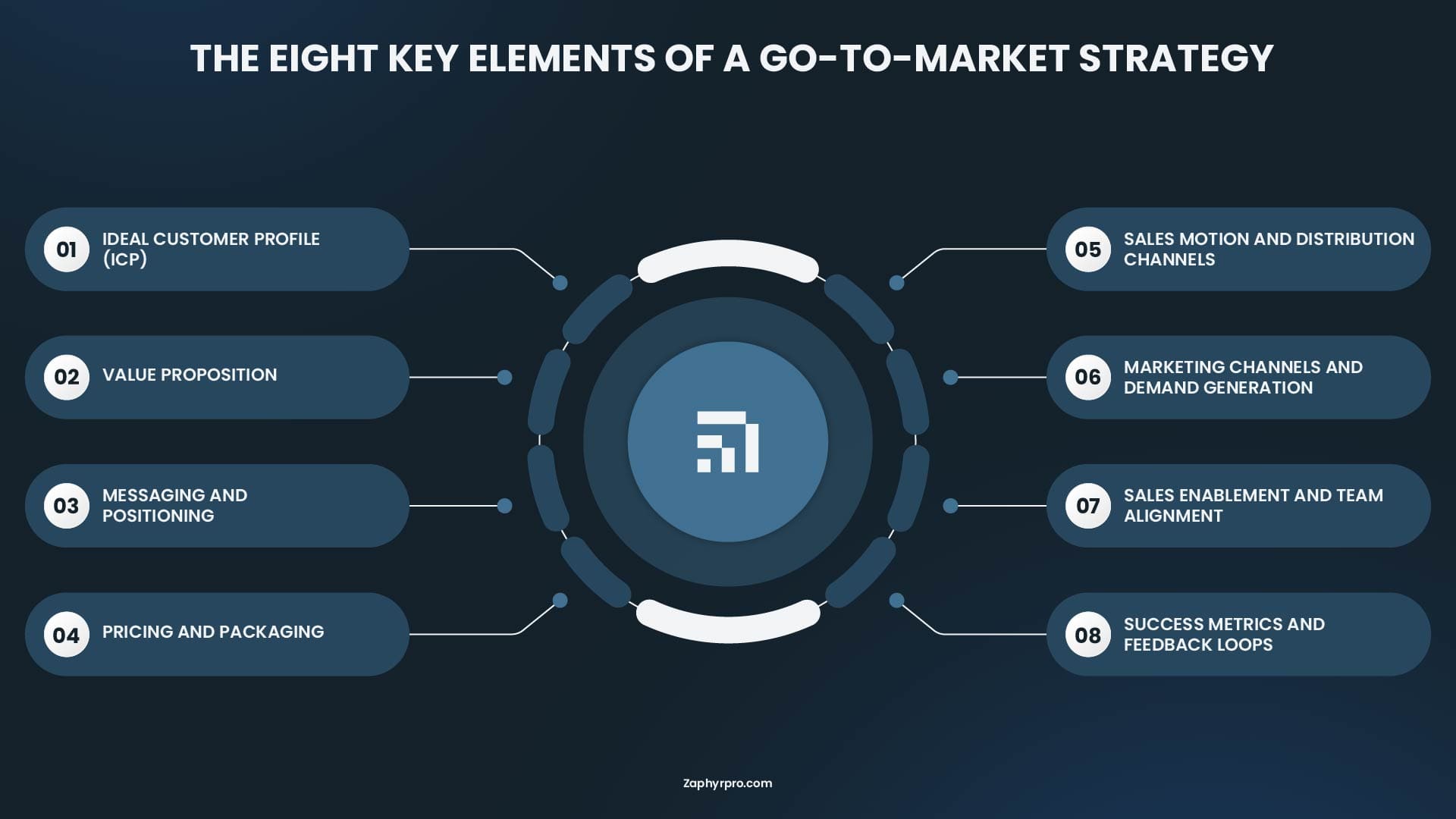
1. Ideal Customer Profile (ICP)
The ICP is the most precise description your team can produce of the customer most likely to buy your product, derive genuine value from it, and remain a customer over time. For B2B, it covers company firmographics (size, industry, tech stack, growth stage), the individual buyer (title, authority, day-to-day context), the trigger event that creates urgency, and what success looks like from the buyer’s perspective.
Customers spent 73 percent of their evaluation time building internal agreements rather than comparing features. That insight, which only came from careful ICP research, changed their sales enablement approach. A clearly defined ICP has the strongest impact on how the GTM execution model performs across the rest of the strategy.
2. Value Proposition
The value proposition answers, in plain and specific language, what your product does, who it is for, what problem it solves, and why it is the most credible solution in this market at this time. It is not a tagline.
It is the central claim that every piece of GTM messaging should be traceable back to. A strong value proposition is differentiated, verifiable, and relevant. It makes a claim that competitors do not make, that evidence supports, and that addresses a pain the buyer has already identified as significant.
3. Messaging and Positioning
Positioning is the strategic decision about how your product should be perceived relative to alternatives. Messaging is the translation of that position into specific language used across every customer-facing touchpoint such as website copy, sales outreach, paid campaigns, onboarding sequences, and partner materials.
Effective messaging is audience-specific: the language that resonates with a CFO evaluating a procurement decision differs from the language that resonates with an end user doing a product trial, even when both are evaluating the same product.
4. Pricing and Packaging
Pricing is one of the most important decisions in a GTM strategy and one of the least prepared. According to the iconic Harvard Business Review study, a 1 percent improvement in price realization increases median operating profits by 6.4 percent across industries. This shows that pricing requires the same level of careful analysis as market research.
Pricing should be triangulated across three reference points: value-based (what the outcome is worth to the buyer), competitive (where alternatives are priced), and cost-based (what the floor must be). Packaging (the structure of tiers, bundles, and configurations) determines which buyer segments can access the product at which price points and creates the commercial architecture for expansion revenue.
5. Sales Motion and Distribution Channels
The sales motion defines how your product reaches and converts buyers. For high price points and complex buying processes, a direct sales model with dedicated account executives is typical.
For lower-price, high-volume products, a self-service or product-led growth motion is often more efficient. Many products require a hybrid approach that evolves as the company scales.
Distribution channel selection should follow the audience rather than convention.
Gartner’s pre-2020 research predicted that 80 percent of B2B sales interactions would shift to digital channels by 2025. By 2026, benchmarks show about 70 to 75 percent of interactions are digital, reflecting a shift toward buyer led journeys and tools such as digital sales rooms. This makes hybrid digital investment a core part of GTM planning.
6. Marketing Channels and Demand Generation
Demand generation is the set of activities that creates awareness and intent among your ICP before they enter a formal buying process. Channel selection should be driven by evidence of where the ICP actually makes decisions, not by assumptions about where a business of your type ought to be active.
A critical discipline here is focus. Launching across seven channels simultaneously rarely produces strong results on any of them. Two to three channels executed with genuine depth and quality generate cleaner signal and better conversion than broader but shallower distribution. Start focused, then expand from evidence.
7. Sales Enablement and Team Alignment
Even the most precisely targeted GTM strategy produces poor results if the people executing it are not equipped to do so. Sales enablement, providing sales teams with the training, approved messaging, competitive differentiation, and conversion-relevant content they need before launch is a structural requirement, not a post-launch activity.
The materials that matter most are not comprehensive product decks. They are the specific assets that address the moments where deals typically stall: objection responses, competitive differentiation language, and internal champion toolkits that help the buyer justify the decision inside their own organization.
8. Success Metrics and Feedback Loops
A GTM strategy without defined metrics is a plan with no accountability mechanism. The metrics selected should reflect the actual business outcomes the launch is intended to produce. For B2B SaaS, the benchmarks that matter at launch include customer acquisition cost (CAC), conversion rate by pipeline stage, sales cycle velocity, time-to-first-value, and net revenue retention (NRR).
Feedback loops, the structured process of reviewing actual performance against plan and updating assumptions accordingly are what separate a GTM strategy from a static document. A 30/60/90-day review cadence built into the plan from the beginning ensures the strategy remains a live operational tool rather than a pre-launch artifact.
How to Build a GTM Strategy: An 8-Step Framework
The following steps are designed to be sequential while remaining iterative. Signals generated during execution regularly update assumptions formed during planning, and the strongest GTM strategies treat that iteration as integral to the process rather than as a sign that the original plan was flawed.
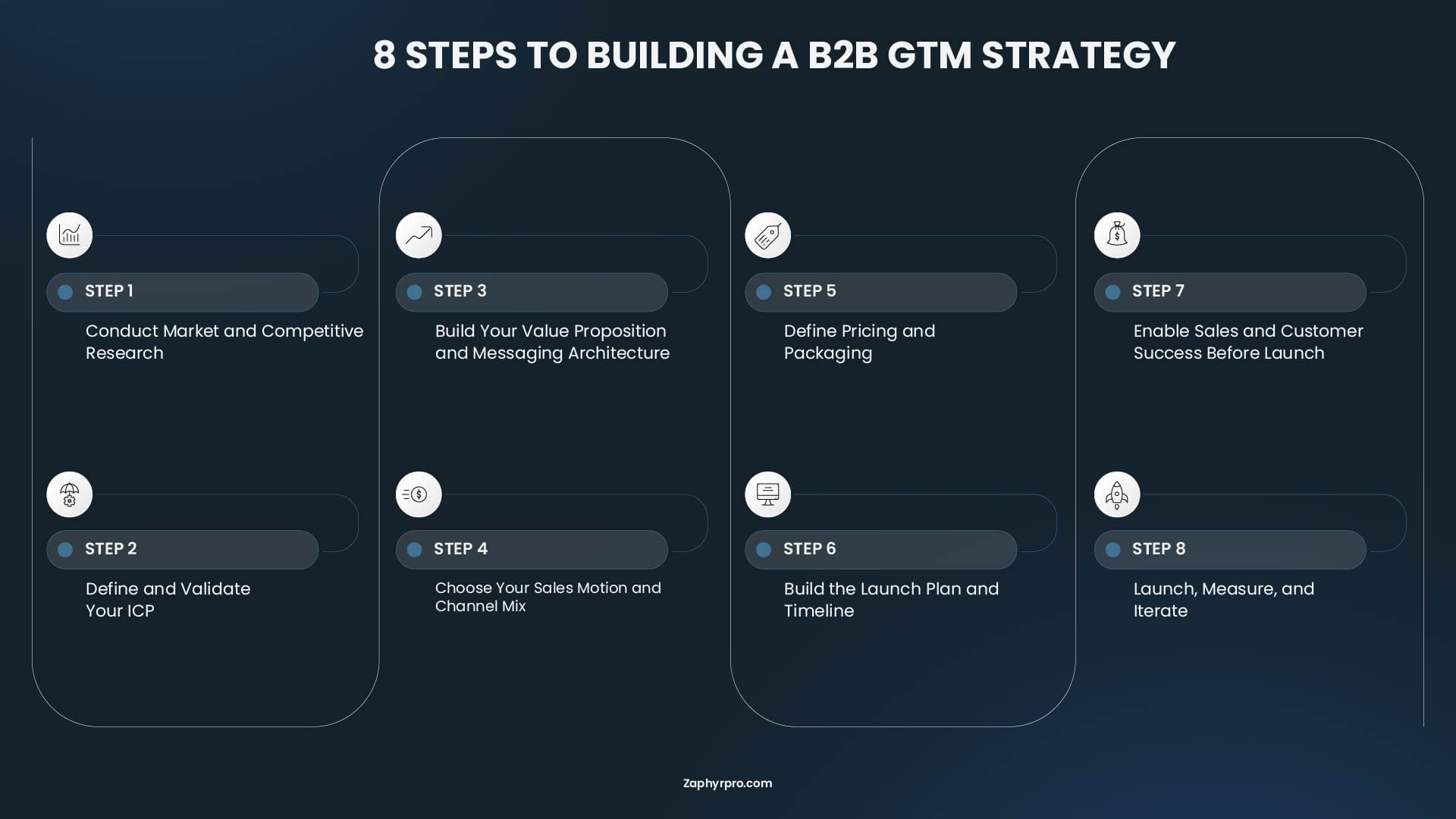
Step 1: Conduct Market and Competitive Research
Begin with an honest, evidence-based assessment of the market you are entering.
- Who are the primary competitors?
- Where are their positioning gaps?
- What are buyers currently using, and what do they wish it did differently?
The most useful competitive signal lives not in feature comparison matrices but in competitor review data, support forum discussions, and conversations with buyers who evaluated alternatives before choosing or rejecting a solution.
Step 2: Define and Validate Your ICP
Develop your ICP from real customer data and direct conversation, not from demographic assumptions. Conduct structured interviews with potential buyers and with existing customers who closely resemble your target.
Ask about their current workflows, their decision-making process, the criteria they use to evaluate solutions, and what a failed purchase in this category has cost them. Fifteen conversations before finalizing the ICP is a reasonable minimum, and each conversation will refine the profile in ways that no internal brainstorming session can replicate.
Step 3: Build Your Value Proposition and Messaging Architecture
Once your ICP is defined and your competitive landscape is mapped, translate that understanding into a clear value proposition. Then build the messaging architecture that operationalizes it: a primary message for the overarching audience, and segment-specific variations for each key buyer type. Every piece of marketing and sales content created for the launch should trace back to this architecture, ensuring consistency across channels and functions.
Step 4: Choose Your Sales Motion and Channel Mix
Select the sales model appropriate for your product’s price point, complexity, and buyer behavior. Choose two to three marketing channels where your ICP is most reachable and where you can genuinely compete for attention. Resist the pressure to be everywhere at once. Depth in a small number of channels consistently outperforms shallow presence across many, and it generates the quality of signal needed to improve the motion over time.
Step 5: Define Pricing and Packaging
Price from value first, then check against competitive and cost reference points. If your value-based price is significantly higher than your competitive benchmark, you either have a differentiation story that needs to be told more clearly or a product gap that needs to be closed before launch. Packaging should lower friction for the entry-level buyer while creating a clear upgrade path as the customer’s use case matures.
Step 6: Build the Launch Plan and Timeline
Translate the GTM strategy into a concrete launch plan with defined milestones, task ownership, and delivery dates. The plan should account for how work actually moves across teams—approvals, handoffs, content production cycles, legal review, rather than reflecting a theoretical ideal. Use a framework the team will actually follow. Roadmaps and Gantt charts help ensure that everyone is working from the same sequence of dependencies and deadlines.
Step 7: Enable Sales and Customer Success Before Launch
Sales enablement is not a launch-day activity. By the time the product goes to market, the sales team should have completed product training, have access to all approved sales materials, and have practiced the conversations they will have with buyers. Customer success teams should be briefed on onboarding protocols and prepared to support the first wave of customers. Any gap in team readiness at launch compounds into slower adoption and higher early churn.
Step 8: Launch, Measure, and Iterate
Launch with your primary channels fully resourced and your measurement infrastructure in place. Establish a 30/60/90-day review cadence that examines actual performance against the metrics defined during planning. Treat early signals, win/loss patterns, objection themes, conversion drop-off points, as the raw material for your first iteration. The businesses that win in competitive markets are not always those with the most polished initial launches. They are those that learn fastest from what the market tells them.
Common GTM Models and Which Fits Your Business
There is no single correct GTM model. The right approach depends on your product, your buyer, and the economics of your market. Most mature businesses operate some combination of the following, and the mix often evolves as the company scales.
| GTM Model | How It Works | Best Fit For | Key Advantages |
|---|---|---|---|
|
Sales-Led Growth (SLG) |
Direct sales team drives customer acquisition and expansion |
High-price products, complex buying processes, enterprise solutions, professional services |
Personalized selling, strong relationship-building, effective for large deals |
|
Product-Led Growth (PLG) |
Product itself drives acquisition through free trials, freemium, or self-serve usage |
Products with immediate value, simple onboarding, user = buyer, team-based adoption |
Scalable growth, lower acquisition cost, organic expansion |
|
Marketing-Led Growth |
Content, branding, and demand generation drive customer acquisition |
Markets where buyers research independently before purchasing |
Builds trust and authority, generates high-quality inbound leads |
|
Partner-Led / Channel-Led Growth |
Uses resellers, partners, and ecosystems to sell and distribute product |
Expanding into new markets, scaling reach without growing internal teams |
Extends market reach, lowers direct acquisition costs, leverages partner networks |
Sales-Led Growth (SLG)
In the SLG model, a direct sales team is the primary mechanism for acquiring and expanding customers. This model is appropriate for products with high price points, complex buying processes, or organizational change implications that require human guidance to navigate.
Enterprise software, professional services, and infrastructure products typically follow this model. The constraint is cost: SLG is expensive per customer acquired, which makes it viable primarily when deal sizes are large enough to justify the sales investment.
Product-Led Growth (PLG)
PLG makes the product itself the primary driver of acquisition, activation, and expansion. Buyers discover value through a free tier, trial, or freemium experience before making a purchase decision.
PLG is most effective when the product delivers immediate, self-evident value, when the buyer and the end user are the same person, and when usage within one team can drive organic spread to others in the organization. The critical metric is activation rate, top-performing PLG companies reaching 50-65% versus an industry average of 20-37% (median ~34-37% per 2024-2026 SaaS benchmarks).
Marketing-Led Growth
Marketing-led GTM places content, brand authority, and demand generation at the center of acquisition. It is most effective in markets where buyers self-educate extensively before engaging a salesperson.
Gartner’s research shows B2B buyers complete ~57-70% of their purchase decision before first sales contact in many categories, with only 17% of total buying time spent with vendors. In those markets, the quality and credibility of pre-purchase content directly determines pipeline quality.
Partner-Led and Channel-Led Growth
Partner GTM uses resellers, system integrators, technology partners, or platform ecosystems to distribute and sell the product. It reduces direct acquisition cost and allows a company to reach markets or segments it cannot address efficiently alone. It requires meaningful investment in partner enablement and clear commercial frameworks, but when executed well, it multiplies GTM reach without proportional headcount growth.
Best GTM Templates & Resources to Build Your GTM Strategy
These six templates cover the strategic layer of your GTM plan, and each one works out of the box, and includes formulas, scoring systems, and examples so you don’t start from a blank page.
1. Market & Competitive Research Tracker
This template helps teams map competitors, find gaps, and understand the market before locking in positioning.
Who it is for: Founders, product marketers, and GTM leads entering a new market or preparing for a first launch.
2. Value Proposition Canvas
It guides teams from vague positioning to a clear, testable value proposition that everyone can use consistently.
Who it is for: Marketing leads, founders, and product teams defining how the product solves problems for customers.
3. Pricing & Packaging Strategy
This template helps set pricing and packaging in a way that maximizes revenue while staying aligned with customer value.
Who it is for: Founders, GTM leads, and product managers creating pricing for the first time or reviewing an existing model.
4. GTM Channel Mix Selector
It helps decide which channels and sales motions to focus on, whether sales-led, product-led, or a hybrid.
Who it is for: GTM leads, heads of growth, and revenue teams choosing where to invest before launch.
5. ICP Scoring Matrix
This template gives a clear, shared definition of your ideal customer and a scoring system to qualify leads consistently.
Who it is for: Sales leaders, demand generation teams, and founders building a precise Ideal Customer Profile (ICP).
6. GTM Readiness Scorecard + 90-Day Launch Plan
It provides a structured way to check if the business is ready to launch, covering key activities and metrics over the first 90 days.
Who it is for: GTM leads, founders, and anyone preparing to launch a product or enter a new market.
How to Measure GTM Success
Measurement is where many GTM strategies lose coherence. The temptation to track what is easy to measure such as impressions, leads, click-through rates, rather than what reflects business progress is persistent.
The metrics below provide a more meaningful picture of GTM performance and connect launch activities to the revenue outcomes that leadership actually cares about:
Customer Acquisition Cost (CAC)
CAC is the total cost of acquiring one new customer, including marketing spend, sales compensation, and enablement costs, divided by the number of customers acquired in the period. It is most meaningful when set against customer lifetime value (LTV). A healthy LTV:CAC ratio for B2B SaaS is 3:1 or better; top performers target 4:1 or above with CAC payback under 80 days.
Sales Cycle Velocity
Sales cycle velocity measures how quickly opportunities move through the pipeline to close. It is a composite metric that reflects the health of your messaging (does it create urgency?), your enablement (is the team equipped to advance deals?), and your ICP definition (are you targeting buyers with genuine intent and authority?). A lengthening sales cycle is typically the earliest indicator of a positioning or qualification problem.
Conversion Rate by Stage
Tracking conversion rates at each stage of the sales or activation funnel (from lead to qualified opportunity, from opportunity to proposal, from proposal to close) reveals exactly where the GTM motion is breaking down. Stage-level data is more actionable than aggregate lead volume because it identifies the specific intervention needed at the specific moment where deals are stalling.
Net Revenue Retention (NRR)
NRR measures the revenue retained from the existing customer base after accounting for churn, downgrades, and expansion. An NRR above 100 percent means the customer base is growing without adding new customers. A strong indicator that the product is delivering the value promised in the GTM motion. Top-quartile B2B SaaS benchmarks put NRR above 120 percent. An NRR below 85 percent typically signals a product-market fit or onboarding problem that no amount of improved acquisition can resolve.
Time-to-First-Value
In products with a PLG or self-serve motion, time-to-first-value measures how quickly a new user reaches the moment where the product’s core benefit becomes tangible and real. Reducing this time is one of the highest-leverage improvements a product and onboarding team can make, because every day added to the time-to-value window increases churn probability during the trial phase.
Is Your GTM Strategy Prepared for Today’s Buyer Behavior?
In 2026, a solid go-to-market strategy is one of the smartest investments you can make when launching a product or expanding your business. It reduces risk, speeds up revenue, and helps your teams stay aligned from day one.
Start by reviewing the framework and templates above. Pick one section to work on this week, whether it’s clarifying your ideal customer or mapping your channels.
Zaphyre, as an execution service partner, supports businesses across strategy and execution, from early planning to post launch optimization. If you are launching something new or want to make your current plan better, you can schedule a consultation to see how a clear GTM plan could help your business.
Frequently Asked Questions
The biggest GTM strategy mistakes include:
- Skipping customer research and relying on assumptions
- Targeting too broad an audience instead of a clear ICP
- Weak or unclear positioning and messaging
- Choosing too many channels without focus
- Lack of alignment between product, marketing, and sales
- Delaying launch in pursuit of perfection instead of testing early
It usually takes 4 to 8 weeks to build a solid GTM strategy if you focus on the main parts. This includes research, customer interviews, and planning channels. For bigger or more complex launches, it can take up to 3 months. The key is to keep it practical and start testing early rather than making it perfect on paper.
You need input from product, marketing, sales, and customer success teams. Founders or CEOs should guide it in smaller companies. Finance can help with pricing and budgets. Bring everyone together early so the plan feels realistic and all teams stay aligned. Leaving any key team out often leads to problems during the actual launch.
Buyers now discover products through AI search and summaries before they visit websites. This means your messaging must be clear and easy for AI to understand and quote. Teams use AI tools to analyze customer data faster and personalize outreach. In 2026, successful GTM strategies focus more on being visible in AI results and less on traditional ads.
Review and update your GTM strategy every 3 to 6 months, or right after major changes like new competitors or shifts in customer behavior. Do a quick check after the first 30, 60, and 90 days of launch. Treat it as a living plan that improves with real results instead of a one-time document.