

As we head into 2027, 89% of B2B buyers are already using AI during the buying process, according to Gartner’s 2026 Technology Buying Behavior Survey. That alone should make you rethink what your SEO strategy is actually trying to achieve.
If your goal is still to rank for as many keywords as possible, you may be looking at SEO from the wrong angle. A keyword can bring thousands of visitors to your website and still have little impact on your sales pipeline.
The real opportunity is finding the searches your potential customers make when they have a problem, are comparing solutions, or are seriously looking for a provider.
In this guide, I’ll show you how to build a B2B SEO strategy around those searches, choose keywords based on buyer intent, and create content that brings the right people to your website, not just more people.
SEO Is Widely Used, but the Real Value Comes From Targeting the Right Searches
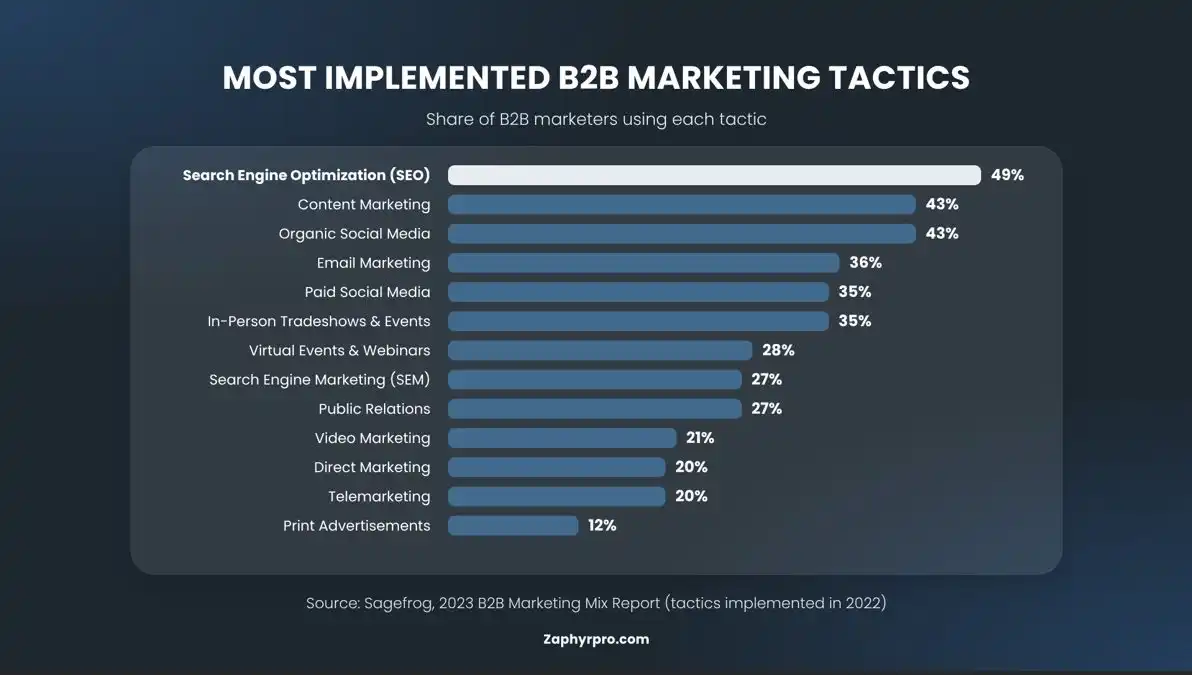
SEO is still one of the most widely used B2B marketing tactics. Sagefrog’s data shows that 49% of B2B marketers are implementing SEO, ahead of content marketing and organic social media at 43% each. That level of adoption makes one thing clear: the challenge is no longer whether companies should invest in SEO.
The bigger question is whether that investment is targeting the right searches. If your SEO strategy is built around broad traffic instead of buyer intent, you can still gain visibility without getting much closer to the pipeline.
What Makes a B2B Keyword High Intent?
A B2B keyword is high intent when the search suggests that someone is actively evaluating a solution, provider, or purchase rather than simply looking for information. The strongest signals usually come from specificity, commercial language, solution awareness, and proximity to a business decision.
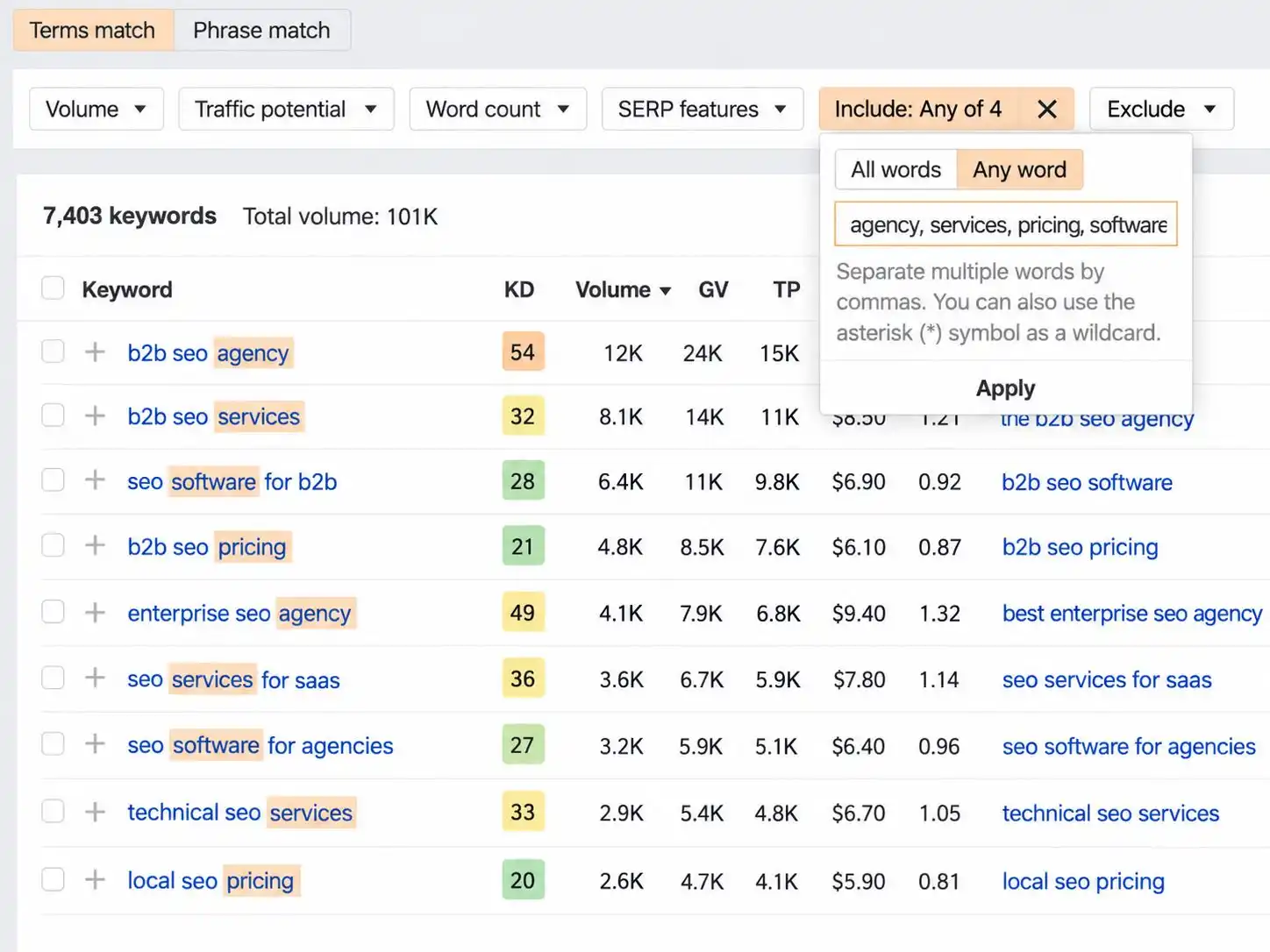
For example, someone searching for “B2B SEO agency” is already showing strong commercial intent. A search for “SEO services for SaaS” narrows that intent to a specific business need, while “B2B SEO pricing” suggests the buyer may already be evaluating providers and comparing what different options could cost.
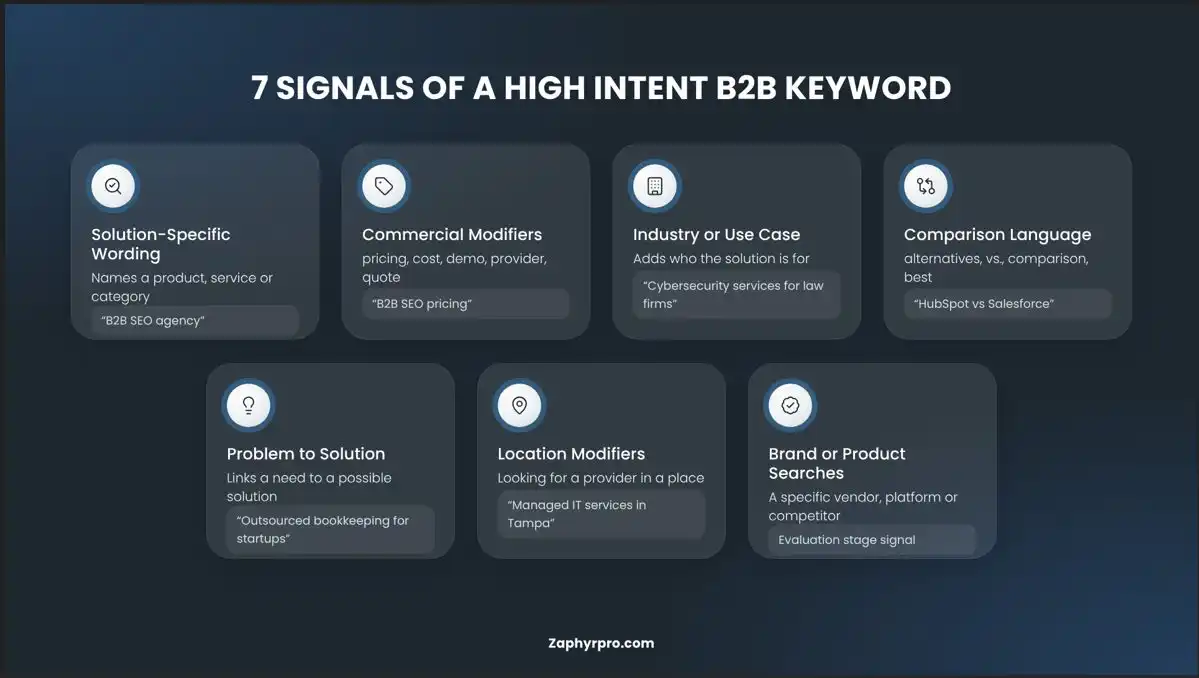
Several signals can indicate high intent:
- Solution-specific wording: When buyers include a particular product, service, or solution in their searches, it often means they have already identified the type of help they need. For example, “outsourced payroll services” shows stronger intent than simply searching for “payroll problems.”
- Commercial modifiers: Words such as pricing, cost, demo, provider, company, services, and quote suggest that buyers are exploring their options and assessing what a solution might involve. These modifiers often indicate that a searcher is moving closer to a purchasing decision.
- Industry or use-case specificity: Searches that mention a particular industry, business type, or use case reveal a more defined requirement. For example, “cybersecurity services for law firms” indicates that the buyer needs industry-relevant expertise rather than general cybersecurity information.
- Comparison language: Terms such as best, alternatives, vs., comparison, and top providers often indicate that buyers are evaluating multiple solutions or vendors. These searches create opportunities for comparison articles, competitor alternatives, and provider evaluation pages.
- Problem-to-solution searches: Some buyers describe their business challenges alongside the type of solution they are considering. For example, “outsourced bookkeeping services for startups” suggests that the searcher has identified a business need and is actively exploring a service to address it.
- Location modifiers: Adding a city, region, or country to a service-related search often indicates that buyers are looking for providers operating in a specific area. For example, “managed IT services in Tampa” suggests that the searcher may be ready to shortlist local service providers.
- Brand or product searches: When buyers search for a specific company, product, or competitor, they may already be familiar with available options and want to learn more before making a decision. Searches such as “HubSpot alternatives” or “Salesforce implementation partners” can indicate active vendor research.
How to Find the Keywords Your Buyers Actually Search for B2B SEO Strategy
The best B2B keyword research starts with your buyers, not a keyword tool. Search-volume data can show you what people search for, but it does not tell you why they search, what problem they are trying to solve, or what information they need to make a decision. Start by understanding the language your target customers use when researching their problems, evaluating solutions, and looking for potential providers.
That matters even more as buyers become more comfortable doing this research on their own. Gartner found that 67% of B2B buyers prefer a rep-free buying experience. If prospects are researching independently, the searches they make can reveal what they need to know before they ever contact your sales team. Your mobile SEO strategy also needs to account for those searches, not just the keywords with the highest search volume.
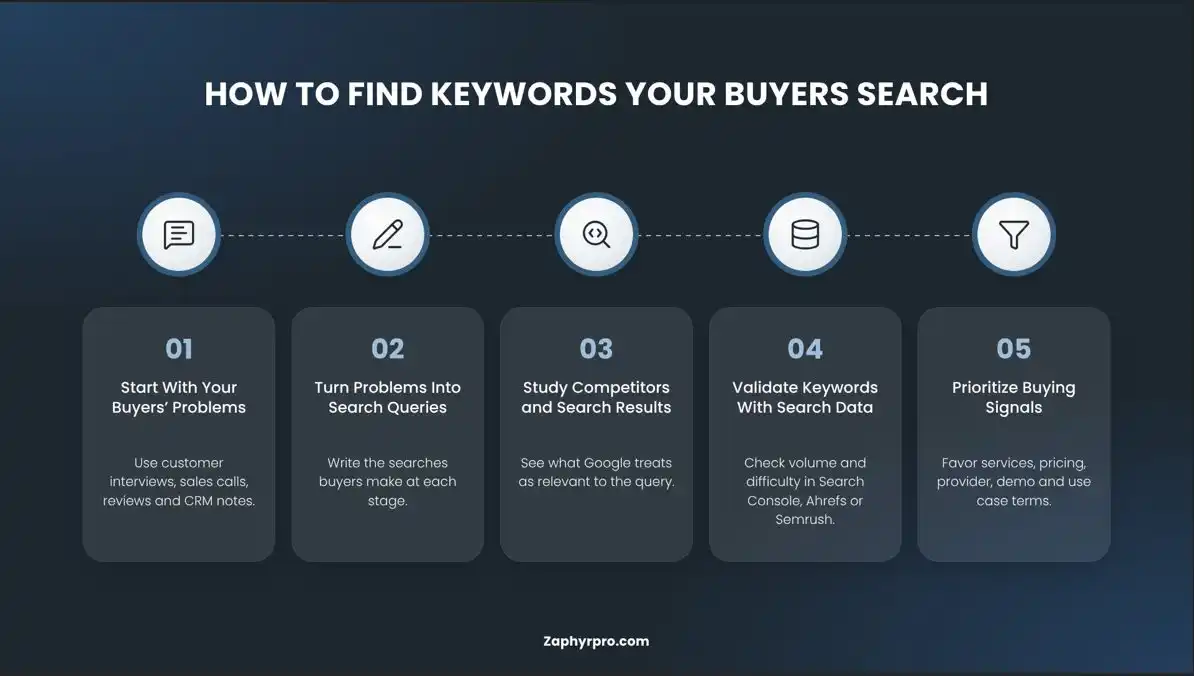
1. Start With Your Buyers’ Problems
List the problems your product or service solves and describe them in the language your customers would naturally use. Look beyond your company’s terminology. A business may describe a service as “revenue cycle optimization,” while its buyers search for “how to reduce medical billing errors.” Customer interviews, sales calls, support conversations, reviews, and CRM notes can reveal this language better than brainstorming alone.
2. Map Customer Pain Points to Search Terms
Once you’ve identified your target audience’s recurring problems, the next step is to understand how they search for solutions online.
Think about the questions a potential buyer might type into Google when they first encounter a problem, start looking for solutions, compare providers, or prepare to make a purchase. Each stage of the buying journey creates different keyword opportunities.
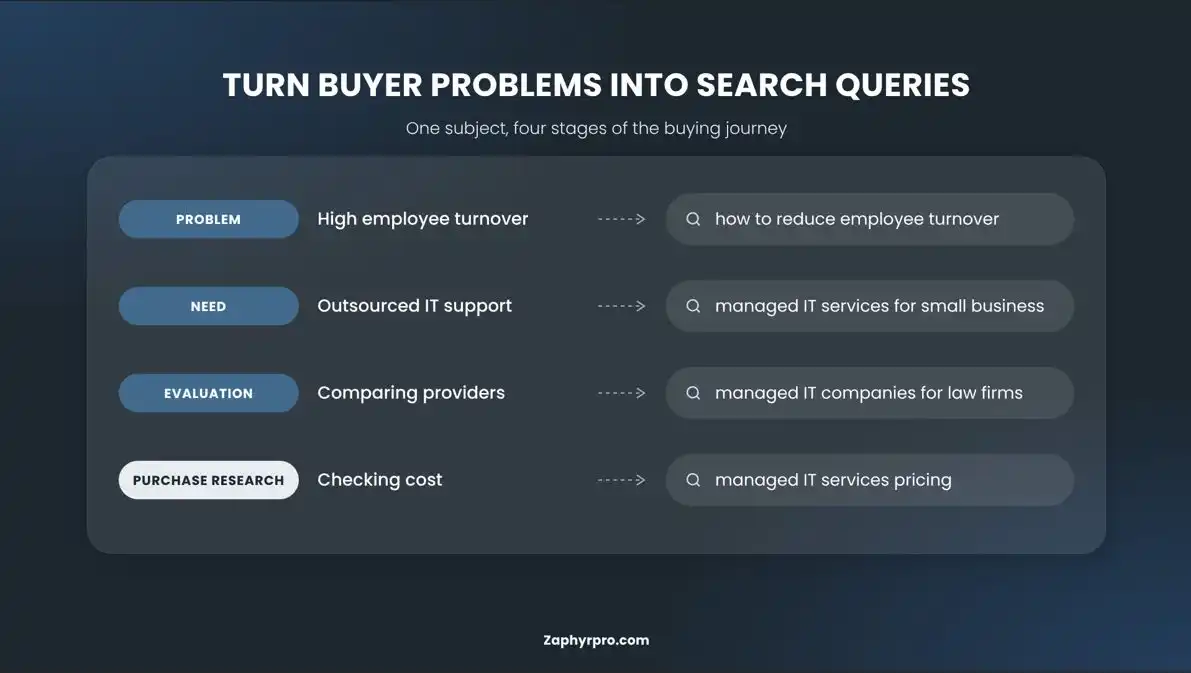
For example, consider a business struggling with employee turnover:
- Problem awareness: The buyer recognizes an issue but hasn’t decided how to solve it yet. They might search for “how to reduce employee turnover” or “why is employee turnover high in small businesses?”
- Solution research: The buyer starts exploring possible solutions. Searches might include “benefits of outsourced HR services” or “how outsourced IT support helps small businesses.”
- Provider evaluation: The buyer knows what type of solution they need and starts comparing providers. They might search for “managed IT companies for law firms” or “best managed IT service providers for small businesses.”
- Purchase research: The buyer is closer to making a decision and wants specific details about costs, contracts, and service scope. Searches might include “managed IT services pricing” or “managed IT support monthly cost.”
This approach helps you build a keyword list around actual buyer needs rather than relying on a few broad industry terms. It also gives you opportunities to create content for every stage of the buying journey, from educational blog posts and solution-focused guides to comparison pages and service landing pages.
3. Study Competitors and Search Results
Look at the keywords competitors rank for, but do not copy their strategy blindly. Review the pages appearing for your target searches and examine what Google considers relevant to the query. Pay attention to recurring service terms, industry modifiers, questions, comparison searches, and related problems. These patterns can uncover opportunities your initial keyword list misses.
4. Validate Keywords With Search Data
Once you have a buyer-led list, use tools such as Google Search Console, Google Keyword Planner, Ahrefs, or Semrush to evaluate search volume, competition, related terms, and ranking difficulty. The goal is not to find the keyword with the highest volume. It is to identify searches where the search intent, buyer, problem, and solution align with what your business actually sells.
5. Prioritize Buying Signals
Give greater attention to keywords that indicate commercial research or a specific business need. Terms containing services, provider, pricing, software, company, demo, alternatives, or an industry/use-case modifier can provide stronger intent signals than broad informational queries. Finally, group keywords by topic, intent, audience, and buying stage. This creates a keyword strategy based on how your buyers actually search, rather than a spreadsheet of disconnected terms.
How to Prioritize B2B Keywords by Buyer Intent
Once you have a list of relevant keywords, the harder question is deciding which ones deserve your attention first. This is where many B2B SEO strategies go off track. They sort keywords by monthly search volume, pick the terms with the largest numbers, and build a content marketing strategy around them.
That approach can leave you investing most of your effort in searches made by people who are still researching a subject, while more commercially valuable searches receive little attention.
A better approach is to look at what the keyword tells you about the buyer’s current situation. Someone searching for information about a business problem has a different level of commercial intent from someone comparing vendors or looking for a specific service. Both searches can be relevant, but they should not necessarily receive the same SEO priority.
1. Start With the Distance Between the Search and the Purchase
At one end, you have searches where the person is trying to understand a problem. In the middle, they are exploring possible approaches and comparing solutions. Further along, they are looking for specific products, providers, pricing, or implementation details.
The closer a search is to a decision your business can fulfill, the more carefully you should consider it for your commercial SEO strategy.
That does not mean informational keywords have no value. An early-stage search can introduce your company to a future buyer and build familiarity before a purchasing decision exists. The important distinction is that traffic value and immediate commercial value are not the same thing.
2. Give More Weight to Keywords That Describe a Real Buying Situation
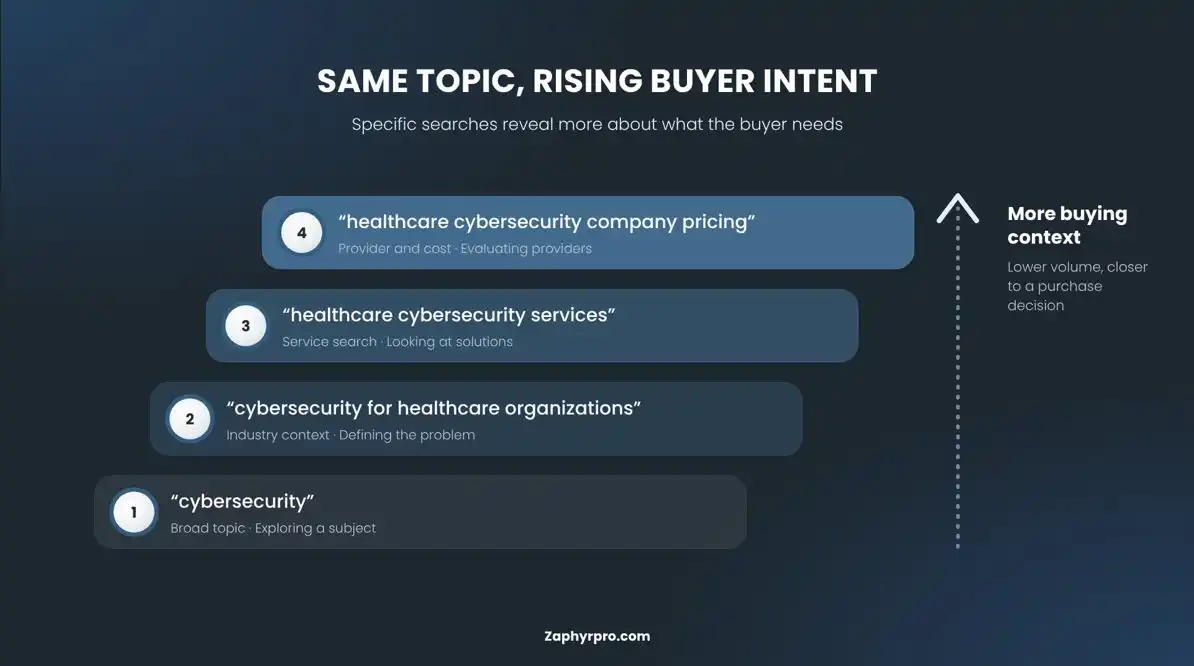
The strongest keyword opportunities often reveal more than the general topic a buyer is interested in. They provide clues about the buyer’s industry, requirements, challenges, and the type of solution they are considering.
Consider the difference between these searches:
- “Cybersecurity” – A broad search that could come from someone researching the topic, studying cybersecurity, or exploring general security concerns.
- “Cybersecurity for healthcare organizations” – A more specific search that identifies the industry and suggests an interest in security challenges relevant to healthcare.
- “Healthcare cybersecurity services” – This search shows greater solution awareness. The buyer is actively looking for services that address their industry’s security requirements.
- “Healthcare cybersecurity company pricing” – This query carries stronger commercial signals because the searcher is exploring potential providers and wants to understand the cost of hiring one.
Although all four searches relate to the same subject, they reveal different levels of buyer awareness and commercial intent. The more specific the query becomes, the more context you gain about what the searcher needs and how close they might be to making a purchasing decision.
This is why low search volume shouldn’t automatically disqualify a keyword. A highly specific B2B search may attract fewer visitors, but those visitors could represent a much better match for your target audience.
3. Factor in the Value of the Customer Behind the Keyword
Intent is only one part of prioritization. You also need to ask whether the people searching the term match your target market.
Imagine two keywords generate similar levels of search activity. One attracts students, job seekers, researchers, and general consumers. The other is searched primarily by operations leaders at companies that purchase your service.
From an SEO perspective, both may look attractive. From a business perspective, they are very different opportunities.
This is where your ideal customer profile should influence keyword prioritization. Industry, company size, job function, use case, geography, and purchasing requirements can help you determine which searches are worth competing for.
4. Then Look at What You Can Realistically Win
A commercially valuable keyword still needs to be attainable. If the search results are dominated by established publishers, major software companies, and highly authoritative websites, ranking for a broad term may require substantially more time and resources than targeting a more specific variation.
That does not mean you should avoid competitive keywords altogether. It means you should understand the trade-off before making them a major part of your strategy.
Look at the current search results, the quality and relevance of the competing pages, the authority of the sites ranking there, and the type of content Google is rewarding. A keyword with strong buyer intent and a realistic competitive path can be more attractive than a high-volume term where your site has little opportunity to gain visibility.
5. Choose Keywords That Bring You Closer to Your Buyers
Keyword prioritization shouldn’t depend on search volume, keyword difficulty, or traffic potential alone. A keyword might attract thousands of monthly searches but bring little business value if those searchers don’t match your target audience or need your services.
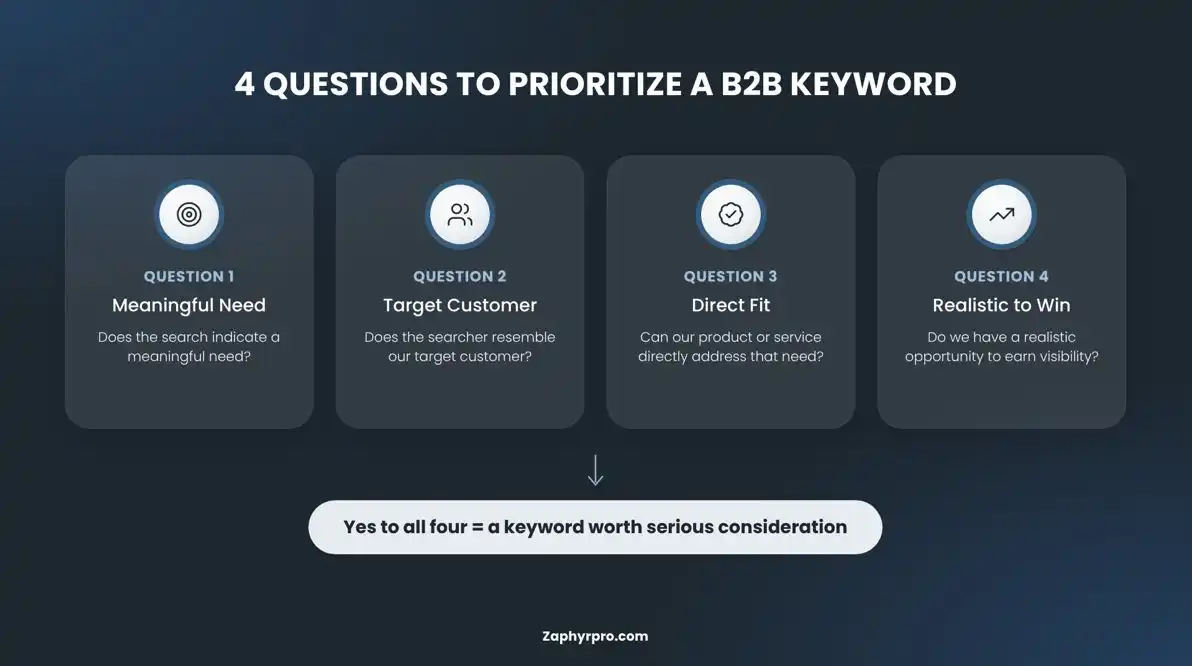
I like to evaluate keyword opportunities by asking four questions:
- Does the search indicate a meaningful need? Look for keywords that reflect a genuine business challenge, operational requirement, or buying need. A search related to a problem your audience actively wants to solve is often more valuable than a broad informational query.
- Does the searcher resemble our target customer? Consider the industry, company size, job role, and business requirements behind the search. For example, a keyword attracting enterprise IT decision-makers may be more valuable to an enterprise-focused provider than one attracting individual users.
- Can our product or service directly address that need? Prioritize searches that connect naturally with what your business offers. If your company provides outsourced lead generation, keywords around appointment setting and outbound sales support are more relevant than general marketing topics with no clear connection to your services.
- Do we have a realistic opportunity to earn visibility? Evaluate keyword difficulty, competitor strength, search intent, and your website’s existing authority. A highly relevant keyword may still be worth targeting, but you need a realistic content and SEO strategy to compete for it.
A keyword that satisfies all four deserves serious consideration, even if its monthly search volume is relatively low. This changes the role of keyword research. You are no longer trying to build the biggest possible keyword list. You are deciding which searches have enough commercial relevance to justify your content, authority, and optimization resources.
Map High-Intent Keywords to the Right Page
Finding a high-intent keyword is only half the job. You also need to decide where that search should lead. This matters because the same keyword can perform very differently depending on the page you use to target it.
A common B2B SEO mistake is trying to make one service page rank for every variation of a topic. That usually creates a mismatch between what the searcher wants to see and what the page is designed to provide. Someone comparing solutions needs a different experience from someone who already knows which service they need.
The page should therefore reflect the job the searcher is trying to complete. McKinsey’s 2026 Global B2B Pulse found that buyers use an average of 10 channels throughout the purchasing journey. For SEO, that means one keyword or landing page should not be expected to answer every question a buyer has from initial research through vendor evaluation.
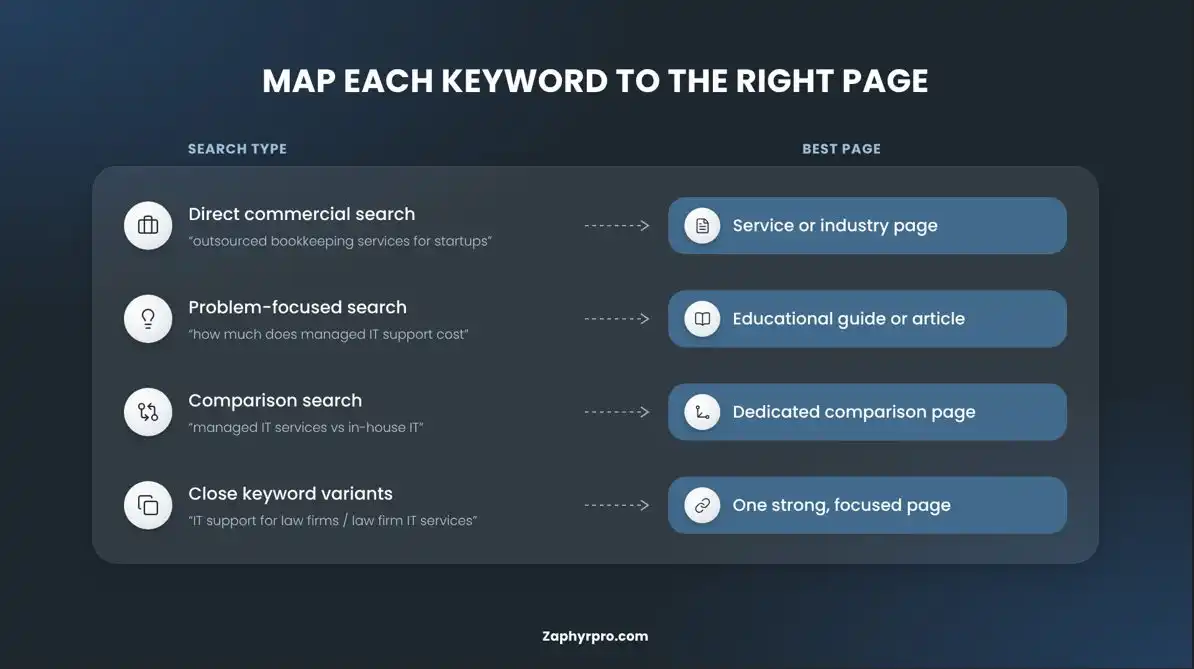
Match the Page to the Searcher’s Expected Answer
Start by looking at the search results for a keyword. The pages Google already ranks can tell you a lot about the type of content searchers expect.
If the results are primarily detailed guides, the query likely requires explanation before a commercial page can satisfy the intent. If the results are dominated by service pages, product pages, or provider listings, searchers are likely looking for something they can evaluate or purchase.
For example, a query such as “Top 10 IT MSP lead generation agencies” calls for listicle-educational content. A search such as “B2B lead qualification services” has a different expectation. Sending both searches to the same page would make it harder to address either need properly.
Use Service Pages for Direct Commercial Searches
When a keyword clearly describes a service you sell, your service page is usually the natural destination.
A search for “outsourced bookkeeping services for startups,” for example, should lead to a page that explains the service, who it is designed for, what it covers, and why a potential customer would consider it.
The important part is specificity. If your business serves several industries or solves different problems, a single generic service page may not adequately address those searches. Relevant industry or use-case pages can give you room to speak directly to the buyer’s situation without turning one page into an oversized collection of unrelated keywords.
Use Educational Content for Problem-Focused Searches
Some searches indicate that the buyer is investigating a problem before deciding how to solve it. These keywords can be valuable opportunities for guides, detailed articles, research-based content, and other educational resources.
For example, someone searching “how much does managed IT support cost” may need an explanation of the factors that influence pricing before they are ready to evaluate providers. A useful article can answer that question while helping the reader understand what to look for when comparing services.
The goal is to give the searcher the information that naturally moves them toward the next stage, rather than forcing a sales pitch onto an informational query.
Give Comparison Searches Their Own Experience
Comparison and alternative keywords deserve particular attention because the searcher is often evaluating choices.
Queries such as “CRM alternatives,” “HubSpot vs Salesforce,” or “managed IT services vs in-house IT” require content that actually addresses the comparison. A generic product or service page is unlikely to satisfy that expectation.
These pages should explain the relevant differences, use cases, limitations, costs or considerations where reliable information is available, and situations in which each option may make sense. That gives the reader enough context to make an informed evaluation while allowing your business to explain where its offering fits.
Avoid Creating a New Page for Every Keyword Variation
Mapping keywords to pages does not mean creating dozens of pages that differ only by a few words.
Several closely related keywords may represent the same underlying search need. If “managed IT services for law firms,” “IT support for law firms,” and “law firm IT services” all lead to essentially the same type of result, they may be better handled by one strong, focused page rather than three pages competing with one another.
The deciding factor should be search intent and topic relationship, not whether every keyword has its own URL.
Your final keyword map should make the relationship clear: the keyword identifies the search, while the page satisfies the need behind it. When those two align, your SEO strategy becomes much more coherent, and each high-intent search has a clear destination on your website.
How to Measure Whether Your B2B SEO Strategy Is Working
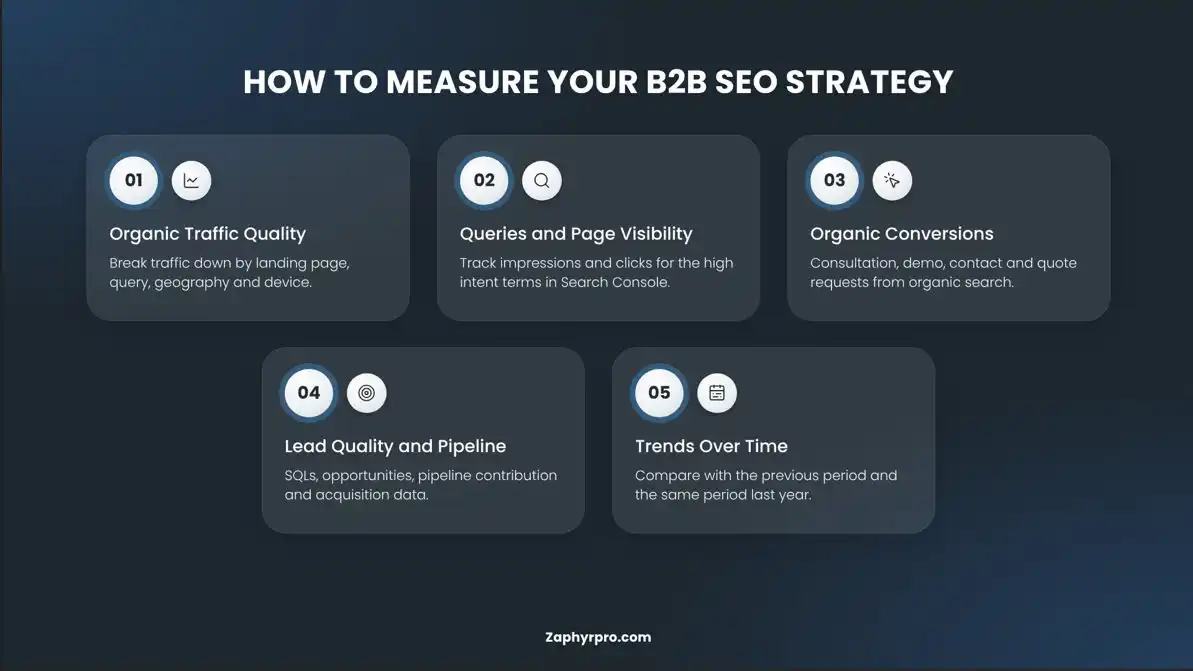
Ranking higher is useful, but rankings alone cannot tell you if your B2B SEO strategy is producing business value. A page can reach the first page of Google and still attract visitors who have no reason to become customers. That means your measurement framework needs to connect your B2B blog strategy, organic search performance, and the outcomes that matter to the business.
Look Beyond Organic Traffic
Organic traffic is a useful starting point because it shows whether your visibility is growing. But an increase in sessions does not automatically mean your SEO strategy is improving.
Break that traffic down by landing page, query, geography, device, and other relevant audience characteristics. You may discover that one page is attracting substantial traffic while another receives far fewer visits but generates considerably more qualified inquiries.
A B2B SEO program should be evaluated on the quality and relevance of the traffic it generates, not simply how much traffic appears in analytics.
Track the Queries and Pages Driving Visibility
Search Console data can help you understand which queries are generating impressions and clicks, which pages are appearing for those searches, and how your visibility changes over time.
Look for movement in the terms that matter to your business. If your B2B SEO strategy is designed around high-intent searches, improvements for those queries are more meaningful than gaining visibility for unrelated informational terms.
You should also watch how individual pages perform. A service page gaining impressions for relevant commercial searches may be showing progress even before it generates a significant number of leads.
Measure Conversions From Organic Search
This is where SEO starts connecting with revenue. Track the actions that indicate genuine business interest, such as consultation requests, demo submissions, contact forms, quote requests, calls, or other conversion events relevant to your sales process.
Do not stop at counting conversions. Where your CRM and analytics setup allows it, connect those leads to later stages of the pipeline. A form submission from organic search tells you someone took an action. Knowing that the lead later became a qualified opportunity gives you a much clearer picture of the value that B2B SEO strategy is creating.
Evaluate Lead Quality, Not Just Lead Volume
B2B companies often have a longer sales cycle, so a successful SEO strategy may not produce a dramatic increase in leads immediately. You might see a different pattern: fewer irrelevant inquiries, more qualified prospects, stronger engagement with service pages, and a growing number of opportunities originating from organic search.
For that reason, review SEO performance alongside your sales-qualified leads, opportunity creation, pipeline contribution, and customer acquisition data where attribution is reliable.
If organic search is generating visitors who fit your ICP and repeatedly producing meaningful sales opportunities, that tells you much more than a traffic chart can.
Give SEO Enough Time to Show Its Effect
SEO results rarely move in a perfectly predictable line. Rankings can fluctuate, new pages need time to establish visibility, and competitive search results can change.
Look at trends over meaningful periods rather than judging the strategy based on a few days or a single ranking change. Compare performance against your previous period and, where possible, the same period in the previous year.
Most importantly, measure the metrics according to the purpose of the strategy. If you built your B2B SEO strategy to reach high-value buyers, your reporting should make it easy to see whether those buyers are finding you and taking commercially meaningful actions.
Build Your B2B SEO Strategy Around Buyer Intent
If you’ve read this far, you probably already see the problem with treating B2B SEO strategy as a race to collect keywords and rankings. The real opportunity is much more specific: getting your business in front of the right buyer at the moment their search reflects a genuine business need.
That means your B2B SEO strategy should start with the people you want to reach and work backward to the searches they make. From there, you can identify the intent behind those searches, decide which opportunities deserve your attention, and create pages that actually match what the searcher needs.
You also need to keep an eye on what happens after the click. Rankings and traffic can tell you that your visibility is changing, but qualified leads and opportunities tell you whether that visibility is helping the business.
You do not need to rank for every keyword in your industry. You need to build visibility around the searches that can put your business in front of the right prospects, with the right need, at the right point in their buying journey.
If you want help turning that approach into a practical B2B SEO strategy, we can help you identify the right search opportunities, build content around genuine buyer intent, and connect organic visibility with your broader growth goals. Schedule a consultation with us today.
Ready to build a buyer-intent SEO strategy?
See how Zaphyre can help you find the right search opportunities and turn organic visibility into qualified pipeline.
Frequently Asked Questions
The fundamental SEO principles are similar, but the buying journey is often different. B2B purchases can involve multiple decision-makers, longer evaluation periods, higher contract values, and more detailed research. As a result, B2B SEO often needs to address the questions and concerns that arise across a more complex buying process.
There is no fixed number that works for every B2B website. The appropriate keyword set depends on the company’s products or services, target customers, industries served, geographic markets, and available content opportunities. A smaller group of closely relevant keywords can be more useful than thousands of terms with little connection to the business.
Not necessarily. Separate pages make sense when the services represent genuinely different offerings or serve substantially different search needs. Creating individual pages for minor keyword variations can result in overlapping content and make the site’s structure harder to manage.
Keyword research should be revisited as your market, offerings, competitors, and customer behavior change. It can also be useful to review search performance regularly to identify new queries that your existing pages are beginning to rank for. An update does not always mean starting the entire research process again.
Yes. Search volume does not show the full commercial value of a query. A highly specific keyword may have relatively few searches but attract people with a strong connection to your target market and a specific business need. This is particularly relevant in B2B markets with specialized products or narrow audiences.
Long-tail keywords can be valuable because they often contain more context about the searcher’s problem, industry, use case, or requirements. However, length alone does not determine intent. A shorter, specific commercial query can be more valuable than a longer search with little connection to a purchasing decision.
There is no universal timeline. Results depend on factors such as the site’s existing authority, technical condition, competition, content quality, search demand, and the amount of work being implemented. SEO should therefore be evaluated through performance trends and meaningful business outcomes rather than a fixed deadline.
A small search market does not automatically mean there is little business opportunity. Start by examining related searches, customer language, industry-specific problems, product or service variations, and the questions prospects ask during sales conversations. In specialized B2B markets, the objective may be to capture a smaller pool of highly relevant searches rather than pursue broad traffic.