A B2B lead magnet can generate hundreds of downloads and still produce no meaningful sales conversations. The problem is often not the design, traffic, or landing page. It is that the asset attracts general curiosity without helping a serious buyer complete a meaningful task.
The best B2B lead magnets help prospects assess their situation, quantify a problem, compare options, prepare for implementation, or experience part of the solution before speaking with sales.
In this guide, you’ll learn what makes a B2B lead magnet effective, which formats are generating the best results in 2026, when to gate your content, how to measure performance, and the practical steps to create lead magnets that generate qualified pipelines.
Key Takeaways
- The best B2B lead magnets solve a specific buyer problem rather than offering generic information that is already easy to find online.
- High-intent formats such as ROI calculators, assessments, RFP kits, audits, and product sandboxes reveal more about a prospect’s needs and buying stage.
- Templates, checklists, research reports, and executive guides remain valuable when they provide practical utility, original insight, or a ready-to-use work product.
- The right lead magnet should match the buyer’s journey. Early-stage prospects need education, while evaluation-stage buyers benefit more from comparison and decision-support tools.
- Not every valuable asset should be gated. Case studies, product information, FAQs, and basic educational content often work better when buyers can access them freely.
- Registration volume alone does not prove success. Measure consumption, ideal-customer fit, engagement, meeting conversion, opportunity creation, and influenced pipeline.
- Every lead magnet should connect to a clear next step, supported by relevant follow-up content, lead scoring, and an appropriate sales or nurture path.
What Is a B2B Lead Magnet?
A B2B lead magnet is a valuable resource that a business offers in exchange for a prospect’s contact information, typically an email address. The goal is to attract potential buyers who are actively researching a problem, evaluating solutions, or looking for expert guidance.
Unlike B2C lead magnets that often focus on discounts or entertainment, B2B lead magnets are designed to help professionals make informed business decisions. They provide practical insights, solve specific challenges, or simplify complex topics. When done well, they establish credibility and start a relationship with prospects before a sales conversation ever begins.
Common goals of best B2B lead magnets include:
- Growing a qualified email list
- Generating marketing qualified leads (MQLs)
- Educating prospects during the buying journey
- Building trust and industry authority
- Supporting sales conversations with valuable resources
When your lead magnet aligns with your ideal customer’s needs and your solution, it becomes the first step toward building a long term business relationship.
Lead Magnet Conversion Statistics (2026)
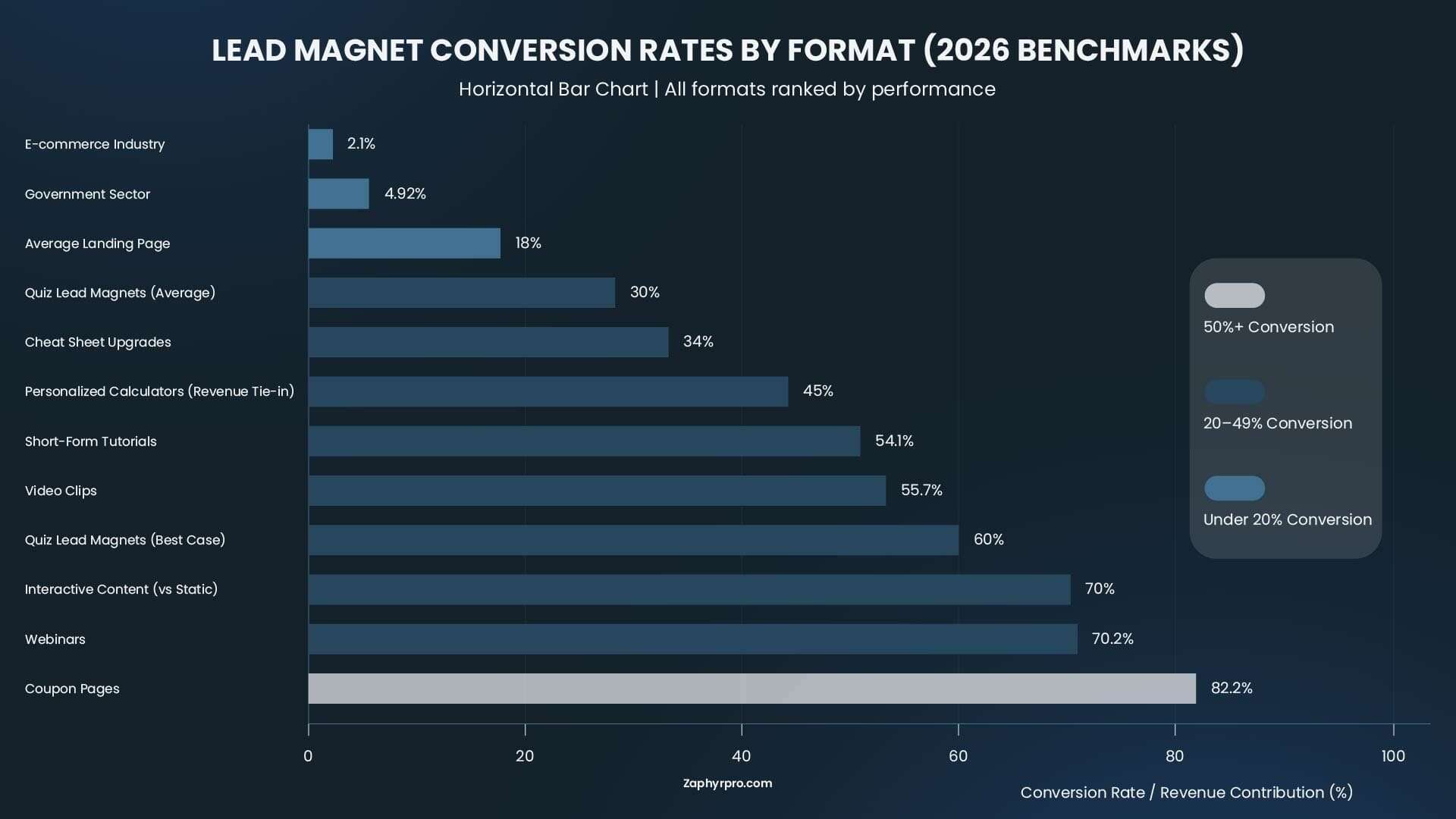
The best B2B lead magnets performance depends on far more than the asset itself. Buyer intent, traffic source, landing page experience, and the format you choose all influence conversion rates. While benchmarks vary by industry, recent B2B data highlights a clear trend: interactive and decision support resources consistently outperform static content because they provide immediate, personalized value
| Statistic | What It Means |
|---|---|
|
6.6% median B2B landing page conversion rate |
A good benchmark for gated B2B content across industries. |
|
Interactive calculators: 8.3% average conversion rate |
Personalized tools often convert better than traditional downloadable content. |
|
Interactive assessments: 6.2% average conversion rate |
Buyers are more willing to exchange contact details for personalized insights. |
|
Traditional gated PDFs: 3.8% average conversion rate |
Static ebooks and white papers are becoming less effective as buyer expectations increase. |
|
57% of B2B marketers say case studies are their top performing content format |
Practical, evidence based content continues to influence buying decisions. |
|
51% of B2B buyers are willing to register for webinars |
Live and on demand educational events remain one of the strongest gated content formats. |
|
Buyers typically consume 5 to 7 pieces of content before contacting sales |
A lead magnet is rarely the final conversion point. It should begin a nurturing journey, not replace it. |
These benchmarks reinforce an important takeaway: buyers no longer exchange their information simply to access content. They expect a resource that helps them make a decision, quantify a problem, or complete a meaningful task. Interactive calculators, maturity assessments, implementation playbooks, and vendor comparison guides consistently outperform generic ebooks because they provide immediate business value instead of information that’s readily available elsewhere.
What Makes a Good Lead Magnet?
The best B2B lead magnets don’t attract the most downloads. They attract the right buyers. A high performing lead magnet solves a real problem, delivers value quickly, and leaves prospects feeling that sharing their contact information was worth it. Here are the qualities that separate effective lead magnets from forgettable ones:
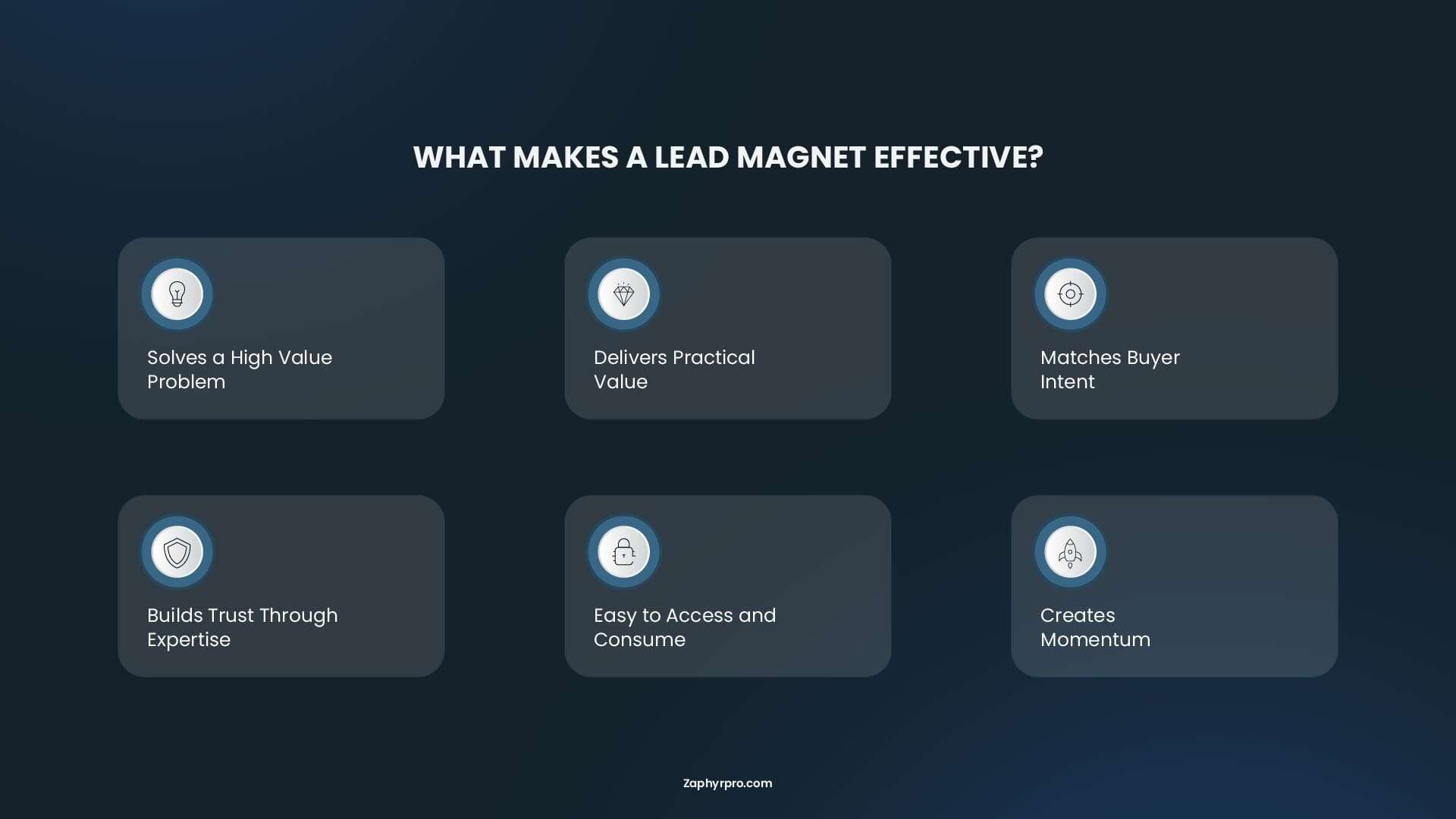
- Solves a High Value Problem: Address one specific challenge your audience actively wants to solve. The more relevant and impactful the problem, the more likely buyers are to exchange their contact information for a solution.
- Delivers Practical Value: Offer something buyers can use immediately, such as a checklist, calculator, template, or implementation guide. If the resource helps them complete a task or make a decision faster, it’s far more valuable than general information.
- Matches Buyer Intent: Align the format with the buyer’s stage. Educational guides work well for early research, while ROI calculators, implementation playbooks, and vendor comparison kits support buyers evaluating solutions.
- Builds Trust Through Expertise: Educate before you promote. Original research, practical frameworks, and actionable recommendations demonstrate expertise without turning the resource into a sales pitch.
- Easy to Access and Consume: Deliver the resource immediately after form submission and present it in a format that’s quick to understand. Busy professionals appreciate content that gets straight to the point without unnecessary filler.
- Creates Momentum: The best B2B lead magnet should naturally encourage the next step, whether that’s downloading a related resource, requesting an assessment, or speaking with your team. It should also be valuable enough that buyers save it, revisit it, or share it with colleagues.
What Do B2B Buyers Want From Lead Magnets in 2026?
B2B buyers have become far more selective about the content they download. With unlimited information available online and AI tools capable of answering basic questions in seconds, generic ebooks and lengthy whitepapers no longer provide enough value to earn a prospect’s contact information.
Gartner found that 69% of buyers preferred to validate AI-generated insights with a sales representative. Buyers want digital tools that help them investigate and organize a decision, followed by human guidance when context, validation, or confidence becomes important.
The best B2B lead magnet should therefore provide:
Actionable Information
Buyers want resources they can put into practice immediately. Checklists, templates, playbooks, and step by step guides often outperform B2B content strategy that only explains concepts because they help prospects take meaningful action.
Data and Real World Insights
Decision makers look for evidence, not opinions. Lead magnets that include original research, industry benchmarks, case studies, or real customer results are more likely to build credibility and influence purchasing decisions.
Personalized Value
One size fits all content is becoming less effective. Buyers appreciate calculators, assessments, quizzes, and interactive tools that generate recommendations based on their specific business needs or challenges.
Time Saving Resources
Busy professionals prefer content that respects their time. A two page checklist or five minute assessment that solves an immediate problem often delivers more value than a fifty page ebook filled with general advice.
Trust Before Sales
Modern buyers want education before they want a sales pitch. The best lead magnets focus on helping first and selling later. When the content delivers genuine value without excessive promotion, prospects are more likely to trust your brand and continue engaging.
As buying journeys become longer and involve more stakeholders, the quality of your lead magnet matters more than the quantity you produce. A single high value resource that addresses a specific pain point can generate more qualified leads than several generic downloads. The best B2B lead magnets in 2026 are practical, relevant, and designed to help buyers make smarter business decisions.
Use our planning worksheet to define your audience, choose the right format, and create an offer that attracts qualified leads.
Top 10 Best B2B Lead Magnets for 2026
The best B2B lead magnets don’t try to appeal to everyone. They solve a specific problem for a specific audience at a specific stage of the buying journey. Whether your goal is to generate awareness, qualify leads, or accelerate sales conversations, the right lead magnet can make a significant difference.
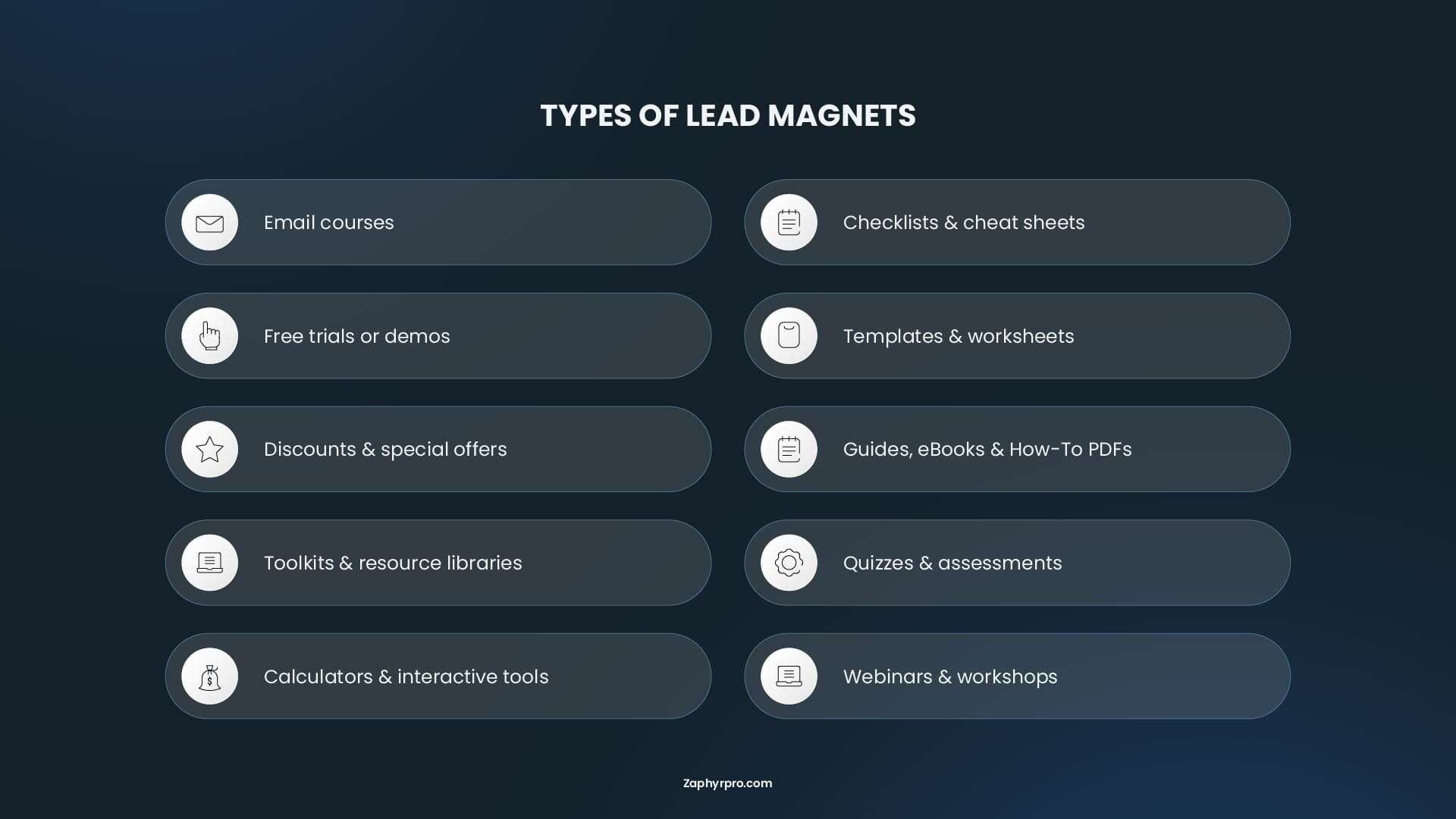
Here are ten lead magnets that continue to deliver strong results in 2026:
| Lead magnet | Best use | Intent strength |
|---|---|---|
|
ROI calculator |
Quantifying financial impact |
High |
|
Maturity assessment |
Identifying gaps and priorities |
High |
|
Implementation playbook |
Planning execution |
Medium-high |
|
Template or worksheet |
Completing a practical task |
Medium |
|
Benchmark report |
Comparing performance |
Medium-high |
|
Executive guide |
Understanding a complex issue |
Medium |
|
Vendor-comparison or RFP kit |
Evaluating solutions |
Very high |
|
Checklist or roadmap |
Organizing next actions |
Medium |
|
Webinar or workshop |
Learning directly from an expert |
Medium-high |
|
Tool, trial, or audit |
Experiencing potential value |
Very high |
1. ROI Calculator
An ROI calculator helps prospects estimate the financial impact of adopting your solution. Instead of making broad claims about cost savings or efficiency, it allows buyers to enter their own business data and receive personalized estimates.
This type of lead magnet works especially well for software, cybersecurity, managed services, consulting, and enterprise technology because decision makers often need to justify investments before requesting budget approval.
An effective ROI calculator should be simple to use, transparent about its assumptions, and provide a downloadable summary that buyers can share with internal stakeholders.
Best for: SaaS, IT services, finance, HR, and operational software.
2. Maturity Assessment
A maturity assessment helps businesses evaluate their current capabilities in a specific area, such as cybersecurity, marketing, sales operations, customer service, or digital transformation.
After answering a series of questions, participants receive a score, insights into their strengths and weaknesses, and recommendations for improvement. This creates immediate value while helping your sales team understand where each prospect stands.
Because the results are personalized, maturity assessments often produce highly qualified leads who are already aware of their challenges.
Best for: Consulting firms, cybersecurity providers, marketing agencies, compliance companies, and business advisory services.
3. Implementation Playbook
Many buyers hesitate because they worry implementation will be complicated or disruptive. An implementation playbook removes that uncertainty by showing exactly what deployment looks like.
A well designed playbook explains timelines, project phases, stakeholder responsibilities, common challenges, and best practices. It helps buyers visualize success before they purchase.
Rather than focusing on product features, an implementation playbook answers an important question every buyer has: “How difficult will this be to roll out?” The easier you make implementation appear, the lower the perceived buying risk becomes.
For example, a company evaluating CRM migration may value a playbook covering data cleanup, integrations, user permissions, testing, and adoption. The resource makes the work more manageable while demonstrating that the provider understands implementation beyond the sale.
Best for: Enterprise software, ERP, CRM, cybersecurity, cloud migration, and professional services.
4. Template or Worksheet
Templates save time, making them one of the highest performing lead magnets across nearly every industry.
Instead of explaining how to complete a task, they provide a ready to use framework that buyers can customize immediately. Examples include budgeting templates, project planning worksheets, sales outreach templates, risk assessment forms, and policy documents.
The best templates eliminate repetitive work and help users produce better results faster. Since they provide immediate value, templates often generate repeat engagement and encourage prospects to return for additional resources.
Best for: Marketing, HR, finance, consulting, operations, and sales teams.
5. Benchmark Report
Business leaders want to know how their organization compares with competitors and industry peers. A benchmark report provides valuable data on performance metrics, trends, challenges, and best practices collected from real businesses. Original research is especially powerful because it offers information buyers cannot easily find elsewhere.
For example, a cybersecurity company might publish average ransomware recovery times, while an HR platform could share hiring benchmarks across different industries.
Content Marketing Institute found that 45% of surveyed B2B marketers rated research reports among the content types producing the best results. The same percentage identified ebooks and white papers as effective, showing that substantial downloadable content can still perform when it contains useful depth.
Best for: Technology companies, research firms, consulting businesses, and industry organizations.
6. Executive Guide
Senior decision makers rarely have time to read lengthy technical documents. Executive guides summarize important topics into concise, strategic resources focused on business outcomes.
NetLine’s 2026 content-consumption report found that ebooks still represented 48.8% of registrations across its dataset of 7.2 million first-party registrations. The format remains widely used, but popularity alone does not guarantee lead quality or commercial relevance.
An executive guide should help leaders understand why an issue matters, what actions to prioritize, and how to make informed decisions. Because executives influence major purchasing decisions, these guides can be highly effective for account based marketing funnel campaigns.
Best for: C suite executives, directors, department heads, and business owners.
7. Vendor Comparison or RFP Kit
Many buyers reach the evaluation stage without knowing how to compare vendors effectively. A vendor comparison guide or Request for Proposal (RFP) kit simplifies this process by providing evaluation criteria, scoring matrices, feature comparison worksheets, and sample RFP questions.
Rather than trying to persuade buyers with marketing claims, this type of lead magnet empowers them to make objective purchasing decisions. When designed honestly, it also positions your solution as transparent and customer focused.
Best for: Enterprise software vendors, managed service providers, manufacturing, procurement teams, and B2B technology companies.
8. Checklist or Roadmap
Checklists remain one of the simplest and best B2B lead magnets because they help buyers take immediate action. Whether it’s a cybersecurity readiness checklist, cloud migration roadmap, compliance checklist, or onboarding plan, these resources break complex projects into manageable steps.
Unlike lengthy ebooks, checklists are quick to consume and easy to reference later, making them valuable throughout the buying process. Roadmaps provide additional value by outlining milestones, timelines, and priorities, helping prospects understand what success looks like over time.
Best for: Compliance, cybersecurity, IT, operations, healthcare, finance, and project management.
9. Webinar or Workshop
Live webinars and interactive workshops allow businesses to educate prospects while building credibility through direct engagement. Unlike static content, webinars give buyers the opportunity to ask questions, see demonstrations, and learn from industry experts.
Content Marketing Institute found that 51% of surveyed B2B marketers rated webinars among their most effective distribution channels.
Recordings can continue generating leads long after the live event has ended, making webinars valuable long term marketing assets.The most successful webinars focus on solving a business challenge rather than delivering a product presentation.
Best for: Complex B2B solutions, consulting, SaaS, professional services, and technical industries.
10. Tool, Free Trial, or Audit
Sometimes the best way to convince buyers is to let them experience the value themselves. Interactive tools, limited free trials, and personalized audits provide direct evidence of your expertise and solution capabilities.
Examples include website performance audits, cybersecurity risk assessments, SEO analysis tools, cloud cost calculators, CRM health checks, or product trials with guided onboarding.
Because these lead magnets require active participation, they often generate highly qualified prospects who are already evaluating solutions.
To maximize conversions, provide actionable recommendations after the trial or audit rather than simply presenting scores or reports.
Best for: SaaS platforms, managed service providers, agencies, cybersecurity firms, and technology vendors.
What Content Should and Shouldn't Be Gated?
Gating the wrong content can reduce traffic, hurt SEO performance, and discourage potential buyers from engaging with your brand. The key is to reserve gated content for resources that offer enough value to justify exchanging contact information.
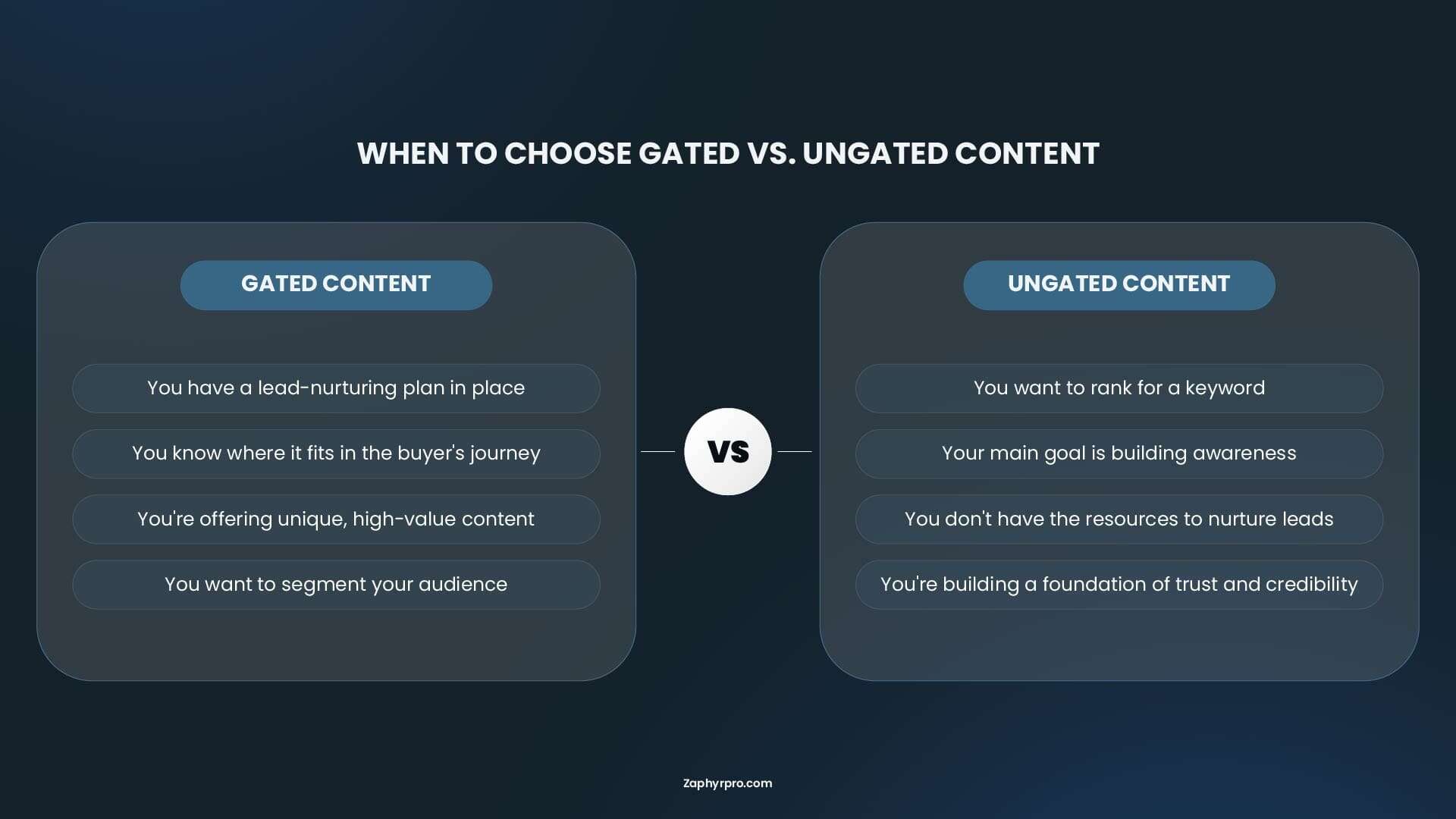
Content That Should Be Gated
These assets typically provide in depth insights, personalized value, or practical tools that buyers cannot easily find elsewhere.
- Original research and benchmark reports that include proprietary data or industry trends.
- ROI calculators and assessment tools that generate personalized results.
- Implementation playbooks with detailed processes, timelines, and best practices.
- Templates, worksheets, and policy documents that save buyers time and effort.
- Vendor comparison guides and RFP kits that help decision makers evaluate solutions.
- Executive guides covering strategic planning, budgeting, or technology adoption.
- On demand webinars and workshops that deliver expert insights or product education.
- Free audits that provide recommendations based on a buyer’s current situation.
These resources require significant expertise or effort to create, making them valuable enough for prospects to exchange their contact information.
Content That Shouldn't Be Gated
Some content is better left freely accessible because its primary purpose is to educate, attract organic traffic, and build trust.
- Blog posts targeting informational search queries.
- Beginner guides that introduce a topic or explain basic concepts.
- Product feature pages and service pages.
- Case studies used to support buying decisions.
- FAQs, knowledge base articles, and documentation.
- Industry news, trend analysis, and opinion pieces.
- Short checklists or infographics that provide limited value on their own.
Making these resources freely available improves your search visibility, allows prospects to evaluate your expertise, and removes friction during the early stages of the buying journey.
Use Progressive Gating Instead of Gating Everything
Rather than placing every valuable resource behind a form, consider a progressive approach. Offer educational content publicly to attract and educate visitors, then gate high value assets that help buyers evaluate solutions or make purchasing decisions.
For example, a blog explaining ERP implementation challenges can remain ungated, while a detailed ERP implementation playbook or ROI calculator requires a simple form to access. This approach balances SEO, user experience, and lead generation while ensuring buyers receive value before they’re asked for their information.
Rule of thumb: If someone can find the same information with a quick online search, don’t gate it. If the content delivers original insights, personalized recommendations, or practical tools that save time or reduce risk, it’s a strong candidate for gating. |
How to Build a B2B Lead Magnet That Generates Pipeline
A best B2B lead magnet should do more than increase email subscribers. Its purpose is to attract buyers who have a genuine interest in solving a business problem and are likely to become sales opportunities. That means every decision, from the topic you choose to the follow up sequence you build, should help qualify prospects rather than simply maximize downloads.
Here’s how to build one:
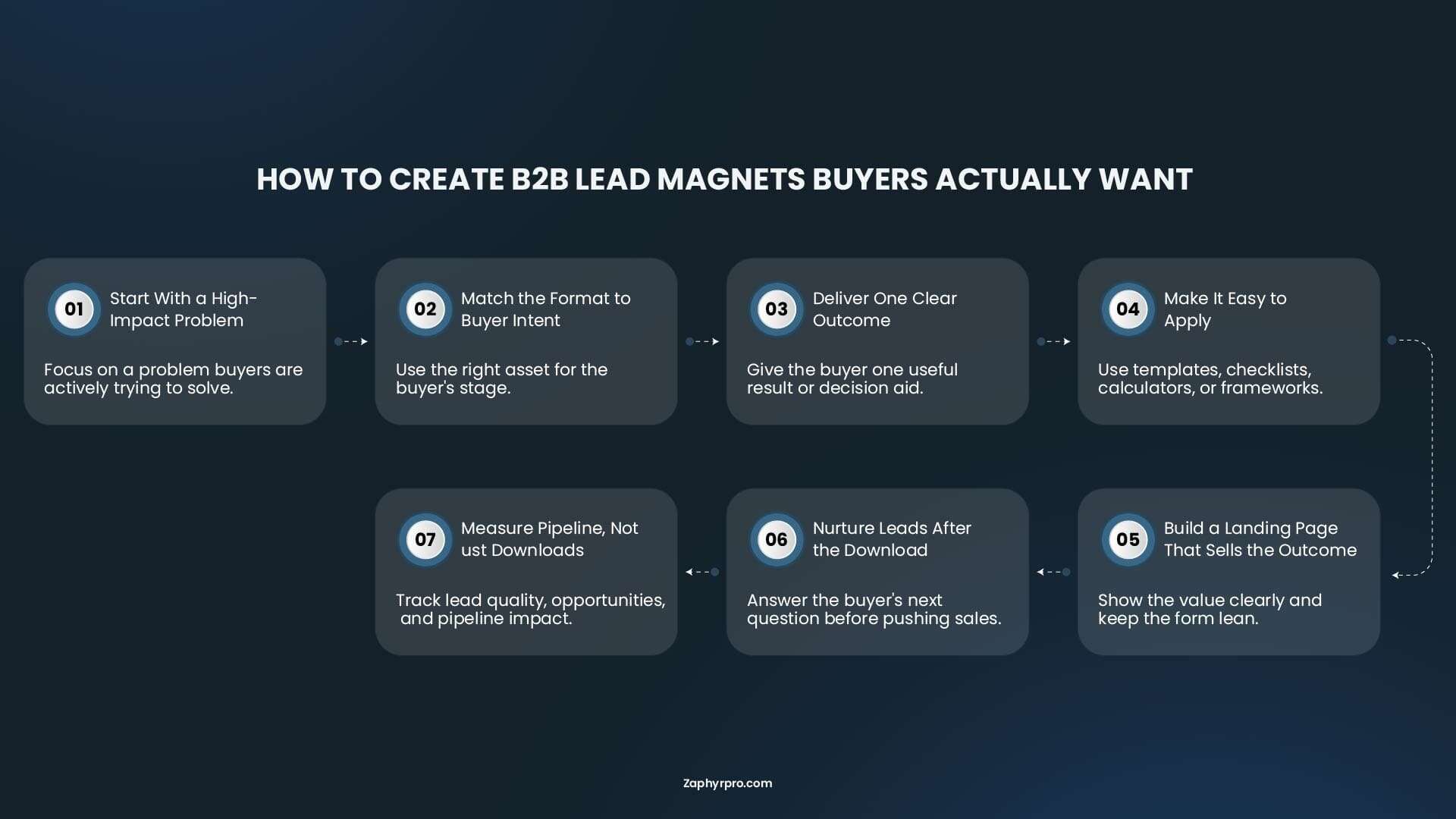
Start With a High Impact Problem
Many lead magnets fail because they’re created around topics the marketing team wants to write about instead of problems buyers are actively trying to solve. Before deciding on a format, identify the questions prospects repeatedly ask during sales calls, customer onboarding, or product demonstrations. Those conversations reveal the information buyers genuinely need before making a purchasing decision.
A useful way to validate an idea is to ask whether someone would actively search for the answer. If the resource helps reduce costs, improve efficiency, simplify compliance, or lower business risk, it addresses a problem worth solving. If it only provides general industry knowledge, it is less likely to generate qualified leads.
Match the Format to Buyer Intent
Different buyers need different resources depending on where they are in the buying journey. Someone who has just identified a problem is looking for education, while someone comparing vendors wants practical information that helps them make a decision.
For example, a benchmark report or executive guide works well during the awareness stage because it helps buyers understand the problem and its impact. During the consideration stage, resources like maturity assessments, implementation playbooks, or ROI calculators provide the information buyers need to evaluate potential solutions. Buyers nearing a purchase often benefit from vendor comparison guides, free audits, or product trials that reduce uncertainty and support internal decision making.
Matching the content to buyer intent increases both conversion rates and lead quality because the resource answers the buyer’s next question instead of overwhelming them with unnecessary information.
Deliver One Clear Outcome
Every lead magnet should have a single objective. Buyers should immediately understand what they’ll achieve after downloading it, whether that’s calculating implementation costs, evaluating their current maturity level, creating a project plan, or comparing vendors.
Trying to solve multiple problems in one resource often reduces its value. A focused lead magnet is easier to consume, easier to promote, and more likely to deliver the quick win that encourages prospects to engage further.
Before publishing your lead magnet, ask a simple question: What will the buyer be able to do after reading this that they couldn’t do before? If the answer isn’t obvious, the content needs a clearer purpose.
Make It Easy to Apply
Information alone rarely changes buying decisions. Buyers gain more value from resources they can apply immediately than from content that only explains concepts.
Whenever possible, include practical elements such as templates, calculators, worksheets, action plans, checklists, or decision frameworks. These tools help prospects put your recommendations into practice while demonstrating your expertise in a way that feels genuinely helpful.
The easier your resource is to use, the more likely buyers are to remember your brand when they’re ready to evaluate solutions.
Build a Landing Page That Sells the Outcome
Your landing page should convince visitors that the resource is worth exchanging their contact information for. Instead of describing what’s inside, focus on what the buyer will gain. A strong landing page clearly explains:
- The business problem the resource solves.
- Who the resource is designed for.
- The outcome buyers can expect.
- Why your resource is more valuable than information available elsewhere.
Keep the form as short as possible. Collect only the information needed for qualification, as longer forms often reduce conversions without improving lead quality.
Nurture Leads After the Download
The download is the beginning of the relationship, not the end of the campaign. Following up with relevant content keeps prospects engaged while helping them move toward a buying decision.
For example, someone who downloads a cybersecurity checklist might next receive a maturity assessment, followed by a case study demonstrating how similar organizations addressed the same challenges. Each interaction should answer the buyer’s next question rather than immediately pushing for a sales meeting.
A thoughtful nurture sequence builds trust over time and helps identify prospects who are genuinely ready to engage with your sales team.
NetLine found an average gap of 47.7 hours between registration and content consumption in its 2026 report. Immediate aggressive outreach may therefore reach buyers before they have used the asset. Follow-up timing should reflect actual engagement rather than registration alone.
Measure Pipeline, Not Just Downloads
High download numbers don’t always translate into business growth. A lead magnet that generates 500 downloads but no qualified opportunities delivers far less value than one that produces 50 highly engaged prospects.
Track metrics that reflect business impact, including landing page conversion rates, marketing qualified leads, sales qualified leads, pipeline contribution, and customer conversion rates. Reviewing these metrics helps you identify which lead magnets attract buyers with genuine purchase intent, allowing you to refine your strategy and invest in the content that drives revenue.
How to Measure Lead Magnet Performance
While a high download count may indicate strong interest, it doesn’t reveal whether the resource is attracting potential customers or simply collecting email addresses. The real measure of success is how well the lead magnet contributes to your sales pipeline
The table below highlights the most important metrics for best B2B lead magnets to monitor and what each one tells you about your lead magnet’s performance:
| Metric | What It Measures | Why It Matters |
|---|---|---|
|
Landing Page Conversion Rate |
Percentage of visitors who download the lead magnet |
Indicates how compelling your offer and landing page are. |
|
Lead Quality |
How closely leads match your ideal customer profile |
Helps determine whether you’re attracting potential customers instead of unqualified contacts. |
|
Marketing Qualified Leads (MQLs) |
Leads that meet predefined marketing qualification criteria |
Measures how effectively the lead magnet identifies interested prospects. |
|
Sales Qualified Leads (SQLs) |
Leads accepted by the sales team for follow up |
Shows whether the content attracts buyers with genuine purchase intent. |
|
Pipeline Contribution |
Value of sales opportunities influenced by the lead magnet |
Connects marketing performance directly to revenue generation. |
|
Cost per Qualified Lead |
Cost to acquire one qualified lead |
Evaluates the efficiency and ROI of your lead generation efforts. |
|
Email Engagement |
Open rates, click through rates, and follow up interactions |
Indicates whether prospects remain interested after downloading the resource. |
|
Customer Conversion Rate |
Percentage of leads that become customers |
Measures the lead magnet’s long term impact on business growth. |
For example, a lead magnet with a 15% landing page conversion rate may appear successful, but if it generates very few SQLs or contributes little to your sales pipeline, it’s likely attracting the wrong audience. Conversely, a resource with fewer downloads but a high customer conversion rate often delivers far greater business value.
Content Marketing Institute found that 74% of surveyed B2B marketers said content helped generate demand or leads, but only 49% said it helped generate sales or revenue. The gap reinforces the need to connect content activity with pipeline progression rather than stopping at lead capture.
Build a Lead Magnet Buyers Will Actually Use
The best B2B lead magnets don’t aim for the most downloads. They attract the right buyers by solving a specific business problem and delivering immediate value. Focus on resources that help prospects make informed decisions, save time, or reduce risk rather than collecting email addresses for the sake of it.
As buyer expectations evolve, relevance matters more than volume. A practical calculator, implementation guide, or assessment often outperforms a lengthy ebook because it answers a question buyers need answered right now.
If you’re looking to build lead magnets that generate qualified pipelines, Zaphyre can help you create content that aligns with buyer intent and supports every stage of the B2B buying journey.
Frequently Asked Questions
The best format depends on the buyer’s stage and the information the business needs. Assessments, ROI calculators, RFP kits, and personalized audits often reveal stronger purchase intent. Templates, reports, checklists, and guides may be better for building an early-stage audience and nurturing trust.
Yes, when they provide focused expertise, proprietary research, a useful framework, or detailed implementation guidance. NetLine reported that ebooks represented 48.8% of registrations in its 2026 dataset. Generic ebooks that simply repeat freely available information are less likely to earn attention or meaningful engagement.
ROI calculators, maturity assessments, vendor-comparison kits, personalized audits, product sandboxes, and trials generally indicate stronger intent because the buyer applies the resource to a real business problem. The asset’s topic and inputs are still important; not every person completing an interactive tool is ready to purchase.
Most individual case studies should remain ungated. They provide important proof when buyers are comparing vendors and should be easy to access and share. A proprietary benchmark report, customer research study, or extensive industry proof library may justify gating when it delivers substantially more value.
There is no universal number. The form should request only the information needed to deliver the asset, personalize the result, qualify the buyer, or guide follow-up. A simple checklist requires less information than a customized ROI assessment. Higher-value resources can justify more detailed questions.
It should be long enough to deliver the promised result and no longer. A useful checklist may be two pages, while an original research report may require twenty or more. Buyers value relevance and usability more than page count.
The buyer should receive the asset immediately, followed by content related to the same problem. Marketing should track actual consumption before adjusting the lead score or triggering outreach. High-intent behavior may justify a tailored sales response, while early-stage downloads should usually enter a relevant nurture sequence.
Review it whenever its data, regulations, technology, pricing assumptions, or recommendations could have changed. Research reports may require annual updates, while compliance guides and technical checklists may need more frequent review. Every lead magnet should have a named owner and scheduled review date.