Hiring a lead generation company can sound like an easy way to fill your sales pipeline. You pay an agency to find prospects, start conversations, and generate opportunities while your sales team focuses on closing deals. But does the investment actually translate into revenue?
The answer depends on more than the number of leads an agency sends your way. A company can generate hundreds of contacts and still deliver little value if those prospects do not fit your ICP, engage with your virtual sales team, or have a genuine reason to buy. On the other hand, a smaller volume of well qualified opportunities can create a much stronger return.
So, are lead generation companies worth it? That depends on what you expect from the partnership, how much you spend, the quality of leads you receive, and what happens after those leads enter your pipeline. In this guide, we’ll break down how to evaluate the real value before you invest.
Key Lead Generation Statistics & Facts for 2026
- Average cost per B2B lead: $213 in 2026, but top performers pay only $84 while others pay up to $397 for the same result.
- Only 1 in 106 leads becomes a customer (0.94% close rate), so counting “leads” can be misleading if you care about revenue.
- Just 9.8% of marketing leads turn into sales conversations (MQL→SQL), down from 13% in 2024, making lead quality more important than lead volume.
- Reply within 5 minutes and you’re up to 21x more likely to qualify a lead, yet more than half of leads wait over 24 hours before anyone contacts them.
- It takes 6–8 follow-ups to create a real sales opportunity, but 44% of sales reps stop after just one attempt.
- 70% of CRM data is outdated or wrong, and contact info decays by 22–30% every year, which silently raises your true cost per lead.
- AI is changing the game: 61% of B2B teams now use AI to score leads, and new AI‑assisted programs have cut cost per sales meeting to about $94.
- Inbound leads close nearly 9x better than outbound (14.6% vs. 1.7%), which is why a cheap outbound lead can still be expensive if it never converts.
What Is Your Goal in Hiring a Lead Generation Company?
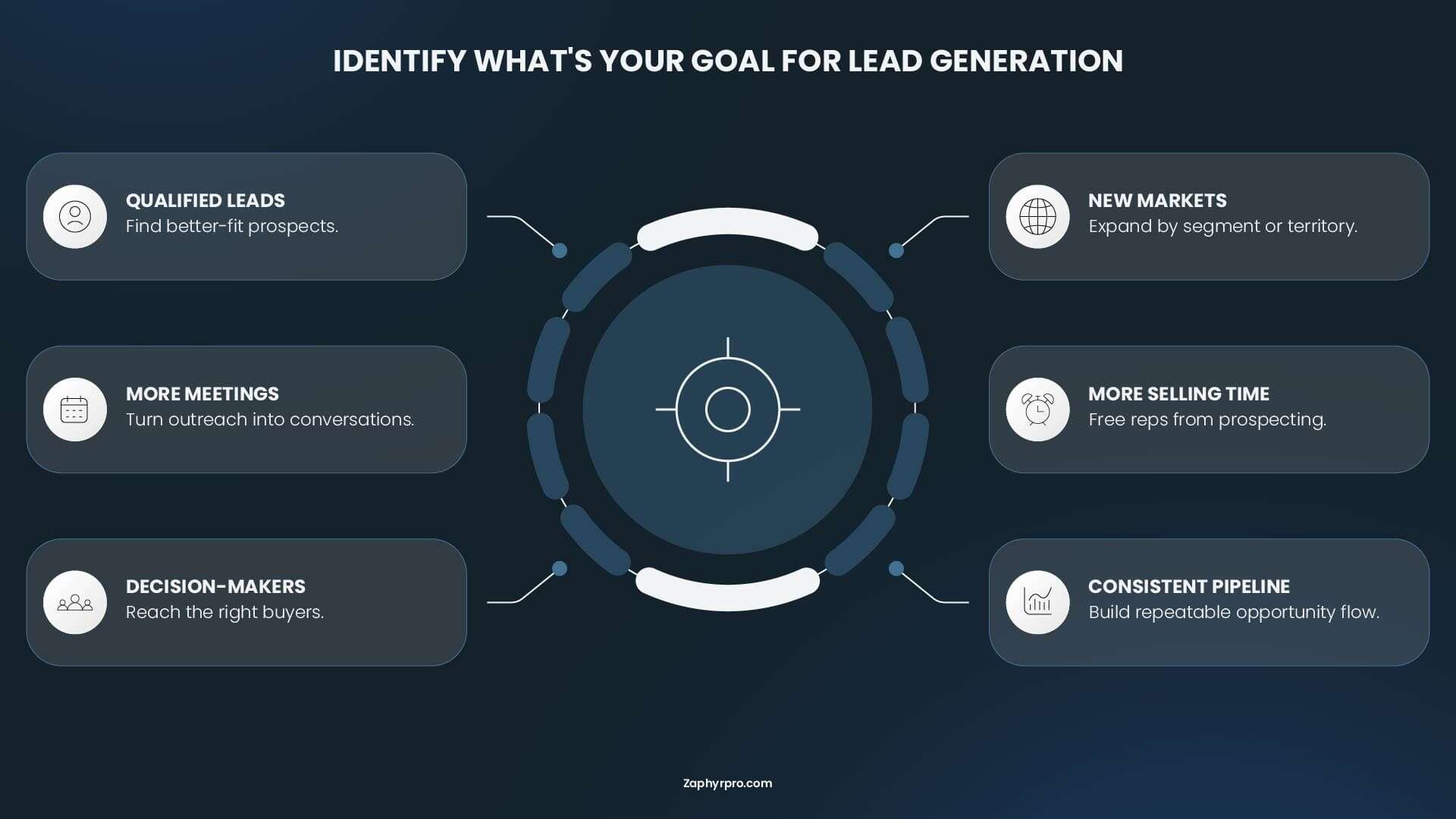
Before you hire a lead generation specialist, start with a simple question: What do you actually need it to do for your business?
“More leads” sounds like a clear goal, but it can mean very different things depending on where your sales process is struggling.
Maybe your sales team has a solid offer but not enough qualified prospects to talk to. Maybe your reps spend too much time prospecting instead of selling. You may want to reach decision makers in a specific industry, enter a new market, or build a more consistent flow of sales opportunities.
Your goal might be one or more of these:
- Generate qualified leads: Find prospects that match your ideal customer profile and have a potential need for your offering.
- Book more sales meetings: Turn outbound prospecting into conversations your sales team can actually act on.
- Reach the right decision makers: Get your sales team in front of people who can influence or make the buying decision.
- Expand into new markets: Build a prospect base in a new industry, territory, or customer segment.
- Give your sales team more selling time: Take prospecting and outreach work off your reps’ plates so they can spend more time on active opportunities.
- Build a consistent pipeline: Create a repeatable prospecting process instead of relying entirely on referrals, inbound leads, or occasional outreach.
The clearer your goal, the easier it becomes to judge whether a lead generation company is actually delivering value.
If your goal is qualified sales opportunities, for example, measuring success by the number of contacts delivered won’t tell you much. You need to look at how many of those contacts fit your ICP, engage with your outreach, become qualified opportunities, and eventually contribute to revenue.
What Does a Lead Generation Company Actually Do?
A lead generation company helps businesses find potential customers and turn them into sales opportunities.
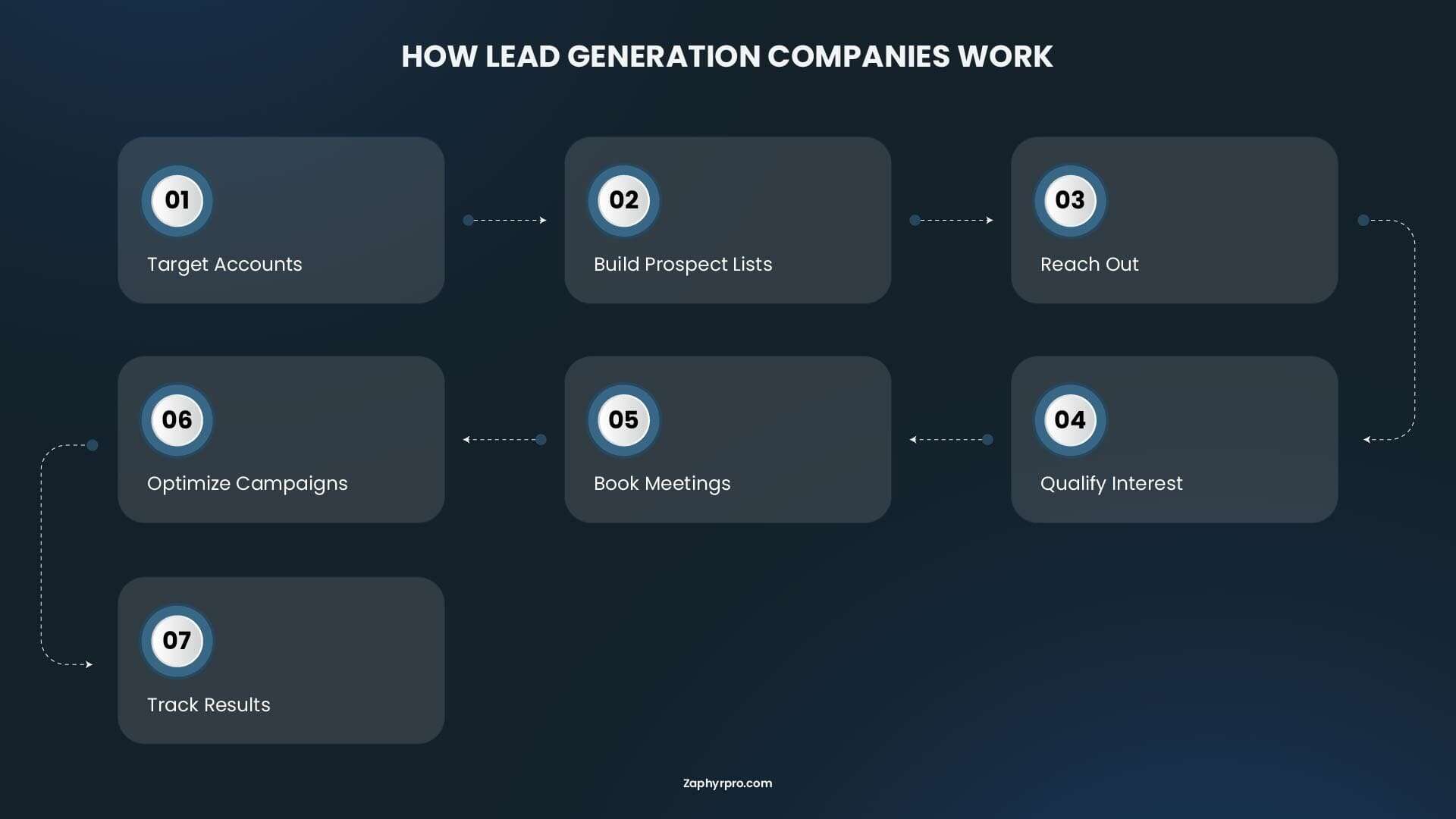
Depending on the service, that can include identifying companies that fit your ideal customer profile, finding the right decision makers, building prospect lists, reaching out through email or phone, qualifying interested prospects, and booking meetings for your sales team.
Here’s what that can involve:
- Prospect research: Finding companies and decision makers that match your target market.
- List building: Collecting and organizing relevant prospect information for outreach.
- Cold outreach: Contacting prospects through channels such as email, phone, or LinkedIn.
- Lead qualification: Determining whether prospects fit your criteria and have a potential business need.
- Appointment setting: Scheduling qualified prospects with your sales team when they are ready for a conversation.
- Campaign management: Testing messaging, monitoring responses, and adjusting outreach based on what generates engagement.
- Reporting: Tracking activity, responses, qualified leads, meetings, and other agreed performance metrics.
The goal is to create more opportunities for your sales team to have conversations with prospects who could actually become customers. That is also why the scope of a lead generation service matters when you’re evaluating its value.
For example, Zaphyre works as an execution service partner, covering areas such as prospecting, market research, LinkedIn outreach, email marketing, and appointment setting. In other words, the support can extend beyond finding contact information to the actual outreach and sales development work that happens afterward.
Lead Generation Models Compared
Before comparing prices, it helps to understand what type of service you’re actually paying for:
| Model | What the Provider Handles | What to Measure |
|---|---|---|
|
Data provider |
Prospect and contact data |
Data accuracy and ICP match |
|
Pay per lead |
Individual leads based on agreed criteria |
Lead quality and customer acquisition cost |
|
Appointment setting |
Sales meetings with prospects |
Qualified meetings held |
|
Outsourced SDR |
Prospecting and sales development |
Qualified opportunities and pipeline |
|
Full execution partner |
Prospecting, outreach, qualification, and broader GTM execution |
Pipeline, CAC, and revenue efficiency |
The right model depends on what you need your partner to handle. If you only need accurate prospect data, paying for a full sales development service may not make sense.
If you need someone to consistently prospect, engage buyers, qualify interest, and create opportunities, a data provider alone won’t solve the problem. Once you know which model fits your goal, you can make a much more meaningful comparison of price and value.
How Much Do Lead Generation Companies Cost?
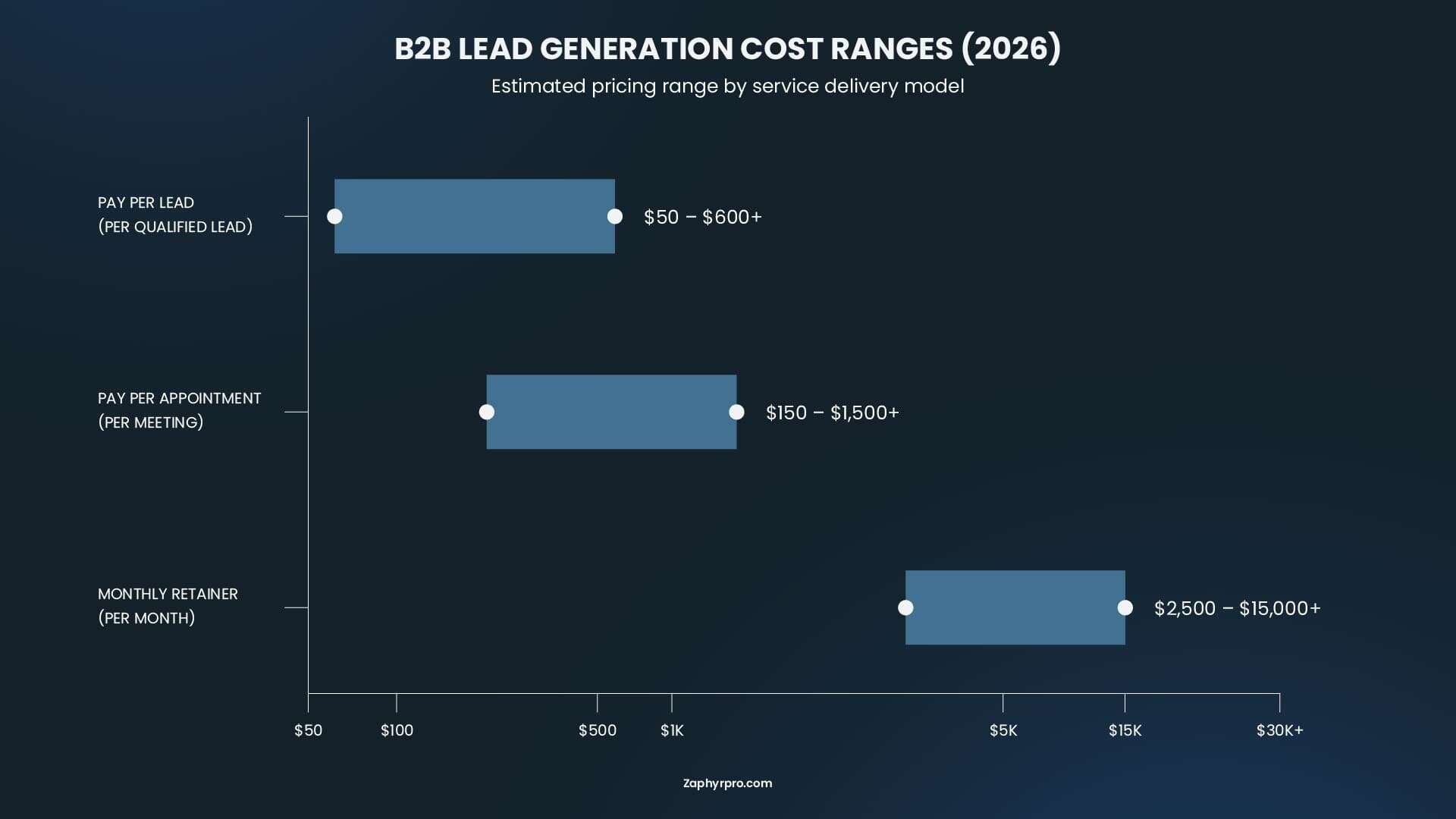
As of October 2026, B2B lead generation services typically cost anywhere from $2,500 to $15,000+ per month for managed programs. Pay per lead models can range from roughly $50 to $600+ per qualified lead, while B2B appointment setting commonly falls around $150 to $1,500+ per meeting. Enterprise programs with more complex targeting, deeper qualification, or broader GTM execution can cost considerably more.
Those numbers have a wide range because “lead generation” does not mean the same thing from one provider to another. You might be paying for contact data, qualified leads, booked meetings, an outsourced SDR function, or a broader sales execution program.
Core Agency Pricing Models
| Pricing Model | Typical 2026 Cost | Best For | What to Consider |
|---|---|---|---|
|
Monthly Retainer |
$2,500–$15,000+ / month |
Businesses that want ongoing prospecting and pipeline support |
Price depends on targeting, channels, outreach volume, team involvement, and scope |
|
Pay Per Lead |
$50–$600+ / qualified lead |
Companies that want to pay based on defined lead output |
Define exactly what qualifies as a lead before comparing prices |
|
Pay Per Appointment |
$150–$1,500+ / meeting |
Companies with a sales team ready to follow up on meetings |
The qualification standard and whether the meeting actually attends matter more than the headline price |
|
Hybrid |
Base fee + performance fee |
Companies looking to share some delivery and performance risk |
The base usually covers ongoing campaign costs, while the variable fee is tied to agreed outcomes |
A campaign targeting small businesses will not necessarily cost the same as one targeting enterprise decision makers. Industry complexity, buyer seniority, geographic targeting, sales cycle length, channel mix, and qualification requirements can all push the price up or down.
What Determines the Cost?
There’s a reason two lead generation companies can quote very different prices for what sounds like the same service. The cost depends on how difficult it is to reach your target buyers and how much of the sales development process the provider is handling.
A few factors can make a significant difference:
- Target market: Reaching a broad SMB audience is usually less involved than targeting a narrow group of enterprise decision makers.
- Campaign complexity: A campaign built around one audience and one channel requires less work than one targeting multiple buyer personas across several channels.
- Qualification requirements: There’s a big difference between delivering a contact that matches your ICP and delivering a prospect that has been researched, engaged, qualified, and booked for a meeting.
- Outreach volume: More accounts, contacts, calls, emails, and follow ups require more people, time, and infrastructure to manage.
- Service scope: Prospecting alone costs less than having a partner manage prospecting, outreach, qualification, appointment setting, and other sales development activities.
- Sales cycle and industry: Complex or high value products often require more research, personalization, and follow up before a prospect is ready to speak with sales.
So when you’re comparing two proposals, don’t assume the higher price means you’re simply paying more for the same thing. Look at what each provider is actually responsible for delivering.
A $5,000 monthly engagement and a $10,000 monthly engagement may have very different scopes, targets, and expected outcomes.
That brings us to a more useful way to compare lead generation costs: what you’re paying to create an actual sales opportunity, not simply what you’re paying for a lead.
Why Cost Per Lead Can Be Misleading
A $50 lead sounds better than a $300 lead. Until you look at what happens after you buy it. If the $50 lead is just a contact that matches your industry, your sales team still has to verify the person, find out whether there is a real need, start the conversation, and determine whether the account is worth pursuing.
The $300 lead might already meet your ICP, come from the right decision maker, and have shown enough interest to warrant a sales conversation.
Imagine:
| Metric | Provider A | Provider B |
|---|---|---|
|
Leads |
100 |
40 |
|
Program cost |
$10,000 |
$10,000 |
|
Cost per lead |
$100 |
$250 |
|
Qualified opportunities |
5 |
12 |
|
Cost per opportunity |
$2,000 |
$833 |
If you evaluate only CPL, Provider A looks significantly better. Once you measure opportunity quality, Provider B becomes much more attractive. This is why you should move down the funnel:
Lead → Held Meeting → Qualified Opportunity → Pipeline → Customer
The further you can connect your lead generation spend to actual sales outcomes, the better you can judge whether the investment is working. CPL tells you what you paid for a lead. It doesn’t tell you what that lead was worth.
What Makes a Lead Generation Company Worth the Investment? (THE VALUE TEST)
So, how do you actually decide whether a lead generation company is worth the money?
Look beyond the monthly fee and work through five things: your economics, what you’re buying, the total cost, lead quality, and the revenue that comes from the program.
You can use the framework, we call “THE VALUE TEST” to work through each one.
Zaphyre’s Value Test Framework
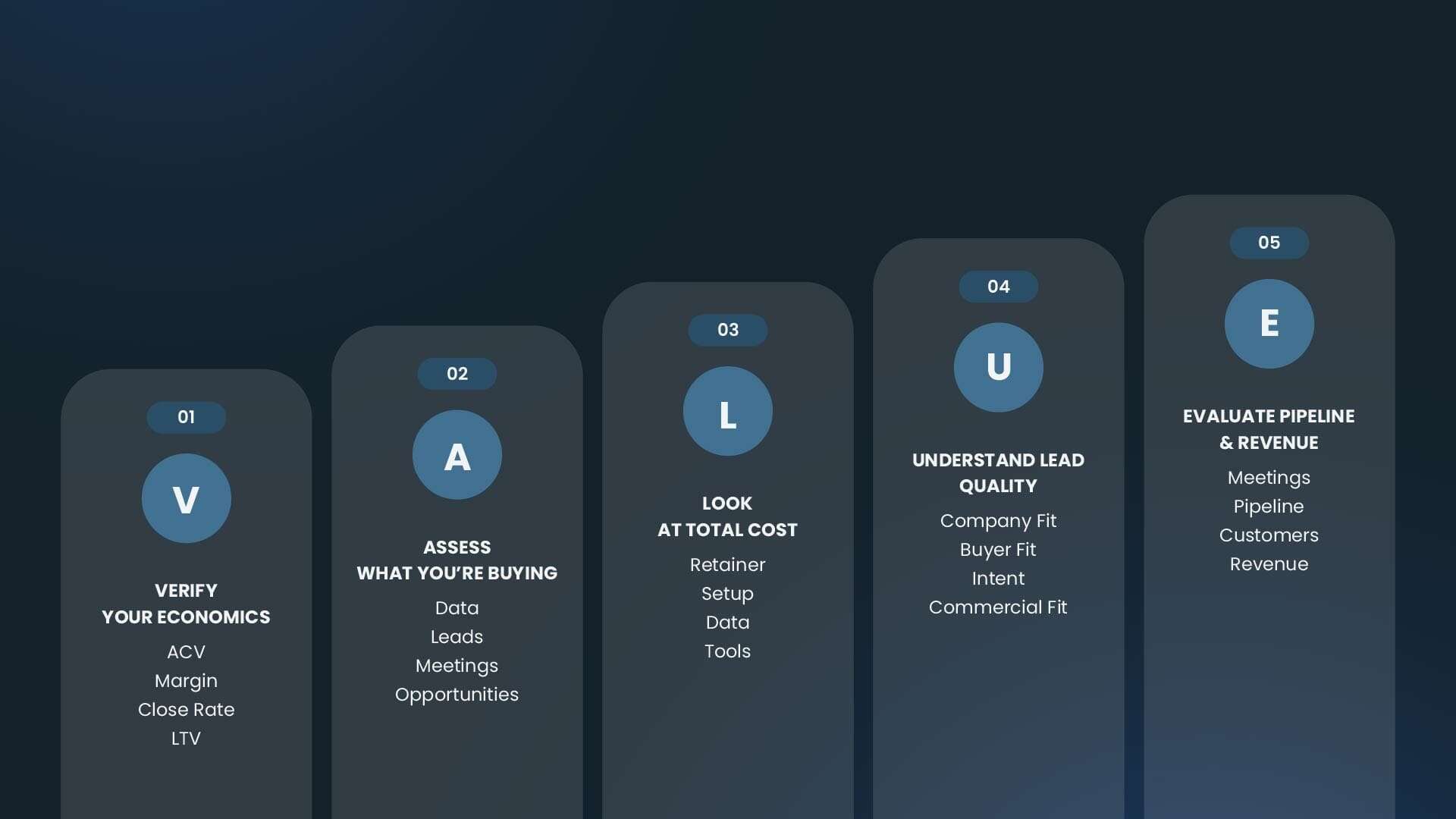
V: Verify Your Economics
Start with your own numbers before you start comparing providers. At a minimum, you should have a reasonable estimate of:
- Average contract value
- Average gross margin
- Close rate
- Customer lifetime value
- Sales cycle
- Target customer acquisition cost
These numbers give you a baseline for what you can realistically afford to spend to acquire a customer. For example, a $5,000 monthly lead generation program may make sense if one new customer is worth $100,000 in revenue and produces a healthy margin.
The same $5,000 could be difficult to justify if your average customer generates only a few hundred dollars in gross profit. The provider’s price doesn’t determine whether the investment makes sense. Your unit economics do.
A: Assess What You Are Actually Buying
The word “lead” can mean very different things from one provider to another. Before signing a contract, ask a simple question:
What exactly has to happen for you to count something as a lead?
It could mean:
- A target account has been identified
- Contact information has been verified
- A prospect has replied to an email
- A prospect has requested more information
- A meeting has been booked
- A meeting has been held
- A prospect has met specific qualification criteria
- Sales has accepted the opportunity
A verified contact requires far less work than a qualified prospect who has agreed to speak with your sales team. Make sure the provider’s definition of a lead matches what your sales team considers worth pursuing.
L: Look at the Total Cost
The monthly invoice is only part of the calculation. Depending on the engagement, you may also have costs for:
- Monthly retainer
- Setup fees
- Prospect data
- Email infrastructure
- Paid media, if applicable
- CRM work
- Internal campaign management
- Sales follow up
- Account executive time
You should also compare the program against your realistic alternative. What would it cost to hire, train, manage, and equip an internal team to handle the same work? That gives you a more useful comparison than looking at an agency fee in isolation.
U: Understand Lead Quality
More leads do not necessarily mean more value. Before outreach begins, define what a good lead actually looks like for your business.
Company Fit
Does the account match your target market?
- Industry
- Company size
- Geography
- Technology
- Revenue
- Business model
Buyer Fit
Are you reaching someone who can influence the purchase?
- Job title
- Department
- Seniority
- Decision making authority
Need or Intent
Does the prospect have a reason to consider your solution?
- Relevant business problem
- Current priority
- Interest in evaluating a solution
- Appropriate timing
Commercial Fit
Could this realistically become a valuable customer?
- Budget potential
- Deal size
- Relevant use case
A prospect can match every demographic requirement on your list and still have zero interest in buying. That is why relevance matters alongside firmographic fit. Gartner found that 73% of B2B buyers actively avoid suppliers that send irrelevant outreach, making message relevance and buyer context important parts of effective sales prospecting.
E: Evaluate Pipeline and Revenue
This is where the question of “Is it worth it?” gets answered. Look at what happens after the lead enters your funnel:
Lead → Held Meeting → Qualified Opportunity → Pipeline → Customer
Track metrics such as:
- Qualified opportunities created
- Pipeline generated
- Opportunities progressing
- Customers acquired
- Customer acquisition cost
- Gross profit
- Revenue generated
Activity metrics still matter. They help you understand where the process is working and where it is breaking down. But ultimately, revenue and profitability tell you whether the investment is creating enough business value to justify the cost.
If a provider generates fewer leads but creates more qualified opportunities and revenue, that may be a much better outcome than a campaign producing a large volume of low value contacts. That’s the real VALUE test: not how much activity a provider creates, but whether the activity makes economic sense for your business.
How to Calculate Lead Generation ROI
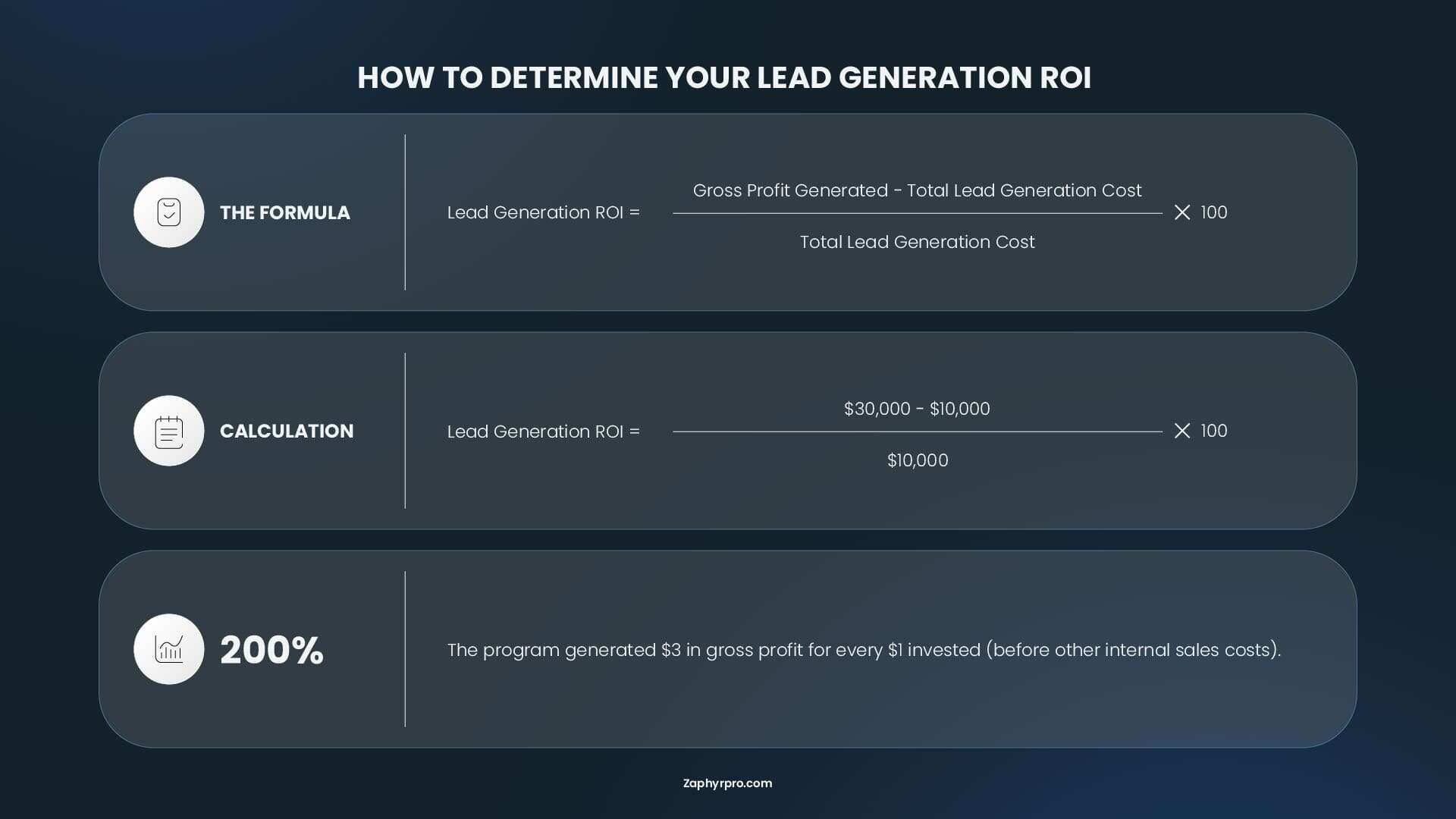
Once you know what you’re spending and what your lead generation program is producing, you can calculate whether the investment is actually paying off.
A simple formula is:
Lead Generation ROI = (Gross Profit Generated − Total Lead Generation Cost) ÷ Total Lead Generation Cost × 100
For example, suppose you spend $10,000 on a lead generation program. It generates 10 qualified opportunities, and two become customers. Each customer generates $15,000 in gross profit.
Your results would look like this:
| Metric | Result |
|---|---|
|
Lead generation cost |
$10,000 |
|
Qualified opportunities |
10 |
|
Customers acquired |
2 |
|
Gross profit per customer |
$15,000 |
|
Total gross profit |
$30,000 |
|
ROI |
200% |
The calculation:
($30,000 − $10,000) ÷ $10,000 × 100 = 200%
That means the program generated $3 in gross profit for every $1 invested, before accounting for other internal sales costs.
Don't Stop at the ROI Percentage
ROI gives you the overall picture, but you should also work backward through the funnel to understand where that return came from.
Track:
- Cost per lead: Total program cost ÷ leads generated
- Cost per qualified opportunity: Total program cost ÷ qualified opportunities
- Customer acquisition cost: Total acquisition costs ÷ new customers
- Pipeline generated: Total value of qualified opportunities created
- Revenue generated: Revenue from customers acquired through the program
- Gross profit generated: Revenue minus the direct costs of delivering what you sold
This helps you identify where the economics are working or breaking down.
For example, if your campaign generates plenty of leads but very few qualified opportunities, the problem may be targeting or qualification. If qualified opportunities are strong but few become customers, the issue may sit further down the sales process.
That’s why lead generation ROI is a way to understand whether your investment is creating enough value at each stage of the sales funnel to support continued spending.
Lead Generation Company vs. In House SDR Team
If you need more outbound capacity, you have two main options: build an SDR team internally or outsource the work to a lead generation company. Salesforce’s 2026 State of Sales report found that 48% of sales professionals lack enough bandwidth for adequate cold outreach, while nearly a full day of the workweek can go toward prospecting.
The right choice depends on how much control you need, how quickly you want to scale, and whether you have the resources to build and manage the function yourself.
| Factor | Lead Generation Company | In House SDR Team |
|---|---|---|
|
Hiring |
No need to recruit individual SDRs |
You recruit and hire the team |
|
Ramp time |
Can provide an existing team and process |
Requires hiring, onboarding, and training |
|
Management |
Provider manages day to day execution |
Your sales leaders manage the team |
|
Infrastructure |
May include prospecting and outreach tools |
You purchase and manage the tools |
|
Control |
Shared control over execution |
Direct control over people and process |
|
Scalability |
Easier to adjust the scope of an engagement |
Scaling requires additional hiring |
|
Internal expertise |
Access depends on the provider |
Knowledge stays within your company |
|
Long term cost |
Ongoing service expense |
Salaries, benefits, tools, management, and overhead |
When an In House SDR Team May Make More Sense
Building internally can be a better option when you have a proven outbound motion and want to develop that capability as a long term part of your sales organization.
It may make sense if:
- You have enough consistent pipeline demand to keep SDRs productive.
- Your sales process requires deep product or industry knowledge.
- You want direct control over messaging, training, and daily activity.
- You have sales leadership available to manage and coach the team.
- You are prepared to invest in recruiting, technology, training, and management.
The tradeoff is that you’re taking responsibility for the entire function. Hiring the SDR is only the beginning. You also need to provide the data, tools, training, management, messaging, and processes needed to make the team productive.
When a Lead Generation Company May Make More Sense
Outsourcing can make more sense when you need additional prospecting capacity without building the entire function internally.
It may be worth considering if:
- Your sales reps spend too much time prospecting.
- You need to increase outbound activity without adding a full time headcount.
- You want to test a new market before committing to an internal team.
- You don’t currently have the resources to recruit and manage SDRs.
- You need support with prospect research, outreach, qualification, or appointment setting.
- You want to scale prospecting activity up or down as your needs change.
For some companies, keeping prospecting in house provides the control and product knowledge they need. For others, outsourcing provides the additional capacity they need without taking on another hiring and management function. The better choice is the one that gives your sales team the capacity, control, and economics needed to create a healthy pipeline.
What Should a Good Lead Generation Company Actually Deliver?
You should be able to see a clear connection between who the provider targets, how they reach those prospects, what happens when prospects respond, and what opportunities make it into your sales pipeline.
Before you hire a provider, make sure you know what you should expect.
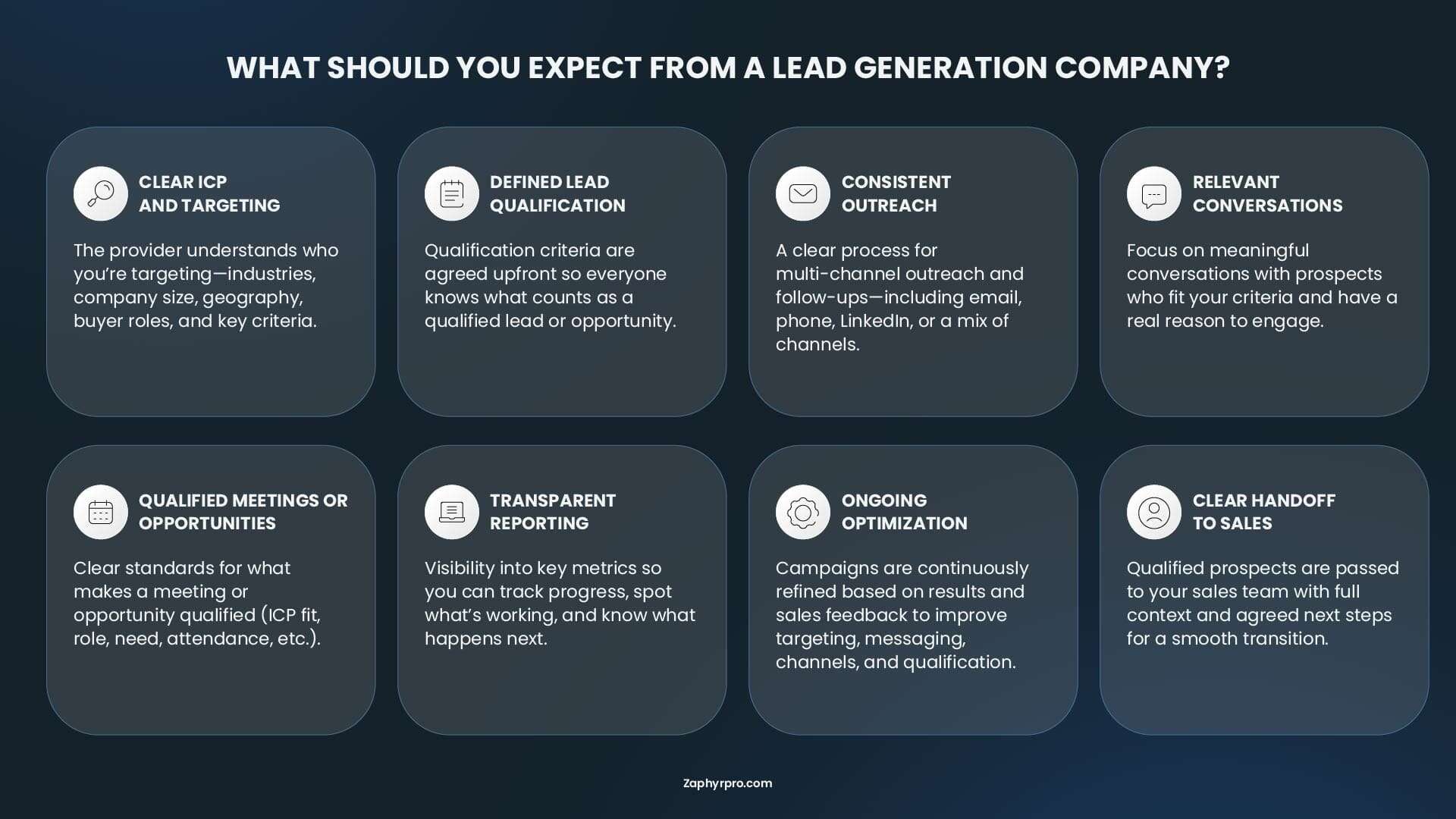
1. Clear ICP and Targeting
The provider should understand who you’re trying to reach before launching outreach. That includes your target industries, company size, geography, buyer roles, and other criteria that determine whether an account is worth pursuing. If the targeting is wrong, even a well executed campaign can generate the wrong leads.
2. Defined Lead Qualification
You should know exactly what counts as a qualified lead or opportunity. A good provider should agree with you on qualification criteria before the campaign begins rather than changing the definition later to make the results look better.
3. Consistent Outreach
Lead generation is not simply about building a list. The provider should have a clear process for reaching prospects through the agreed channels and following up appropriately. Depending on the engagement, that could include email, phone, LinkedIn outreach, or a combination of channels.
4. Relevant Conversations
The goal should not be to generate activity for the sake of activity. Your provider should work toward creating conversations with prospects who fit your criteria and have a reasonable reason to consider your offering.
5. Qualified Meetings or Opportunities
If the appointment setting is part of the engagement, you should understand what makes a meeting qualified. For example, does the prospect need to match your ICP? Speak with a specific role? Have a relevant business need? Attend the meeting? The more clearly these requirements are defined, the easier it is to judge performance.
6. Transparent Reporting
You should be able to see what is happening throughout the campaign. Depending on the service, reporting may include:
- Prospects contacted
- Outreach activity
- Response rates
- Positive responses
- Qualified leads
- Meetings booked
- Meetings held
- Opportunities created
- Pipeline generated
The exact metrics will vary by engagement, but the reporting should help you understand what is working, what isn’t, and what happens next.
7. Ongoing Optimization
A good campaign should not run on autopilot. Your provider should use campaign results and sales feedback to improve targeting, messaging, channels, and qualification over time. If a particular audience or message consistently performs poorly, the provider should be willing to adjust rather than simply continue sending more outreach.
8. A Clear Handoff to Sales
Generating an opportunity is only useful if your sales team knows what to do with it. There should be a clear process for passing qualified prospects to your sales team, including the relevant context from the conversation and any agreed next steps. Ultimately, a good lead generation company should make your sales team’s job easier, not harder.
You shouldn’t have to sort through hundreds of contacts to find the few prospects worth pursuing. The provider should help create a clearer path from target account → prospect → conversation → qualified opportunity → pipeline.
That’s the standard to use when comparing providers. Don’t just ask how many leads they can generate. Ask what those leads look like, what happens to them, and how their work contributes to your sales process.
When Lead Generation Companies Are Usually Worth It
A lead generation company is usually worth considering when the problem is sales capacity, reach, or consistency, rather than a fundamentally broken sales model. For example, outsourcing can make sense when:
- Your sales team doesn’t have enough prospecting capacity: Your sales reps have opportunities to work but struggle to consistently find and engage new prospects.
- You have a clear target market: You already know which companies and buyers you want to reach, but your team needs more capacity to reach them.
- Your offering has proven demand: You have a product or service that customers already buy, so the challenge is reaching more of the right prospects rather than figuring out whether there is a market.
- You want to expand into a new market: You need to test a new industry, geography, or customer segment without immediately building a dedicated outbound team.
- You need a more consistent pipeline: Your sales pipeline depends heavily on referrals, inbound demand, or occasional prospecting, and you want a more repeatable source of opportunities.
- You want to increase outbound activity without adding headcount: You need more prospecting and outreach capacity but aren’t ready to recruit, train, and manage additional SDRs.
- Your sales team is better used elsewhere: Your account executives or founders are spending significant time finding prospects when their time would be more valuable working active opportunities and closing business.
In these situations, the value of outsourcing comes from adding sales development capacity without requiring you to build the entire function internally.
But that doesn’t mean outsourcing automatically fixes a weak sales process. If the underlying offer, targeting, or economics aren’t working, adding more outreach can simply create more activity without creating more revenue.
When a Lead Generation Company Is Probably Not Worth It
Outsourcing lead generation may not make sense if your business isn’t ready to turn additional prospecting into additional sales. You may want to hold off if:
- You don’t know who your ideal customer is: If your target market is still “any business that needs our service,” a provider will struggle to build a focused campaign.
- Your offer hasn’t been validated: If you haven’t established that customers want what you’re selling, generating more prospects won’t solve the underlying problem.
- Your sales team can’t follow up: More meetings won’t help if qualified prospects sit in a CRM for days or never receive a proper follow up.
- Your unit economics don’t support outbound acquisition: If the potential gross profit from a customer is too low to support the cost of acquiring one, the problem isn’t the lead generation provider.
- You expect immediate revenue: B2B prospecting often involves testing, follow up, and a sales cycle before opportunities turn into customers. It shouldn’t be treated as an instant revenue channel.
- You only care about lead volume: If your definition of success is simply getting as many contacts as possible, you’re likely to optimize for quantity rather than business value.
- You don’t have a process for handling opportunities: Even strong prospecting cannot compensate for unclear sales ownership, weak qualification, or a poor closing process.
- You aren’t prepared to work with the provider: Good campaigns often require feedback from your sales team on messaging, lead quality, objections, and opportunities. If nobody internally can provide that input, optimization becomes difficult.
In these cases, spending more on lead generation may only make the existing problem more expensive. Before outsourcing, make sure the basics are in place: a defined market, a credible offer, workable economics, and a sales team capable of acting on the opportunities you generate.
If those pieces are already in place, outsourcing can help you add capacity. If they aren’t, fixing those issues first will usually create more value than simply generating more leads.
How Long Should You Give a Lead Generation Company to Prove Value?
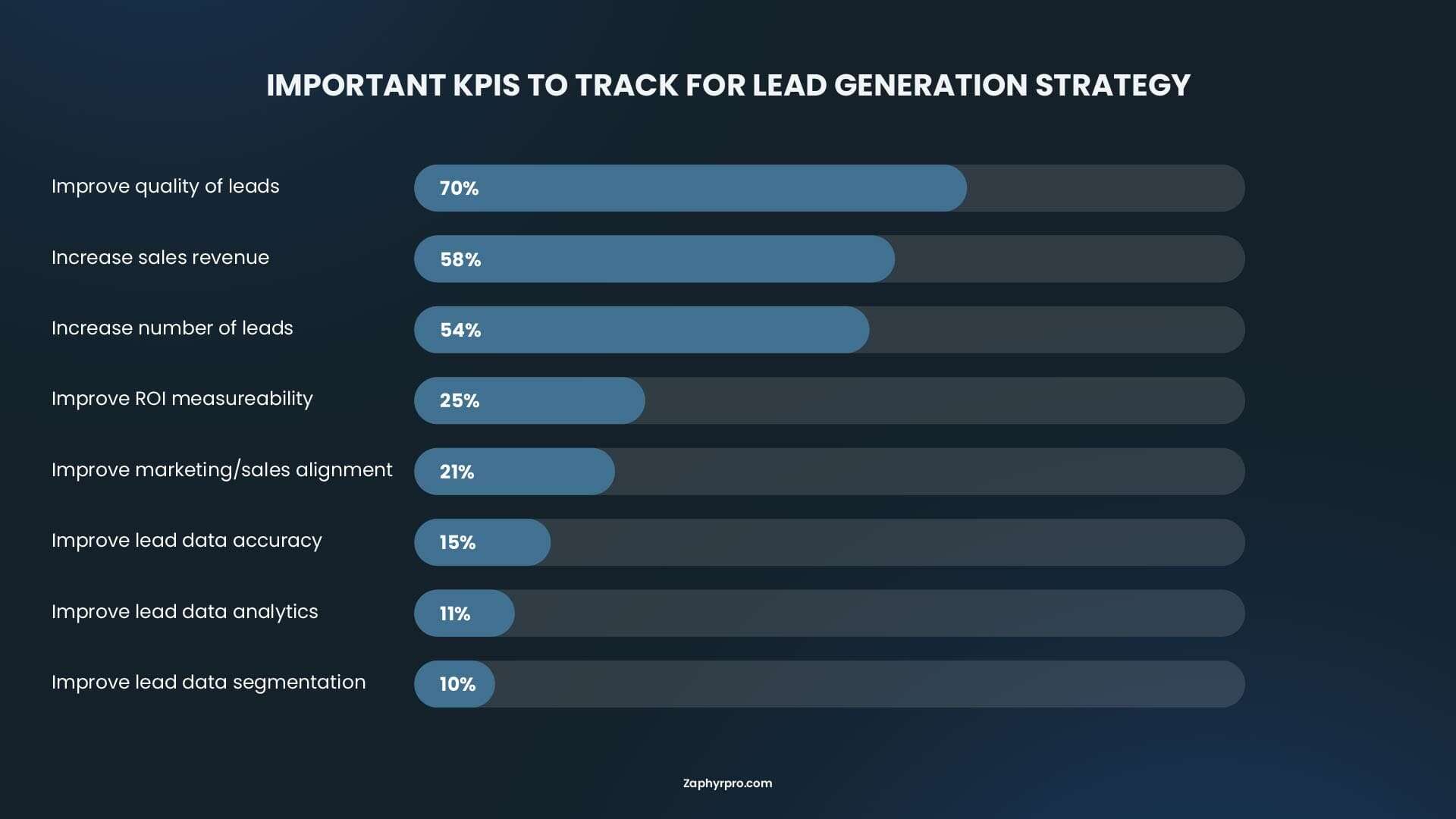
Don’t judge a lead generation company only by what happens in the first few weeks. But you also shouldn’t keep paying indefinitely without seeing signs that the program is moving in the right direction.
In one Reddit discussion about using lead generation companies, business owners and service providers shared mixed experiences with outsourced prospecting. The recurring lesson was that handing prospecting to another company does not automatically solve the sales problem. Targeting, provider quality, lead relevance, and the business’s ability to convert those opportunities still matter.
For most B2B campaigns, the first few weeks are better used to establish a baseline and identify what needs to change. Targeting, messaging, prospect lists, outreach channels, and qualification criteria may need adjustments before you can properly evaluate performance.
A useful way to think about the timeline is:
| Stage | What to Look For |
|---|---|
|
First few weeks |
Campaign launch, targeting accuracy, outreach activity, early responses, and initial feedback |
|
First 1–2 months |
Response patterns, qualified conversations, meetings, and evidence that targeting and messaging are improving |
|
2–3+ months |
Qualified opportunities, pipeline contribution, conversion trends, and stronger evidence of commercial value |
|
Longer sales cycles |
Opportunities progressing through the pipeline and eventually converting into customers |
The exact timeline can be shorter or longer. A company selling a straightforward service to a well defined market may generate useful signals quickly. A provider targeting senior enterprise buyers with a longer sales cycle may need more time before opportunities turn into revenue.
Don't Wait Until Revenue to Evaluate Performance
You don’t have to wait six months to decide whether a campaign is working. Early indicators can tell you whether the program is moving in the right direction.
For example:
- Are the right accounts being targeted?
- Are the right people responding?
- Are responses becoming qualified conversations?
- Are meetings being held?
- Are qualified opportunities entering the pipeline?
- Are those opportunities progressing?
If the answer is consistently “no” at an early stage, waiting longer may not solve the problem. On the other hand, if the campaign is generating qualified meetings and opportunities but those deals have a three or six month sales cycle, the absence of closed revenue does not necessarily mean the campaign has failed.
The key is to agree on what success should look like at each stage before the campaign starts. That gives you a much better basis for deciding whether to continue, adjust, or stop the engagement than simply asking whether the provider has generated revenue yet.
Questions to Ask Before Hiring a Lead Generation Company
Once you’ve narrowed down a few providers, don’t choose based on price or a promised number of leads alone. Ask how they work, what they actually deliver, and how they handle results that fall short. These are also common concerns in business owner discussions, such as this conversation in the Blue Collar Millionaire Facebook community.
Here are the questions worth asking before you sign a contract:
- How Do You Define a Qualified Lead?
- How Will You Identify Our Target Prospects?
- Which Outreach Channels Will You Use?
- Who Will Actually Run the Campaign?
- How Will You Measure Success?
- What Does the Sales Handoff Look Like?
- How Long Should We Expect Before We Can Evaluate Results?
- What Does Your Pricing Include?
- What Do You Need From Our Sales Team?
- What Happens If the Campaign Isn’t Working?
Before You Sign
You don’t need a provider that promises the biggest number of leads. You need one that can clearly explain who it will target, what it will do, how success will be measured, what it will cost, and what happens when the results aren’t where they need to be. If those answers are vague before you sign the contract, they are unlikely to become clearer after you do.
How to Get Better Results From an Outsourced Lead Generation Partner
The companies that get the most from an outsourced partnership usually give the provider enough context to start well, respond quickly to what they learn, and make sure qualified opportunities don’t get lost after handoff.
Here are the areas that can make the biggest difference:
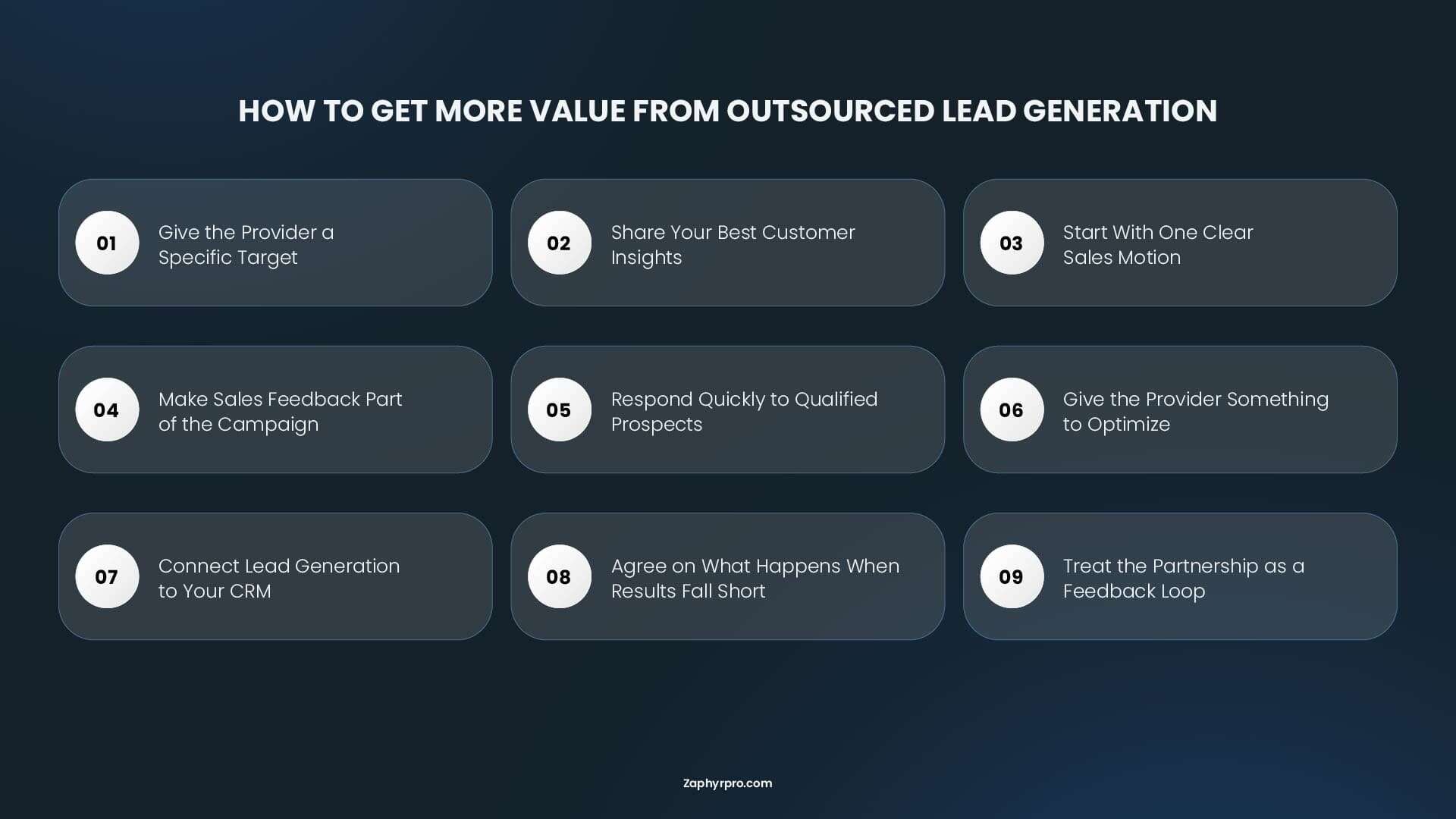
1. Give the Provider a Specific Target
Don’t start with “find us more B2B leads.” Give the provider a clear picture of the accounts you want to reach. Include your priority industries, company size, geography, buyer roles, common use cases, and accounts or segments you don’t want targeted. If your target is too broad, the campaign has to spend more time figuring out who to contact before it can figure out how to engage them.
2. Share Your Best Customer Insights
Your existing customers can tell a provider more than a generic buyer persona can. Share examples of your best customers, why they bought, what problem triggered the purchase, common objections, and what usually causes a prospect to move forward. This gives the provider real customer language to work with instead of forcing them to build messaging from your website alone.
3. Start With One Clear Sales Motion
Trying to target five industries, four buyer personas, and multiple offers at once can make it difficult to tell what’s actually working. Start with a focused segment and a clear offer where possible. Once you see which accounts, messages, and channels generate quality conversations, you can expand from there.
4. Make Sales Feedback Part of the Campaign
Don’t wait until the end of the month to tell the provider that the meetings aren’t useful. If your sales team notices that certain job titles, company sizes, industries, or use cases consistently produce better conversations, share that feedback quickly. The same applies to poor fit. If sales rejects several opportunities for the same reason, that pattern should influence future targeting.
5. Respond Quickly to Qualified Prospects
A generated opportunity still needs a sales response. Make sure every qualified meeting has a clear owner and that your team knows what information the provider collected before the handoff. If prospects regularly wait several days for a response, the problem may not be lead generation. You may simply be losing the value that the campaign created.
6. Give the Provider Something to Optimize
Campaign performance becomes more useful when you look for patterns. For example:
- One industry produces significantly better conversations.
- One buyer role responds more often.
- One message generates replies but poor quality meetings.
- One channel produces fewer leads but better opportunities.
- Certain objections appear repeatedly.
Use those patterns to decide what to test next instead of judging the entire campaign by one month’s lead count.
7. Connect Lead Generation to Your CRM
Where practical, make sure campaign activity and sales outcomes can be connected. You should be able to see what happened to a prospect after the initial handoff. Did the meeting happen? Did it become an opportunity? Did the opportunity progress? Was the deal eventually won or lost? Without that feedback loop, the provider can optimize for leads while your business needs to optimize for revenue.
8. Agree on What Happens When Results Fall Short
Before problems arise, decide how you’ll review performance and make changes. If lead quality drops, you may need to change the audience. If response rates fall, messaging or channel strategy may need attention. If meetings are strong but opportunities aren’t progressing, your sales process may need to be examined. The goal isn’t to expect every campaign to work perfectly from day one. It’s to make sure both sides have a process for learning and adjusting when it doesn’t.
9. Treat the Partnership as a Feedback Loop
The most effective outsourced programs aren’t simply: Agency generates leads → Sales receives leads
They’re closer to: Target → Outreach → Response → Sales Feedback → Optimization → Better Targeting → Better Opportunities
Your provider brings the prospecting and execution capacity. Your team brings the product knowledge, customer insight, sales experience, and feedback needed to improve the campaign.
When both sides contribute to that feedback loop, you give the program a much better chance of producing the outcome you actually hired it for: more qualified opportunities that can turn into revenue.
If Outsourcing Makes Sense, Start With the Right Execution Partner
By now, you should have a clearer answer to whether a lead generation company is worth it for your business. If your economics work, your target market is defined, and your sales team needs more prospecting capacity, the next question is who can actually execute the work well?
Zaphyre works as an execution service partner, helping B2B companies handle the prospecting and sales development work that can otherwise consume significant internal time. That can include market research, prospecting, email marketing, LinkedIn outreach, and appointment setting.
If you’re considering outsourcing and want to understand what that could look like for your business, schedule a consultation with our team. We can discuss your goals, target market, current sales process, and where additional execution support may fit.
Use our planning worksheet to define your audience, choose the right format, and create an offer that attracts qualified leads.
Rule of thumb: If someone can find the same information with a quick online search, don’t gate it. If the content delivers original insights, personalized recommendations, or practical tools that save time or reduce risk, it’s a strong candidate for gating. |
Frequently Asked Questions
Yes, they can. Small businesses can benefit when they have a defined target market, a proven offer, and enough customer value to support the cost of acquiring new business.
Yes. Many lead generation companies (including Zaphyre) can build campaigns around specific industries, markets, geographies, company sizes, and buyer roles. This allows outreach to focus on prospects that closely match your ideal customer profile.
Yes. An outsourced provider can handle prospecting, outreach, qualification, or appointment setting while your internal sales team manages qualified conversations and opportunities. This adds sales capacity without requiring your team to handle every prospecting task.
Yes. You can outsource specific activities such as prospect research, list building, cold email, LinkedIn outreach, cold calling, lead qualification, or appointment setting instead of outsourcing the entire sales development process.
Your agreement should define what qualifies as a valid lead. If prospects do not meet the agreed criteria, you should have a clear process for reporting, reviewing, and addressing those leads with the provider.
Ownership depends on your contract. Before signing, clarify who owns prospect data, contact information, campaign records, conversation history, and CRM data created during the engagement.
Yes. A provider can identify target accounts, reach potential buyers, and gather market feedback that helps you assess a new segment. However, lead generation alone cannot validate your pricing, offer, or overall market fit.
It depends on the service. A provider may deliver contact data, qualify responses, book meetings, or manage sales development through the handoff. Your agreement should clearly define where the provider’s responsibility ends and your sales team’s begins.