
Ask ChatGPT, “What are the best vendors for this?” and it names a handful of companies, often with links. If your company is not one of them, you were not part of the conversation.
I track AI citations for B2B clients at Zaphyre, and one question keeps coming up: how do you get cited by ChatGPT? There is no switch to flip, and nobody can guarantee a citation. But the pages that do get cited share patterns you can learn from.
In this guide, I’ll explain how ChatGPT picks its sources, what the research and our client data show, and an 8-step playbook you can follow.
Key Takeaways
- Getting cited by ChatGPT is earned, not guaranteed. It starts with letting OpenAI’s search crawler, OAI-SearchBot, reach your pages.
- Blocking GPTBot opts you out of model training only. Blocking OAI-SearchBot keeps you out of ChatGPT search answers.
- Pages that answer the prompt first, compare options clearly, and back claims with sourced data give AI systems something concrete to cite.
- In one B2B client’s data, two buyer’s guides produced 51.6% of page-level citations, and about half of all citations came from comparison-style queries.
- AI assistants tend to cite newer pages. Ahrefs found that AI-cited URLs averaged 1,064 days old, versus 1,432 days for organic Google results.
- Measure with manual prompt tests, Bing Webmaster Tools AI Performance, and GA4 AI referral sessions. Citations are not clicks.
Want the bigger picture? Our guide, Getting Found in the Age of AI Search, covers AI search visibility from strategy to measurement.
What Does It Mean to Get Cited by ChatGPT?
When ChatGPT uses its search capability, it can show sources next to its answer: links to the pages it drew on. Being “cited” means your page appears among those sources. That is different from being mentioned, where ChatGPT names your brand without a link, and different from ranking, because there is no numbered list of positions to climb.
For B2B companies, this matters because buyers increasingly use these answers to build shortlists. A citation puts your page in front of a buyer at the moment they compare options, often before they open a search results page.
Can You Rank in ChatGPT?
Strictly speaking, no. ChatGPT does not publish a ranked list of results, so “ChatGPT SEO” is shorthand for improving how often your pages are retrieved and used in answers.
Google makes a similar point about its own AI features: pages need to be indexed and eligible to appear in Search, there are no special requirements, and standard SEO best practices still apply. The same logic holds for ChatGPT. If a page cannot be crawled, indexed, and understood, it cannot be used.
How Does ChatGPT Choose Which Sources to Cite?
OpenAI does not publish a ranking formula, so anyone who claims to know the exact recipe is guessing. What we do know comes from OpenAI’s documentation, large third-party studies, and citation data from our own clients.
Crawler Access Comes First
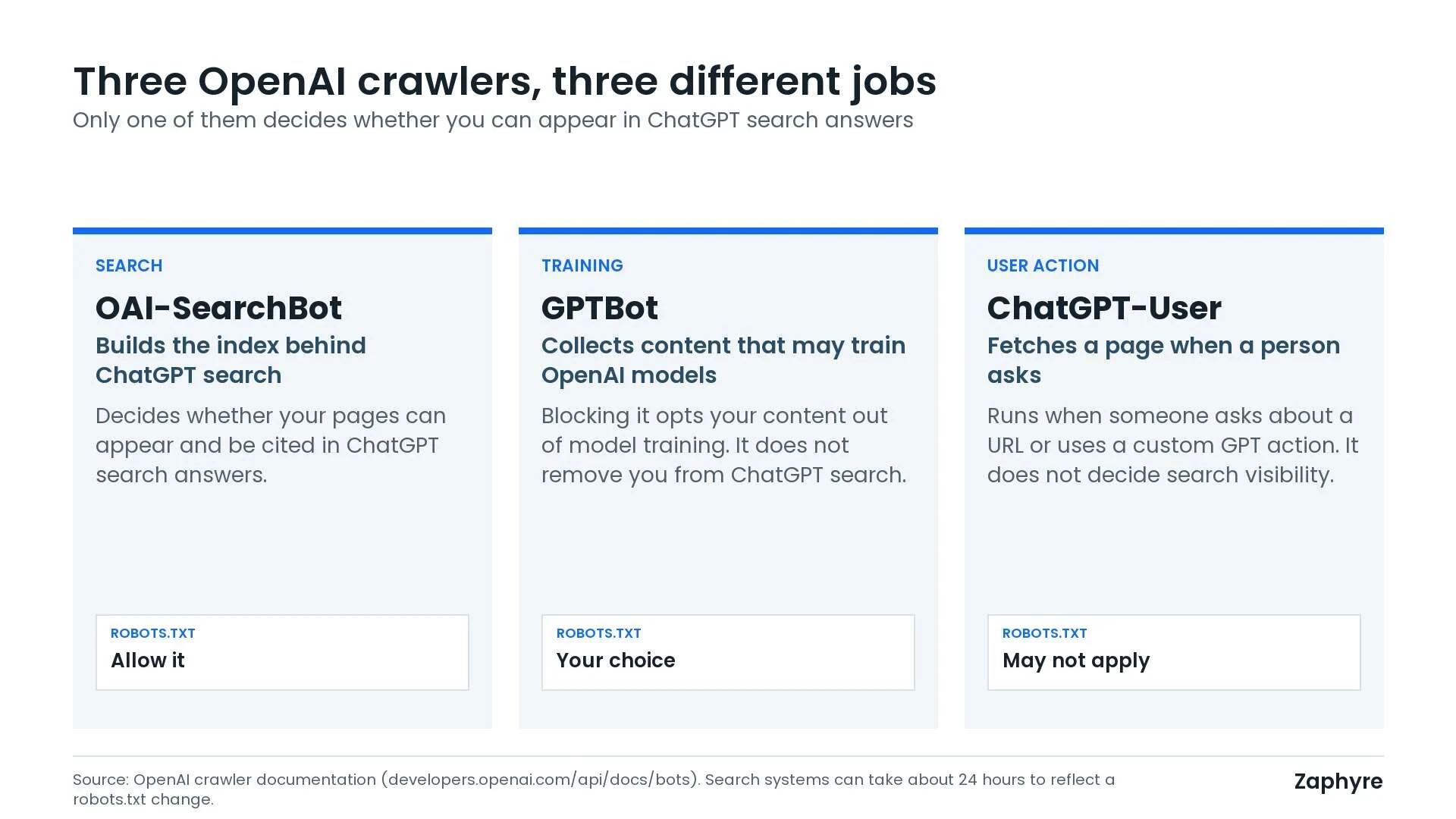
OpenAI runs separate crawlers for separate jobs, and its documentation explains each one:
- OAI-SearchBot crawls sites to surface them in ChatGPT search. If you block it, your site will not appear in ChatGPT search answers, although it can still show up as a navigational link.
- GPTBot crawls content that may be used to train OpenAI’s foundation models. Blocking it signals that you do not want your content used for training.
- ChatGPT-User handles actions a person requests, such as visiting a page to answer a question. Robots.txt rules may not apply, and it does not decide search visibility.
OpenAI recommends allowing OAI-SearchBot in robots.txt and allowing its published IP ranges. Its search systems can take about 24 hours to reflect a robots.txt change.
Freshness Helps
An Ahrefs study of 16.975 million cited URLs across ChatGPT, Perplexity, Gemini, Copilot, AI Overviews, and Google found that URLs cited by AI assistants averaged 1,064 days old, compared with 1,432 days for URLs in organic Google results. That makes AI-cited pages about 25.7% fresher. ChatGPT was the most likely to cite newer pages.
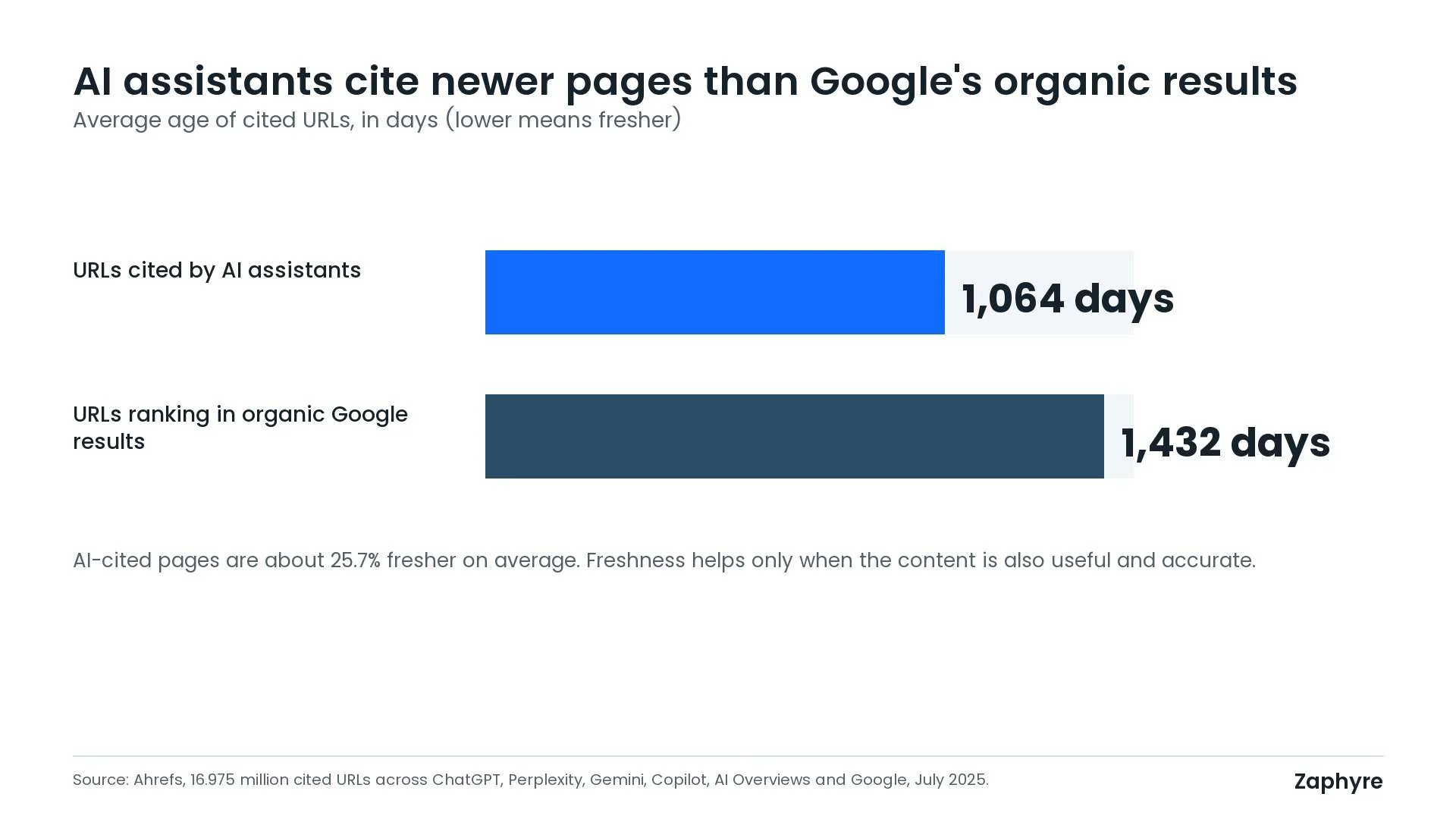
The study also warns against over-reading the result. Updating low-quality content daily will not create visibility on its own. Freshness helps when the page is already useful, accurate, and well-structured.
Page Format Matters
An April 2026 analysis by Evertune of more than 40,000 heavily cited ChatGPT URLs found that about half were listicles, and 58% of those were ranked lists such as “10 Best CRM Tools.” That is a vendor study, and formats shift as models change, but it matches what we see in client data: buyer’s guides and comparison pages earn the most citations.
Different AI Platforms Use Different Crawlers
ChatGPT is not the only place buyers ask questions. Each platform documents its own access rules, so check them all.
| Platform | What to allow | Where it is documented |
|---|---|---|
| ChatGPT search | OAI-SearchBot. GPTBot controls training only. | OpenAI crawler documentation |
| Perplexity | PerplexityBot. Perplexity-User handles user-requested fetches. | Perplexity crawler documentation |
| Google AI Overviews and AI Mode | Googlebot. Pages must be indexed and eligible to show a snippet. | Google Search Central |
| Microsoft Copilot and Bing AI summaries | Bing’s index. Verify your site in Bing Webmaster Tools. | Bing Webmaster Blog |
What Did We Learn From a B2B Client's AI Citation Data?
At Zaphyre, we track AI citations for B2B clients using the AI Performance report in Bing Webmaster Tools. It shows how often a site’s pages are cited as sources in Microsoft Copilot and Bing’s AI-generated summaries, plus the grounding queries AI systems used to retrieve them.
It does not measure ChatGPT directly, so I treat it as a directional signal for how AI systems that retrieve web content treat your pages, and I confirm with manual ChatGPT prompt tests. With that caveat, here is what one B2B client’s data showed between January 1 and October 3, 2026.
Two Buyer's Guides Did Most of the Work
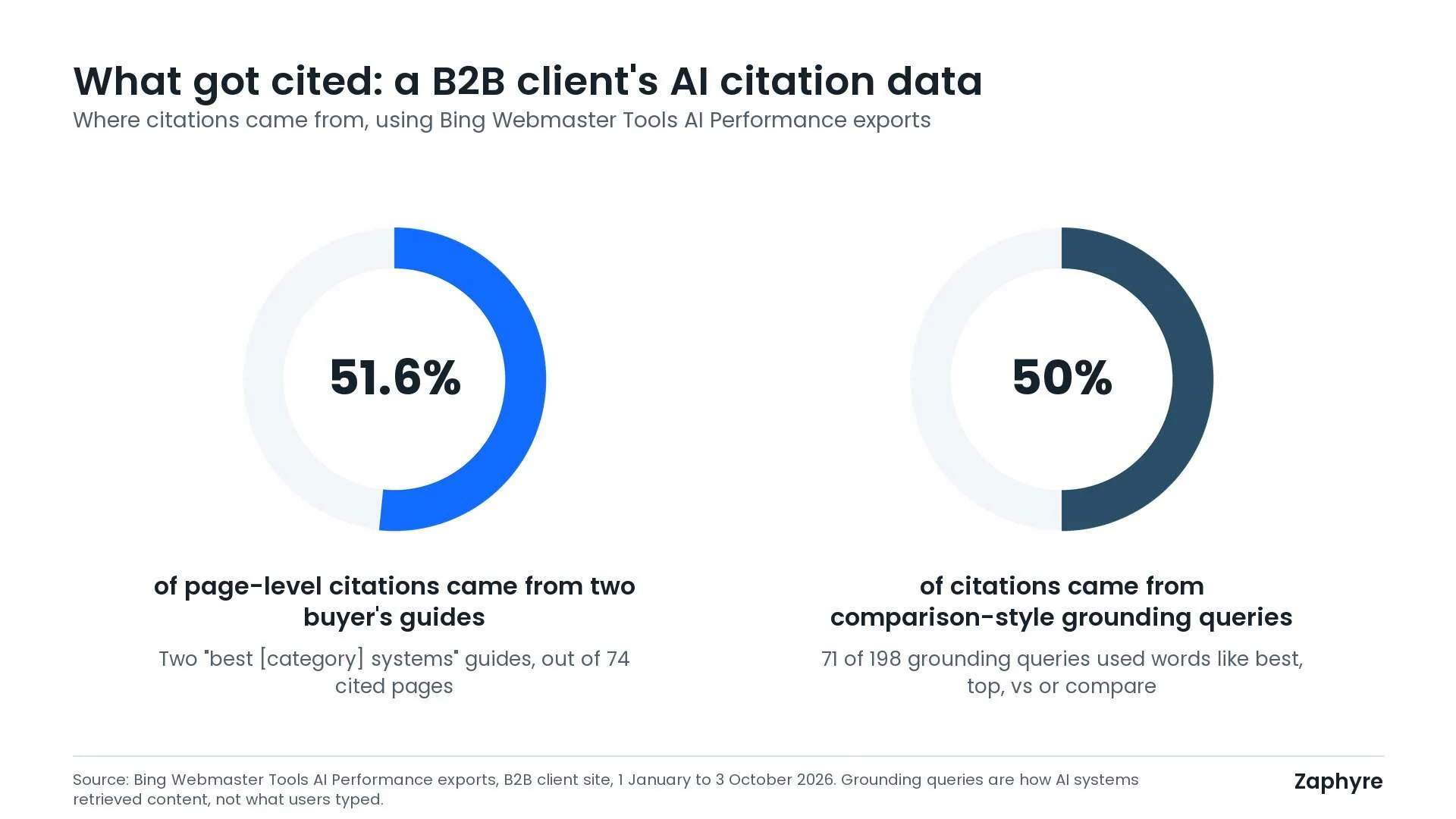
The client had 74 pages cited in AI answers. Twenty-one pages earned 100 or more citations, and three earned more than 1,000. But two buyer’s guides, each built around “best [category] systems” for 2026, accounted for 51.6% of page-level citations.
Comparison and “Best” Queries Dominated
Of 198 grounding queries, 71 used words such as best, top, vs, or compare, and those queries produced about half of all citations. Commercial-intent queries produced the largest single share, at 33%. In other words, AI systems reached for this client when buyers were evaluating options.
Cleaning Up Duplicates Paid Off
In July, 44 of the client’s pages were showing up in Search Console at two addresses: an old root-level URL and a newer /blog/ URL. That split their signals. After we consolidated them, 28 remained by August, and two merged guides gained 54% and 77% more impressions on a single URL.
AI Visitors Are Few but Engaged
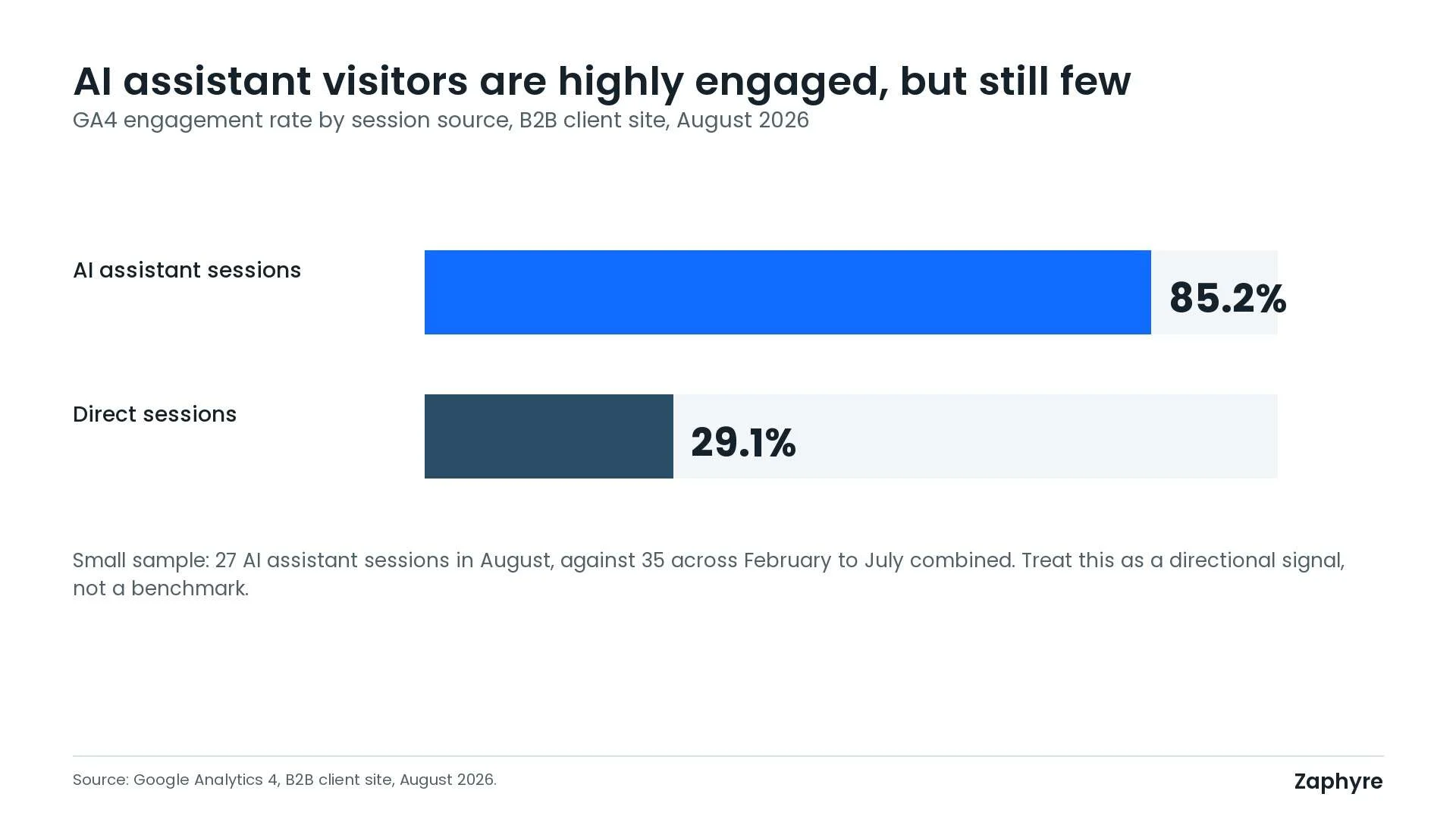
AI assistants sent only 27 sessions to the client’s site in August 2026, compared with 35 across February to July combined. But those visitors were the most engaged on the site, with an 85.2% engagement rate in GA4, versus 29.1% for direct traffic. The sample is small, so treat it as a signal, not a benchmark.
A Young Domain Can Earn Citations
The client’s Ahrefs Domain Rating rose from 6 to 10 during the year. Authority still matters for search, but these results show that a young, low-authority domain can earn citations when its pages answer buyer questions clearly and completely.
Which Prompts Should B2B Brands Target?
Buyers do not ask one kind of question. Mapping prompts to page types tells you what to build. Our client’s grounding queries were dominated by evaluation questions, so I would start there.
| Prompt type | Example prompt | Page to build |
|---|---|---|
| Category discovery | What are the best [category] providers for [industry]? | Buyer’s guide |
| Comparison | [Option A] vs [Option B] for [use case] | Comparison page |
| Alternatives | Alternatives to [Option A] | Alternatives page |
| Cost | How much does [service] cost? | Cost and pricing explainer |
| Selection | How do I choose a [vendor type]? | Selection checklist |
| How-to | How do I set up [process]? | Step-by-step guide |
| Definition | What is [concept]? | Answer-first explainer |
How Do You Get Cited by ChatGPT? An 8-Step Playbook
These steps combine OpenAI’s documentation, published research, and what we have seen in client data. Do them in order, because the early steps make the later ones count.
1. Let OAI-SearchBot and Search Crawlers In
Check robots.txt, your CDN, and your firewall rules. A broad bot-blocking rule is the most common reason a good page never gets used. Here is an example that allows ChatGPT search while opting out of model training:
User-agent: OAI-SearchBot
Allow: /

User-agent: GPTBot
Disallow: /
Whether to block GPTBot is a business decision. According to OpenAI, it does not affect your visibility in ChatGPT search. If you are comfortable with training use, you can leave GPTBot alone and simply make sure OAI-SearchBot is allowed.
2. Make Target Pages Indexable and Consolidate Duplicates
- Remove accidental noindex tags and fix canonical tags.
- Keep one URL per topic and redirect the duplicates.
- Keep the page in your XML sitemap and link to it from related pages.
- Verify your site in Bing Webmaster Tools and submit your sitemap, so you can see AI citations later.
3. Write for the Prompt: Question Titles and Answer First
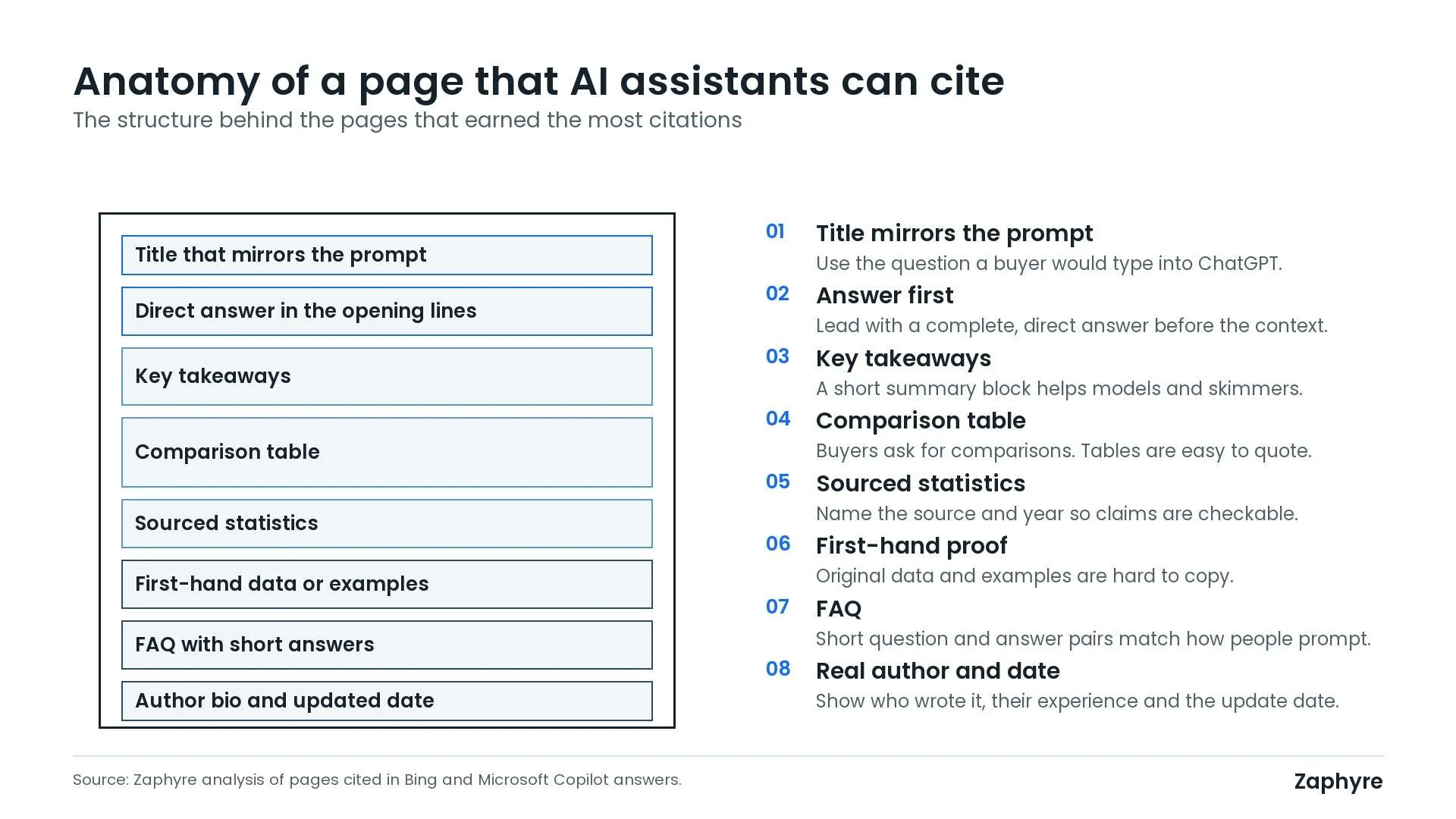
Buyers do not type keywords into ChatGPT. They ask questions. Title your page with the question or comparison a buyer would ask, then answer it in the first two sentences before adding context.
A simple pattern works well: definition or answer, then who it is for, then criteria, then examples. Use a short summary block near the top and descriptive subheadings throughout.
4. Build Buyer's Guides and Comparison Pages
This was the clearest pattern in our client data. Pages that help a buyer evaluate options earn the most citations. Start with the formats buyers search for when they are close to a decision:
- Best [category] for [use case]: a guide with clear selection criteria.
- [Option A] vs [Option B]: a fair, side-by-side comparison.
- Alternatives to [option]: useful for buyers who already know the market.
- Cost and pricing explainers: honest ranges and what drives them.
Be fair to competitors, state your criteria, and use a table so the comparison is easy to quote. Link each guide to the relevant service page, such as our SEO and AEO service. If you need help producing guides at this standard, our SEO content writing team can support you.
5. Add Sourced Statistics and First-Hand Data
- Name the study, the organization, and the year, and link to the primary source.
- Add your own numbers wherever you have them. First-hand data is the hardest thing for competitors to copy.
- Explain your method so readers can judge the data.
- Be honest about limits. A caveat builds more trust than a bold claim you cannot support.
6. Show Real Authors and Keep Pages Fresh
Add an author bio, credentials, and a profile page for each author, as I have done with my own author profile. Show the date a page was last updated, and only change that date when the content has materially improved. Review your most important pages at least once a year.
7. Earn Mentions Beyond Your Own Site
AI answers draw on more than your website. In my experience, how others describe you matters: reviews, directory listings, industry publications, partner pages, and community discussions all shape what an AI system can say about you. Prioritize relevant, editorially independent placements over volume.
8. Measure, Learn, and Repeat
- Run a fixed set of buyer prompts every month and record which sources ChatGPT cites.
- Check the AI Performance report in Bing Webmaster Tools for citations, cited pages, and grounding queries.
- Watch GA4 for sessions from AI assistants.
- Use grounding queries to choose the next pages to build or improve.
How Do You Structure a Buyer's Guide That AI Can Cite?
Because buyer’s guides earned most of our client’s citations, here is the structure I use. Adapt it to your category.
- Title: “Best [Category] for [Use Case] in 2026,” or a clear comparison of two named options.
- Opening answer: two or three sentences that name the selection criteria and the kind of option that suits each need.
- Key takeaways: four to six short bullets.
- How we evaluated: your criteria, data sources, and the date of the review.
- Comparison table: option, best for, key features, price range, and main limitation.
- Short profile per option: strengths, limits, and who should choose it.
- How to choose: a decision checklist the reader can apply.
- FAQ: short answers to the follow-up questions buyers ask.
- Sources, author, and update date: so every claim can be checked.
If your own product is on the list, say so, judge it by the same criteria, and be open about its limits. Buyers trust balanced comparisons, and a neutral tone makes the page easier to quote.
Why Is Your Site Not Being Cited? A Troubleshooting Guide
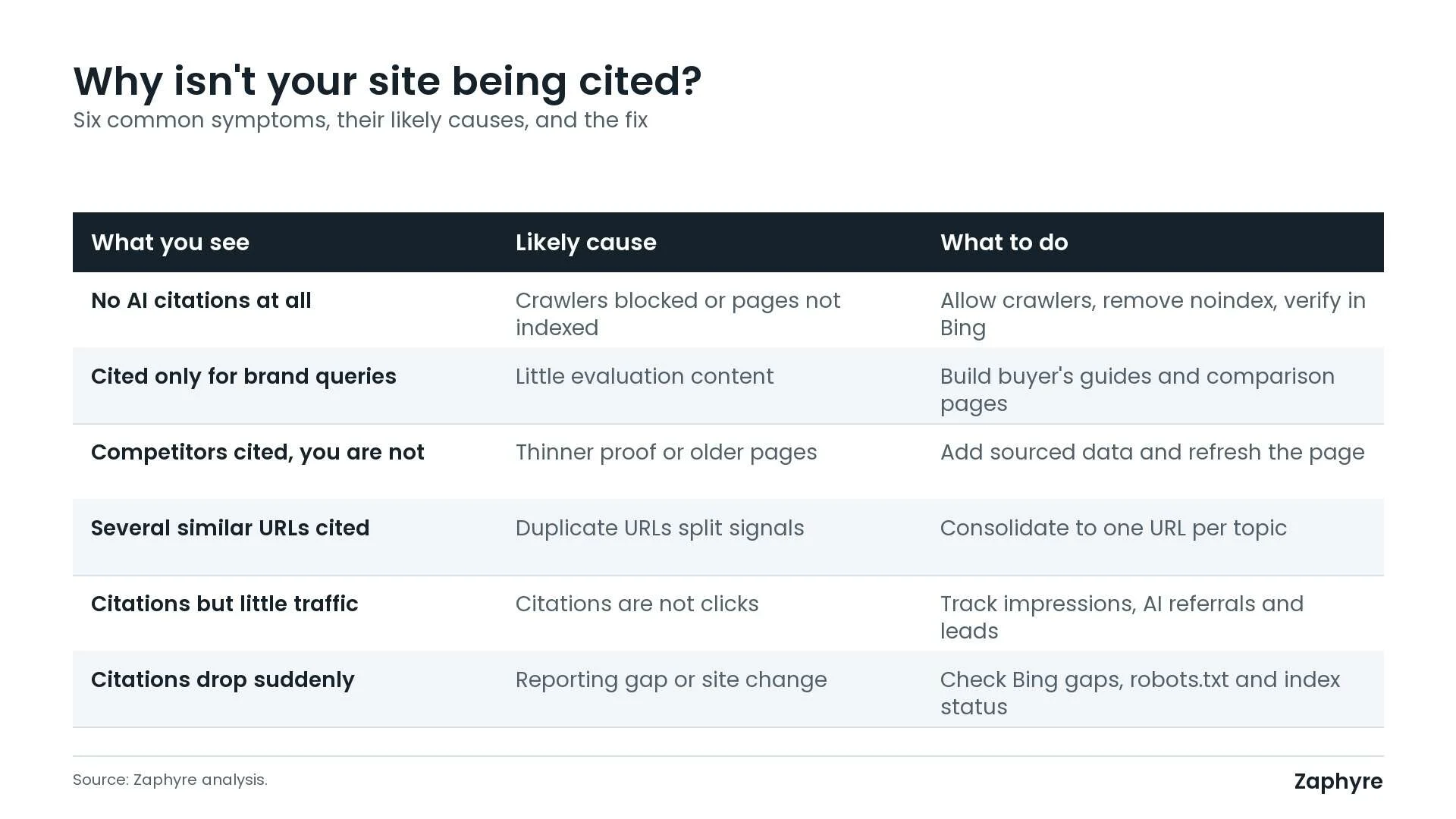
If your pages are not showing up, the cause is usually one of a small set of problems. This table maps what you see to the likely cause and the fix.
| What you see | Likely cause | What to do |
|---|---|---|
| No AI citations at all | Crawlers are blocked, or pages are not indexed | Check robots.txt, CDN, and firewall rules. Remove noindex tags. Verify the site in Bing Webmaster Tools. |
| Cited only for brand-name queries | Little evaluation content for non-branded questions | Build buyer’s guides, comparison pages, and cost explainers. |
| Competitors are cited and you are not | Thinner proof, older pages, or weaker comparisons | Add sourced statistics and original data, refresh the page, and improve the comparison table. |
| Several similar URLs are cited | Duplicate URLs are splitting signals | Consolidate to one URL per topic and redirect the rest. |
| Citations but little traffic | This is normal. Citations are not clicks | Track impressions, branded search, AI referral sessions, and leads. |
| Citations drop suddenly | A reporting gap or a recent site change | Check Bing reporting for gaps, recent robots.txt or CDN changes, and index status. |
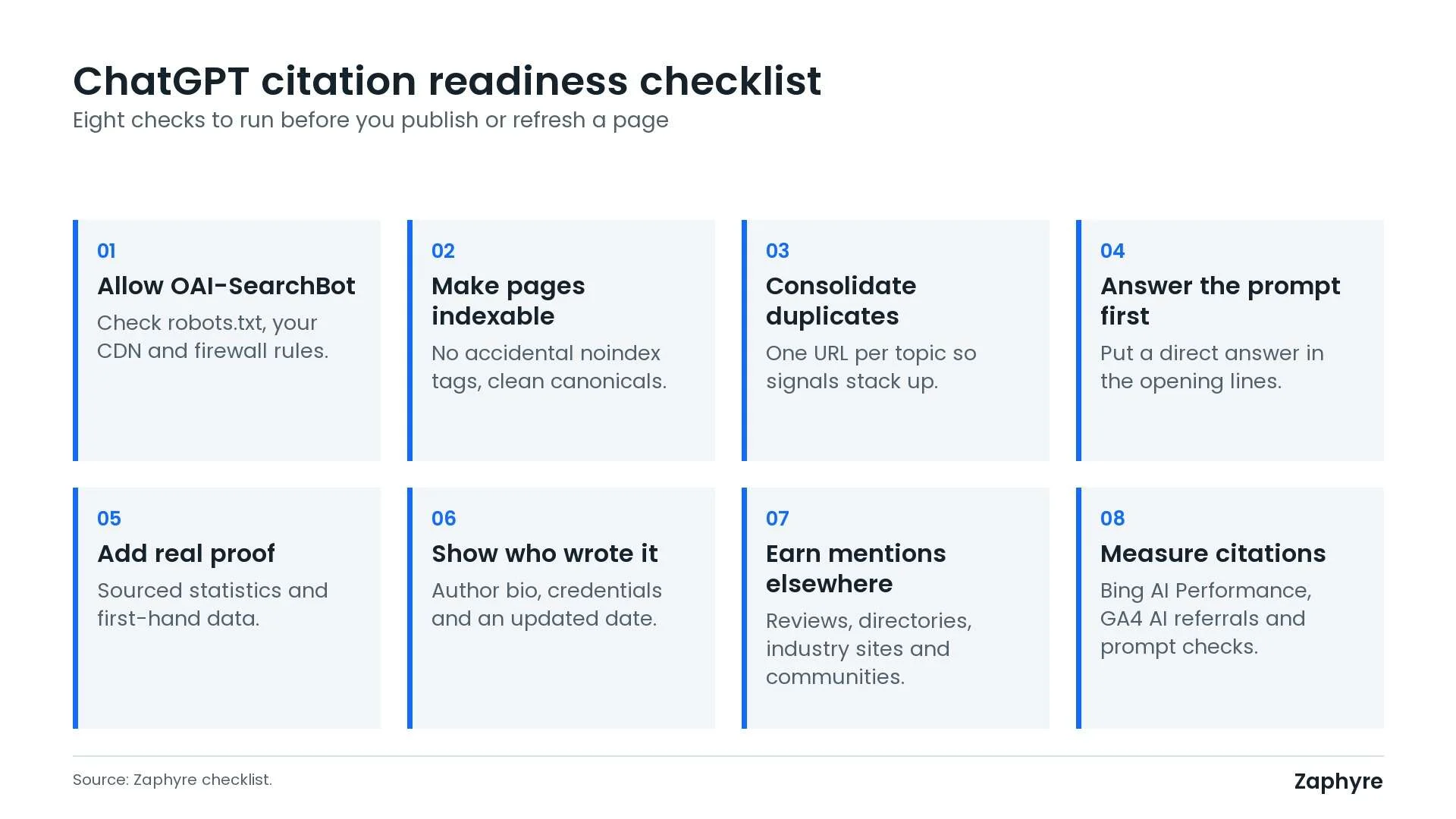
ChatGPT Citation Readiness Checklist
Run through these eight checks before you publish a page or refresh an existing one.
How Do You Measure ChatGPT Citations?
No single tool shows everything, so combine three methods.
Manual Prompt Testing
List 20 prompts your buyers might ask, such as “best [category] for [use case]” or “[Option A] vs [Option B].” Run them in ChatGPT with search on, and record the date, the prompt, whether your site was cited, which pages were cited, and which competitors appeared. Repeat monthly in a simple spreadsheet.
Use a simple tracking sheet with these columns, and keep the prompt list fixed so results are comparable month to month:
| Prompt | Date | Cited? | Pages cited | Competitors cited | Notes |
|---|---|---|---|---|---|
| Best [category] for [use case] | [date] | Yes / No | [URL] | [names] | [follow-up] |
Bing Webmaster Tools AI Performance
The report shows total citations, average cited pages, page-level citations, and grounding queries for Microsoft Copilot and Bing AI summaries. It does not show clicks, and it does not cover ChatGPT directly. Use it to spot which of your pages AI systems favor and which topics they associate with you.
Analytics and Tracking Tools
In GA4, AI assistant traffic typically appears as referral sessions from sources such as chatgpt.com. Tools such as Ahrefs Brand Radar also track brand mentions and citations across AI platforms. Expect small numbers at first. In our client data, AI visitors were few but highly engaged.
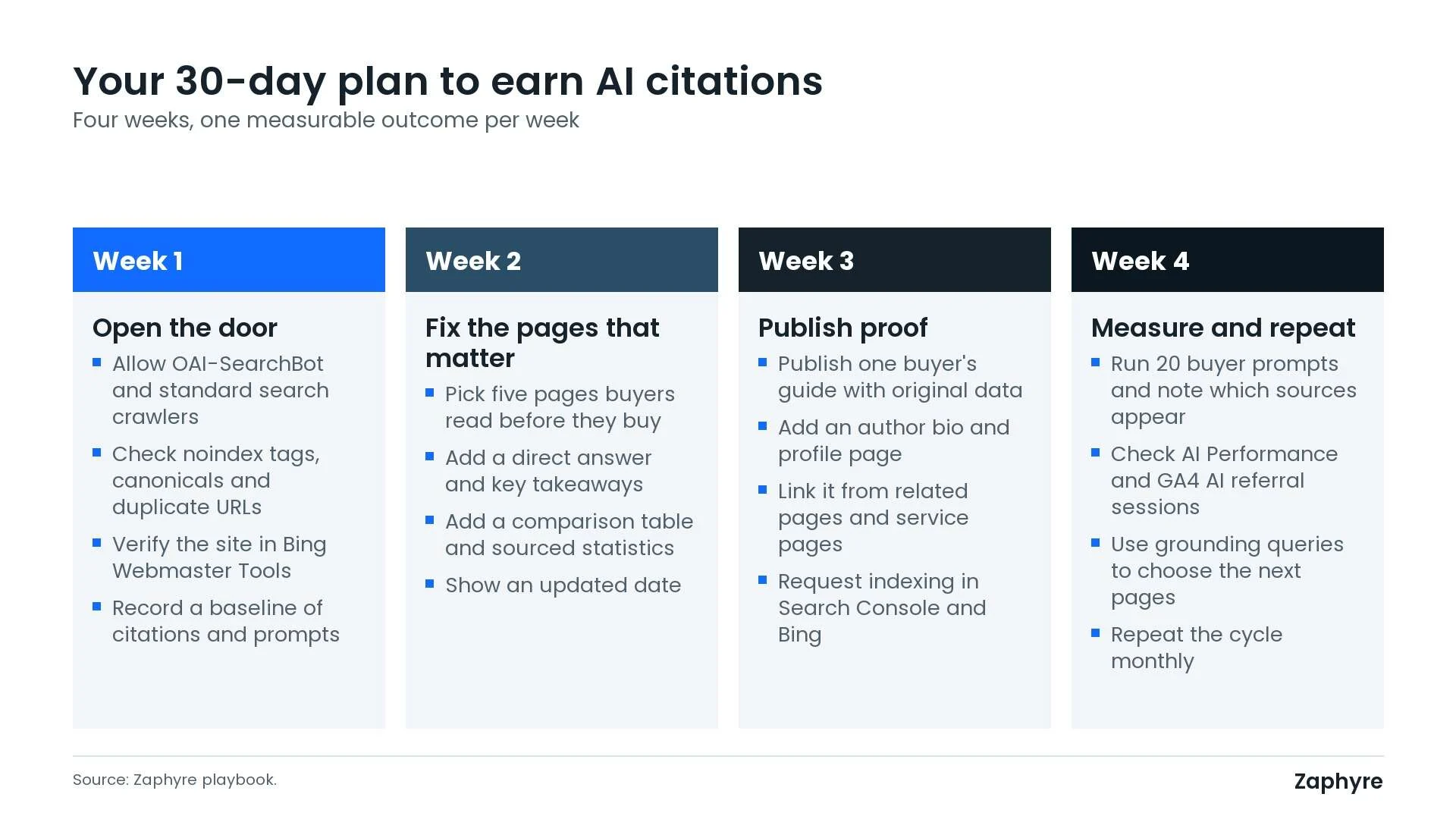
Your 30-Day Action Plan
If you are starting from zero, this plan gets the basics in place in a month and gives you a baseline to improve from.
What Mistakes Should You Avoid?
- Blocking the wrong crawler. Blocking OAI-SearchBot removes you from ChatGPT search answers. Blocking GPTBot does not.
- Publishing thin, AI-written pages. Volume without original value gives AI systems nothing worth citing.
- Chasing hacks. There is no shortcut that replaces useful, sourced, well-structured content.
- Skipping the comparison content. Buyer’s guides and comparisons earned most of our client’s citations.
- Expecting clicks to match citations. Citations build visibility and trust. Clicks are a separate, smaller number.
- Treating it as a one-off. AI citations move month to month. Review and refresh regularly.
Be the Source AI Cites, Not Just Another Vendor in the Answer
Getting cited by ChatGPT is not a separate discipline. It is what happens when strong SEO, clear answers, and real proof come together on pages buyers actually use to decide. We build that as one system at Zaphyre, so technical SEO, content, and AI visibility are measured against the same goal: more qualified pipeline.
Ready to get cited in AI answers?
See how Zaphyre can help your team build the pages, proof, and technical foundation that AI search rewards.
Frequently Asked Questions
There is no fixed timeline. OpenAI says its search systems can take about 24 hours to reflect a robots.txt change, but earning citations depends on content quality and competition. For one B2B client, monthly AI citations in Bing and Copilot grew from 745 in March 2026 to 2,025 in May and 6,360 in July. Your results will vary.
No. GPTBot is OpenAI’s training crawler. OAI-SearchBot controls whether your pages can appear in ChatGPT search answers.
They overlap heavily. Both reward pages that are crawlable, indexable, useful, and trustworthy. ChatGPT-focused work adds an emphasis on answer-first structure, comparison content, sourced data, and mentions beyond your own site.
Start with the pages buyers read when they compare options: buyer’s guides, comparison and alternatives pages, cost explainers, and your core service pages.
Run manual prompt tests in ChatGPT, check GA4 for referrals from chatgpt.com, and use Bing Webmaster Tools AI Performance as a directional signal. A brand tracking tool can automate the prompt checks.
Yes. One client’s domain had an Ahrefs Domain Rating of just 10 and still earned more than 24,000 AI citations in seven months. Clear, complete answers to buyer questions matter more than raw domain strength.