
The best time to post on LinkedIn in 2026 is generally found somewhere between the working hours of Tuesday and Thursday, although the exact hour depends on the audience, industry, and research you follow. Some studies favor late morning, others point towards the afternoon, and a few still recommend publishing before most people have finished their first cup of coffee.
We compared publishing-time recommendations from Sprout Social, Buffer, Hootsuite, and SocialPilot to understand where their findings overlap and where they disagree. The comparison forms the basis of the Zaphyre LinkedIn Timing Consensus Index, an analysis of the hours these studies recommend throughout the week.
Explore the best posting times by day and industry, a practical B2B publishing schedule, and a four-week testing framework to discover when your audience is most likely to engage.
Best Times to Post on LinkedIn by Day
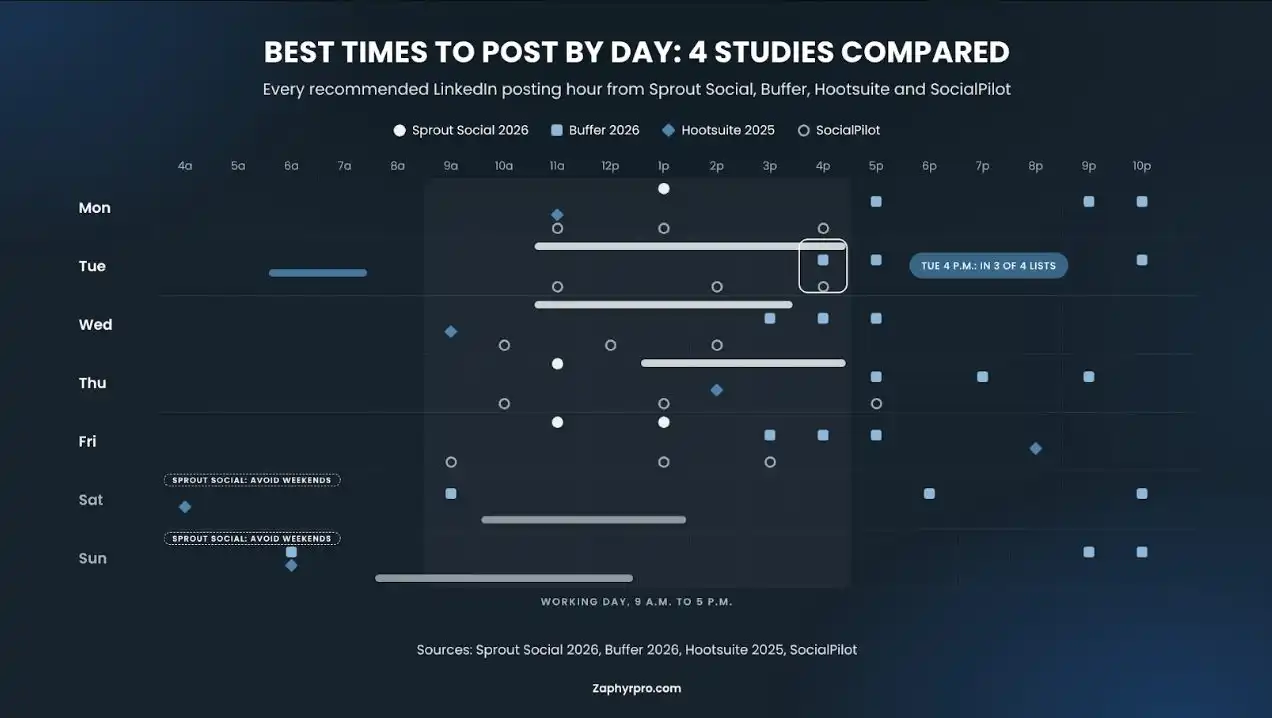
Tuesday, Wednesday, and Thursday appear frequently in LinkedIn timing studies, with recommendations ranging from morning publishing to late afternoon. The table below brings together the reported recommendations from four widely referenced studies so you can see how their findings compare.
| Day | Sprout Social 2026 | Buffer 2026 | Hootsuite 2025 | SocialPilot |
|---|---|---|---|---|
| Monday | 1–2 p.m. | 10 p.m., 5 p.m., 9 p.m. | 11 a.m. | 11 a.m., 1 p.m., 4 p.m. |
| Tuesday | 11 a.m.–5 p.m. | 4 p.m., 5 p.m., 10 p.m. | 6–8 a.m. | 11 a.m., 2 p.m., 4 p.m. |
| Wednesday | 11 a.m.–4 p.m. | 4 p.m., 3 p.m., 5 p.m. | 9 a.m. | 10 a.m., 12 p.m., 2 p.m. |
| Thursday | 11 a.m. and 1–5 p.m. | 5 p.m., 7 p.m., 9 p.m. | 2 p.m. | 10 a.m., 1 p.m., 5 p.m. |
| Friday | 11 a.m. and 1–2 p.m. | 3 p.m., 4 p.m., 5 p.m. | 8 p.m. | 9 a.m., 1 p.m., 3 p.m. |
| Saturday | Avoid | 9 a.m., 6 p.m., 10 p.m. | 4–5 a.m. | 10 a.m.–2 p.m. |
| Sunday | Avoid | 10 p.m., 9 p.m., 6 a.m. | 6 a.m. | 8 a.m.–1 p.m. |
Best Time to Post on LinkedIn on Monday
Monday can be a useful day for business updates, industry commentary, and content that helps people plan their week, although it does not receive the same level of attention as Tuesday through Thursday in the studies compared here.
Sprout Social recommends publishing between 1 p.m. and 2 p.m., while Hootsuite identifies 11 a.m. as its preferred Monday slot. SocialPilot also lists 11 a.m., 1 p.m., and 4 p.m. among its recommendations.
For a B2B company, early Monday morning may not be the best time to publish an important announcement if the intended audience is catching up on emails, reviewing internal priorities, or preparing for the week. Testing a lunchtime or early-afternoon post gives your content another opportunity to reach people after their morning workload has settled.
What to publish: Industry news, a useful observation from the previous week, a short business update, or a question that encourages professionals to share their experiences.
Best Time to Post on LinkedIn on Tuesday
Tuesday deserves a place near the top of your testing schedule. Sprout Social recommends a broad window from 11 a.m. to 5 p.m., Buffer lists 4 p.m., 5 p.m., and 10 p.m. among its leading slots, and SocialPilot includes 4 p.m. in its recommendations.
The 4 p.m. slot is particularly interesting because it appears in three of the four studies’ published recommendations. However, the time-zone difference between the reports must be resolved before treating this as a confirmed three-study consensus.
For B2B marketers, Tuesday afternoon is a sensible starting point for testing content that requires more attention, such as a document carousel, a practical framework, or a customer success story. These formats give readers something useful to explore and can encourage them to spend more time with the post.
What to publish: A downloadable resource, a carousel explaining a business problem, an original research finding, or a detailed post about a common industry challenge.
Best Time to Post on LinkedIn on Wednesday
Wednesday receives strong recommendations across the studies, although the preferred hours vary. Sprout Social identifies 11 a.m. to 4 p.m., Buffer lists 3 p.m., 4 p.m., and 5 p.m., Hootsuite recommends 9 a.m., and SocialPilot includes 10 a.m., noon, and 2 p.m.
The spread gives B2B teams several hours worth testing, from mid-morning through the afternoon. Buffer also identifies Wednesday as its strongest day overall, making it a useful candidate for content that supports an important campaign or business objective.
Wednesday can work well for posts that share a lesson, explain a process, or give readers a closer look at how a company approaches a particular problem. A customer story, for example, can show how a challenge was handled without turning the entire post into a sales pitch.
What to publish: Customer stories, practical lessons, educational carousels, expert commentary, and posts that explain how a particular process works.
Best Time to Post on LinkedIn on Thursday
Thursday’s recommendations also lean towards the middle and later parts of the working day. Sprout Social lists 11 a.m. and several afternoon hours, Buffer recommends 5 p.m., 7 p.m., and 9 p.m., Hootsuite identifies 2 p.m., and SocialPilot includes 10 a.m., 1 p.m., and 5 p.m.
For a B2B audience, early afternoon is worth testing when your content is intended for people who are still working through their professional tasks. A webinar announcement, event invitation, or longer educational post can fit naturally into this part of the week.
If your audience includes people who work across different time zones or regularly check LinkedIn after office hours, a later slot may also deserve a place in your experiment.
What to publish: Webinar invitations, event announcements, longer educational posts, industry opinions, and resources connected to an upcoming campaign.
Best Time to Post on LinkedIn on Friday
Friday has a more varied set of recommendations. Sprout Social identifies 11 a.m. and 1 p.m. to 2 p.m., Buffer recommends 3 p.m., 4 p.m., and 5 p.m., Hootsuite lists 8 p.m., and SocialPilot includes 9 a.m., 1 p.m., and 3 p.m.
Friday content does not have to be limited to light updates, although the nature of your audience should influence what you publish. A detailed industry report may receive more attention earlier in the day, while a short reflection, team update, or useful takeaway from the week may suit a later slot.
If your business sells to professionals who spend Friday afternoon wrapping up their work, test a post before the end of their working day and compare its performance with your Tuesday and Wednesday content.
What to publish: A weekly industry roundup, a lesson from a completed project, a team update, a short poll, or a useful summary of a recent report.
Best Time to Post on LinkedIn on Saturday and Sunday
Weekend publishing receives fewer strong recommendations for B2B content. Sprout Social advises avoiding Saturday and Sunday, while the other studies list several weekend hours without showing the same weekday pattern.
That does not mean every LinkedIn audience disappears on Friday evening and returns on Monday morning. Founders, recruiters, independent professionals, business owners, and people working across international markets may use the platform outside conventional office hours.
The important question is how your particular audience behaves. If your analytics show that weekend posts consistently receive fewer impressions and interactions, there may be little reason to use your strongest content on those days. If your audience is active on weekends, test a suitable slot and compare the results over several weeks.
What to publish: Personal reflections, professional milestones, community updates, or lighter educational content that does not depend on an immediate business response.
The Zaphyre LinkedIn Timing Consensus Index
A quick search for the best time to post on LinkedIn can leave you with several conflicting answers. One report recommends early mornings, another identifies afternoon publishing, and another gives a broad window that covers much of the working day.
We wanted to understand how much agreement actually exists between these recommendations, so we compared four published studies, and a comparison intended to show how frequently each hour appears in the studies’ recommended publishing windows.
What is the LinkedIn Timing Consensus Index?
The index examines the 168 hours in a week and records how many of the four selected studies recommend each hour. A score can range from zero to four, with a higher score indicating that more studies include that time in their recommendations.
What the index found
- Weekdays receive more attention than weekends. The four reports generally place greater emphasis on weekday publishing, with Tuesday, Wednesday, and Thursday appearing frequently in their recommendations. Sprout Social specifically advises avoiding Saturday and Sunday.
- Late morning and afternoon are worth testing. Several recommendations fall between 10 a.m. and 5 p.m., giving B2B teams a reasonable starting range for testing posts during the working day. Buffer’s later recommendations also make it worth examining afternoon and evening activity instead of assuming that every audience is most active before lunch.
- The studies do not agree on every day. Hootsuite’s early-morning recommendations differ from several of the later slots listed by Buffer and Sprout Social. This is one reason a single universal posting schedule can be misleading.
- The audience matters as much as the published benchmark. A company selling to executives in the United States may need a different schedule from a business targeting independent professionals in Europe or software developers in Asia. The same publishing hour does not represent the same point in everyone’s working day.
How We Calculate the Index
For a reliable comparison, every recommendation must first be converted to the same time basis. This is especially important when one study reports EST and another uses local audience time.
The calculation should follow these steps:
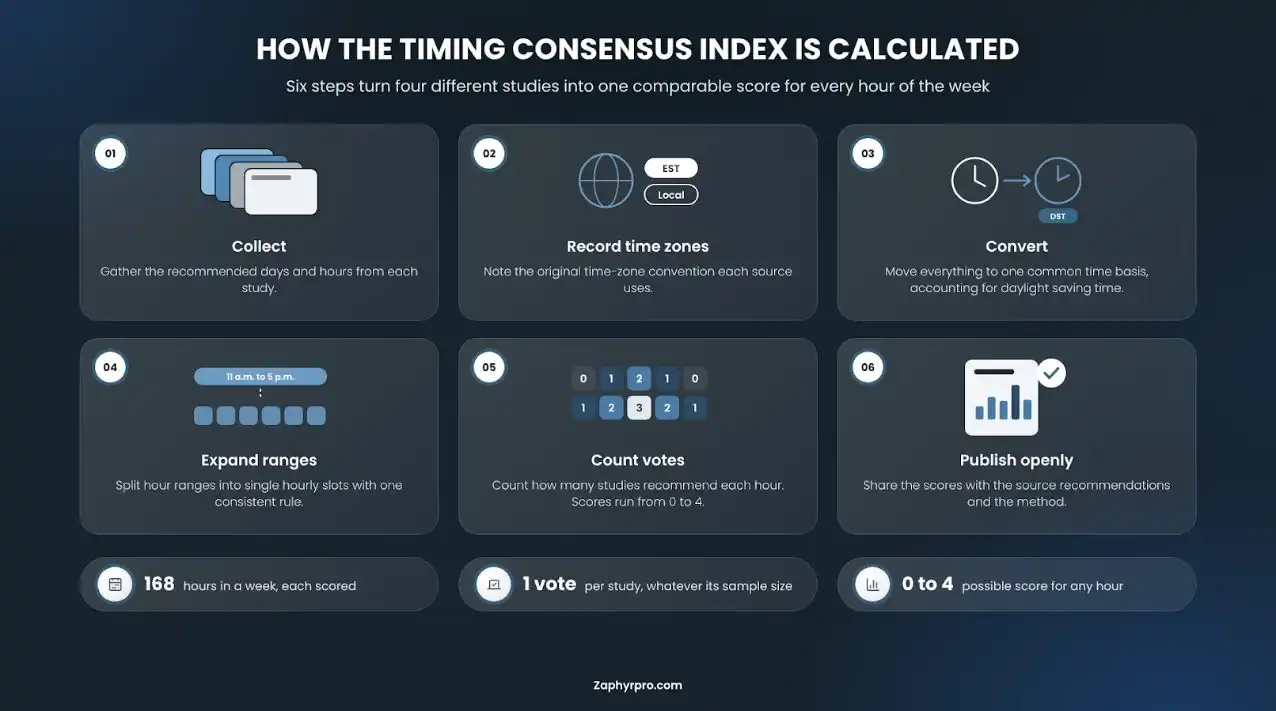
The index gives each study one vote, so a study with a larger dataset does not automatically receive more influence. This makes the comparison easier to understand, although it does not account for differences in sample size or research design.
The Consensus Heatmap
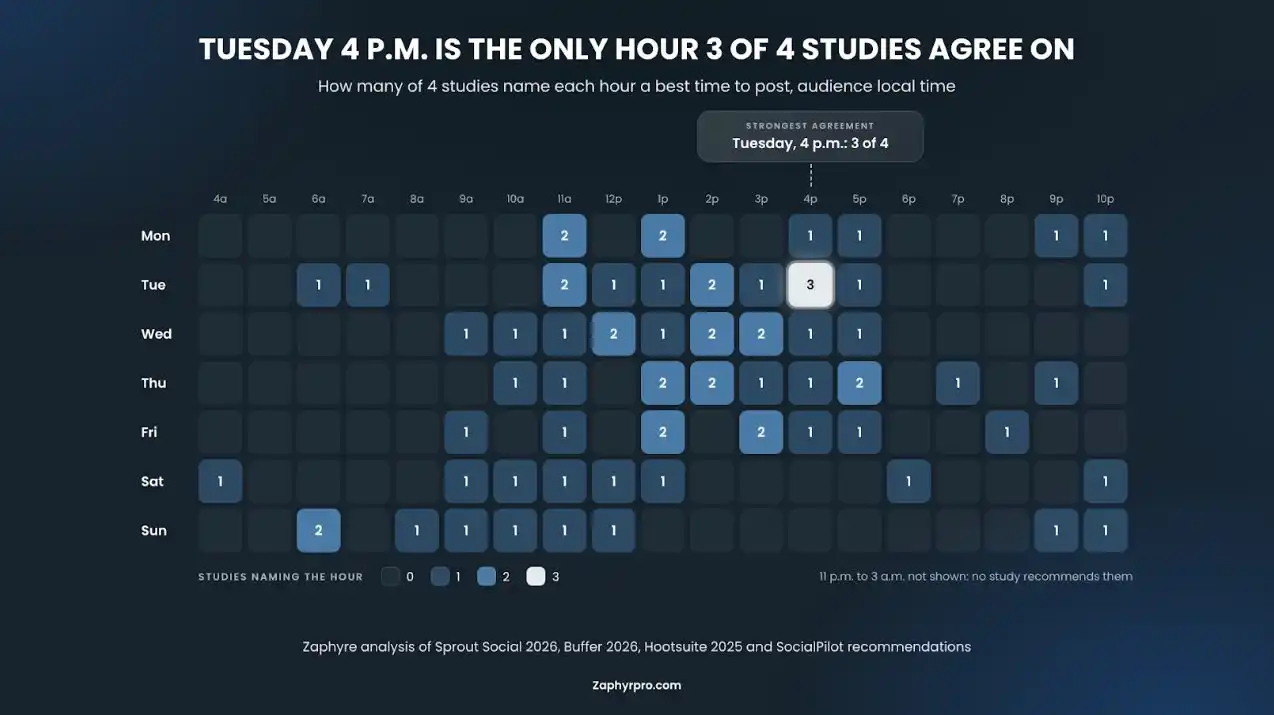
The heatmap brings all four studies together in one view, showing how frequently each hourly publishing slot appears in their recommendations across the seven days of the week. Darker cells indicate stronger agreement, while lighter cells show hours that receive less support across the selected sources.
The clearest concentration appears on weekday afternoons, particularly from Tuesday to Thursday. Morning recommendations also feature across the studies, although the suggested hours vary. Weekend slots receive considerably less agreement, making weekdays the more consistent starting point for B2B publishing tests.
The visualization covers 4 a.m. to 10 p.m. Hours between 11 p.m. and 3 a.m. are excluded because none of the four studies recommends them.
Best Time to Post on LinkedIn for a US-Wide B2B Audience
A business targeting buyers across the United States has a scheduling problem that a local company may never encounter. A post published at 9 a.m. in New York reaches someone in California at 6 a.m., while a post scheduled for late afternoon on the East Coast may appear during lunchtime on the West Coast.
Zaphyre analysis uses approximate US population shares of 47% Eastern, 29% Central, 16% Pacific, and 6.5% Mountain. These figures add up to 98.5%, so the weights need to be normalized or the missing share explained before they are used in a final weighted calculation.
Convert each candidate Eastern Time publishing slot into the corresponding local time in the other zones, measure how well that slot matches the normalized recommendations, and then weight the results by the audience distribution.
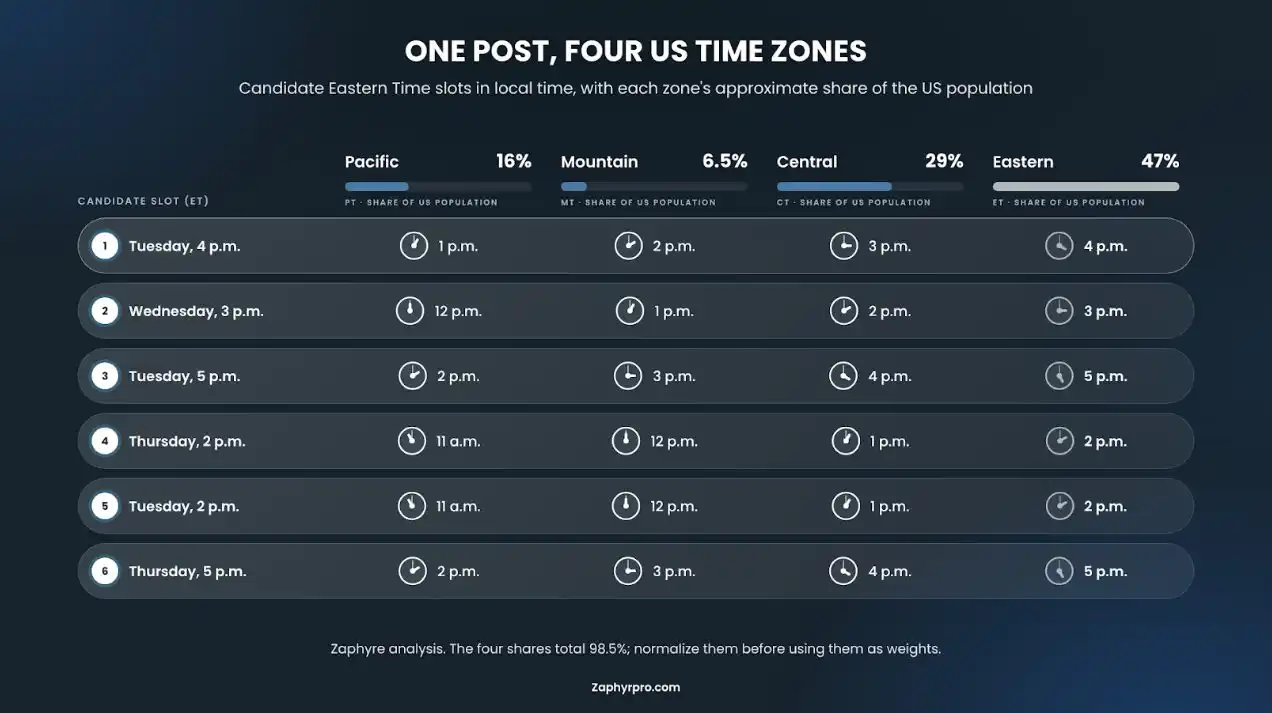
For a business whose audience is concentrated in one region, use that region’s local time as your starting point. A company targeting buyers in New York does not need to optimize its schedule for California if only a small share of its prospects are based there.
If your audience spans North America, Europe, and Asia, one post may not reach everyone during their working day. Publishing separate versions at suitable times can give each regional audience a better opportunity to see and interact with your content.
Best Times to Post on LinkedIn by Industry
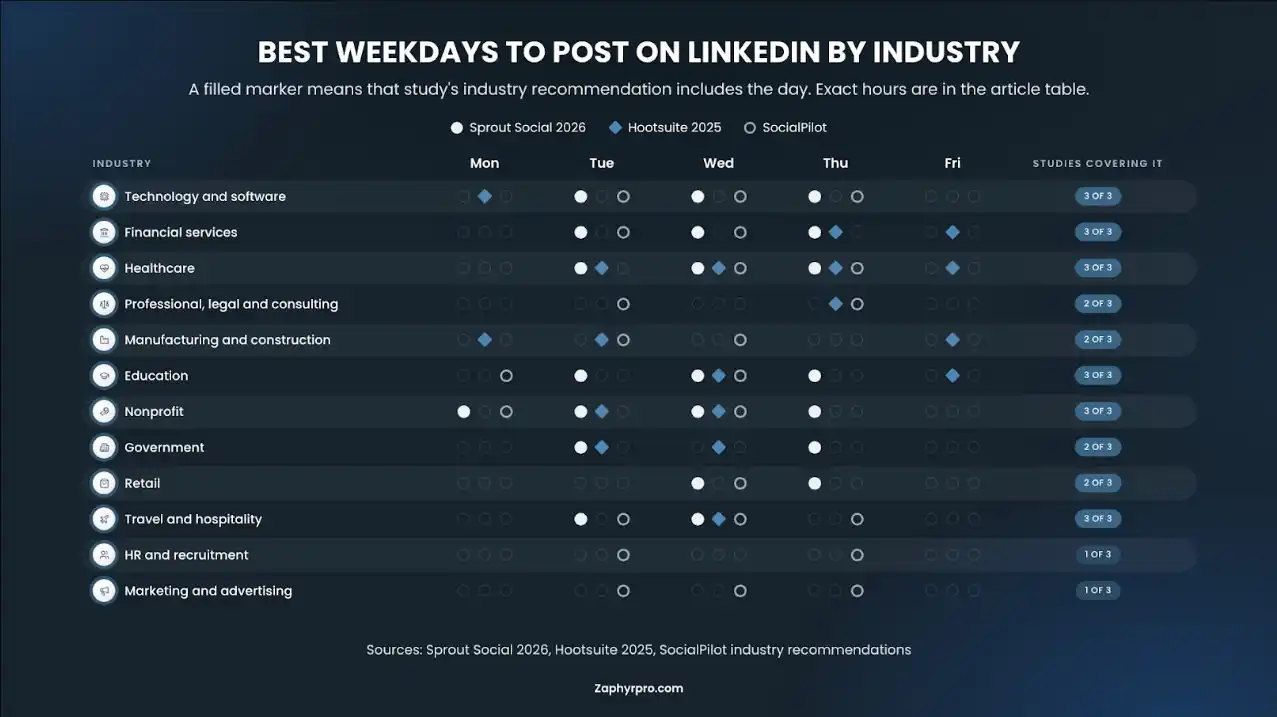
A general posting schedule can help you begin, but industry-specific research gives you a more useful starting point when your audience has a distinct working routine. The table below brings together the industry recommendations available in the selected Sprout Social, Hootsuite, and SocialPilot reports.
Technology and Software
Technology and software companies have several useful weekday windows to test, particularly Tuesday through Thursday. Sprout Social’s recommendations cover much of the working day, while SocialPilot points towards mid-morning publishing.
For SaaS companies and technology service providers, the content itself should influence the publishing slot. A short product update may be easy to consume during a morning break, while a detailed guide or customer story may benefit from a time when the audience can spend longer reading.
Financial Services
Financial services recommendations vary more noticeably between the reports. Sprout Social includes morning and afternoon windows, SocialPilot favors early weekday hours, and Hootsuite identifies late Thursday afternoon and Friday lunchtime.
Financial professionals often have busy schedules, so testing more than one window is sensible. Compare the results for educational content, regulatory updates, and industry commentary separately, since these posts may attract different types of engagement.
Healthcare
The healthcare recommendations generally favor weekdays, with several windows between mid-morning and late afternoon. The best slot may depend on the audience you are targeting, since hospital administrators, healthcare technology leaders, clinicians, and practice owners do not necessarily follow the same work patterns.
For healthcare B2B marketing, publish educational material and operational insights at times when decision-makers are likely to have an opportunity to read them, then use account analytics to identify the strongest patterns.
Professional Services, Legal and Consulting
The available recommendations point towards weekday mornings, although the research coverage is limited compared with industries such as technology and healthcare.
Law firms, accounting firms, and professional service providers should test posts around the start of the working day and late morning. Content that explains a business issue, shares a practical lesson, or comments on an industry development can be a good fit for these audiences.
Manufacturing and Construction
Manufacturing and construction recommendations include early weekday hours, mid-morning, and some afternoon slots. Since many professionals in these industries divide their time between offices, job sites, production facilities, and client locations, their LinkedIn activity may not follow a conventional desk-based schedule.
Test different hours with content that speaks directly to operational challenges, project updates, workforce issues, and industry developments.
Education and Government
Education recommendations include broad weekday windows, while government research points towards Tuesday and Thursday. These audiences may include administrators, institutional leaders, public-sector employees, and other professionals whose schedules are influenced by meetings, academic calendars, or public service responsibilities.
Use the published recommendations as a starting point, then compare performance during the periods when your intended audience is most likely to be available.
Nonprofit, Retail, Travel and Hospitality
The available research generally points towards weekday publishing for nonprofit, retail, and travel-related audiences. However, the people following these organizations may include consumers, employees, partners, donors, and business decision-makers, each with different reasons for using LinkedIn.
A nonprofit speaking to corporate sponsors may need a different schedule from one recruiting volunteers. A hospitality supplier targeting hotel executives may also have different audience behavior from a consumer-facing travel brand.
HR, Recruitment, Marketing and Advertising
SocialPilot provides weekday morning recommendations for HR, recruitment, marketing, and advertising audiences, although the other reports offer limited coverage for these categories.
Recruitment teams can test posts around mid-morning when hiring professionals are working through candidate and client activity. Marketing teams may also find weekday mornings useful for industry commentary, campaign lessons, and practical resources.
Does Posting Time Affect LinkedIn Reach and Engagement?
Publishing time can influence how many people have an opportunity to see a post shortly after it goes live, but it is only one part of the process. A post can appear during a popular publishing window and still receive little attention if the subject is irrelevant, the opening is unclear, or the content offers nothing useful to the people reading it.
For this reason, treat timing research as a starting point. Your own results should determine which hours remain on the calendar.
Timing Is Only One Part of Post Performance
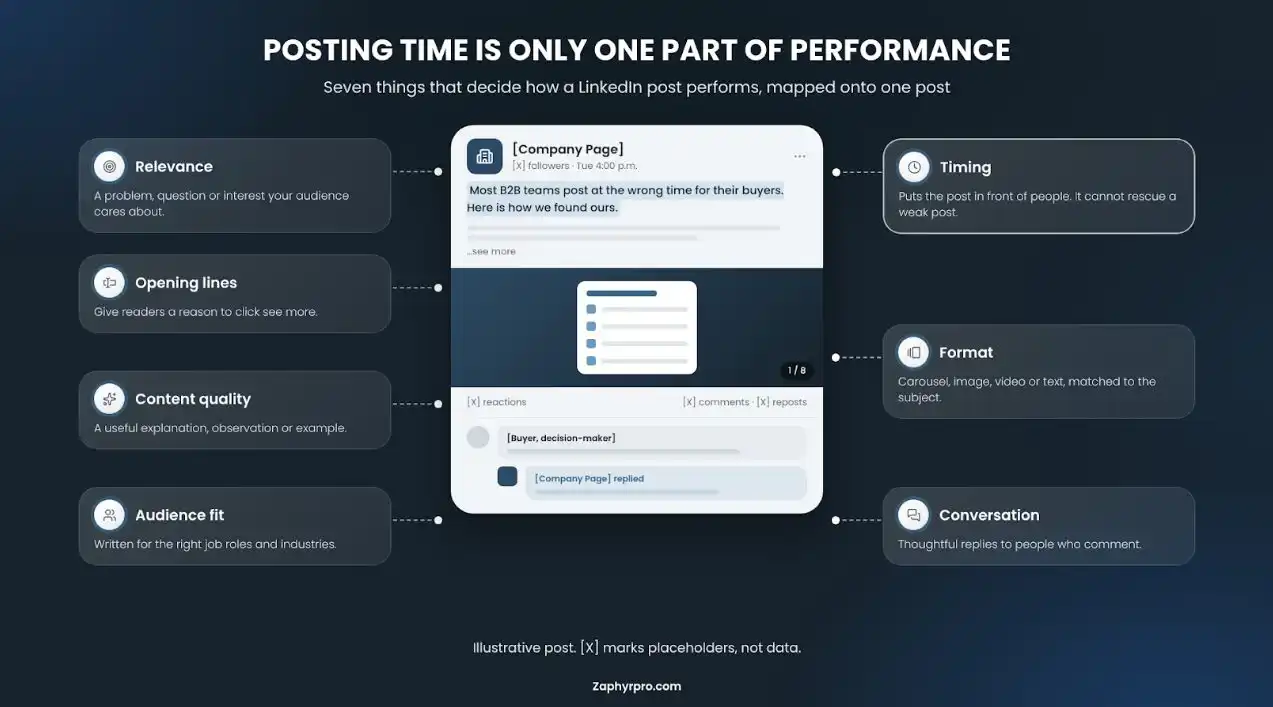
Several factors influence how a LinkedIn post performs:
- Relevance: The topic should address a problem, question, or interest that matters to your intended audience.
- Opening lines: The first lines need to give readers a reason to continue beyond the preview.
- Content quality: A useful explanation, original observation, or practical example gives people something worth reading.
- Format: A carousel, image, video, or text post may suit one subject better than another.
- Audience fit: Content written for the wrong job roles or industries can struggle even when published at a popular hour.
- Conversation: Thoughtful responses to comments help you engage with people who take an interest in your post.
What to Post on LinkedIn: Formats and Content Ideas
A publishing schedule tells you when to share content, but the subject and format determine what people actually have to engage with. B2B companies should build a content mix that gives their audience useful information, shows how the business understands its industry, and introduces its services when there is a natural reason to do so.
Which LinkedIn Post Formats Earn Engagement?
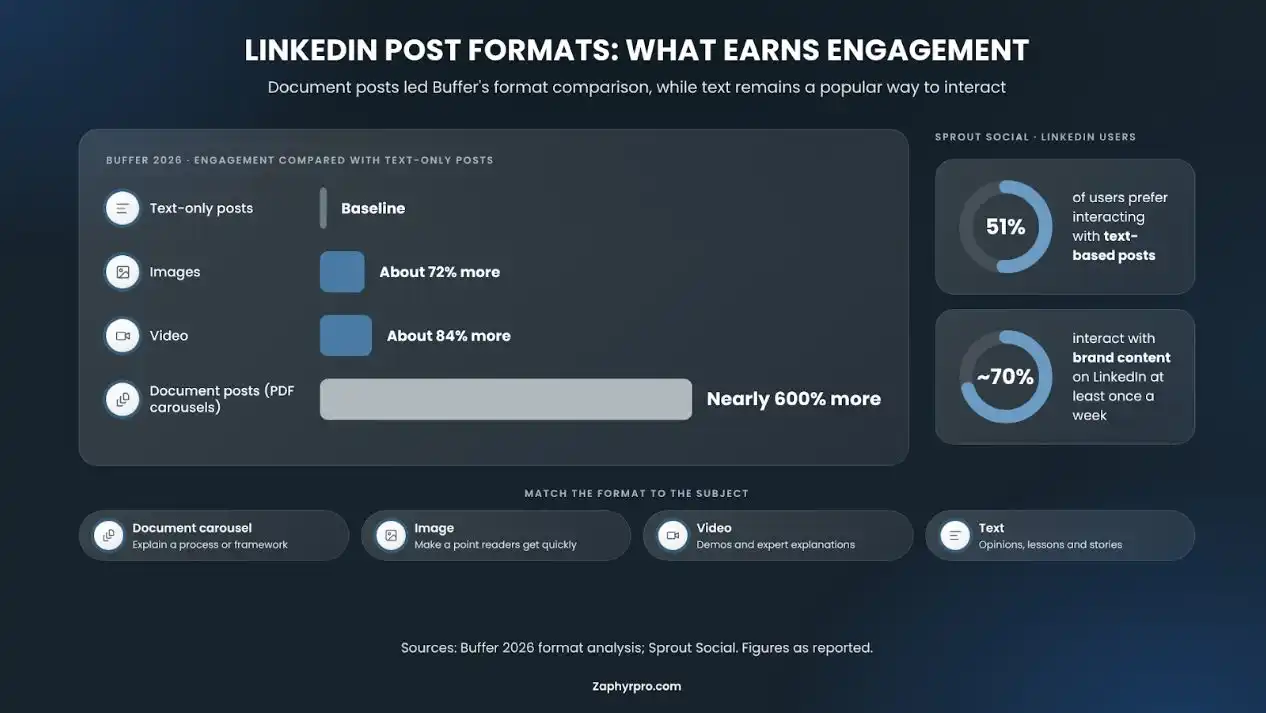
Buffer’s analysis found that document posts, including PDF carousels, achieved the highest engagement and reach among the formats it compared. Its reported figures show document posts performing nearly 600% better than text-only posts in engagement, with images and video also receiving stronger results than text-only content in the study.
The same research reported that images received about 72% more engagement than text posts, while video received about 84% more.
Text posts still have an important role in B2B marketing. Sprout Social reports that 51% of users prefer interacting with text-based posts, while nearly 70% interact with brand content on LinkedIn at least once a week.
The most useful approach is to choose a format that supports the subject you want to explain.
- Document carousels: Use a PDF carousel to explain a process, share a framework, present research findings, or turn a detailed topic into a sequence of easy-to-follow slides.
- Images: Use original graphics, photographs, charts, or simple visual explanations to support a point that readers can understand quickly.
- Video: Share product demonstrations, short expert explanations, event highlights, or conversations with people who understand the subject.
- Text posts: Use text when the message depends on a personal observation, an industry opinion, a practical lesson, or a story that benefits from a more direct explanation.
B2B LinkedIn Post Ideas
If your content calendar is starting to look like a collection of company announcements, give readers more reasons to follow your page by including posts that address the questions they already have.
Here are some ideas to work into your schedule:
- A framework or checklist: Break down a process your audience can use to solve a common business problem.
- An original data point: Share a finding from your own research, explain how you collected it, and discuss what it means.
- A customer story: Describe a challenge, the steps taken to address it, and the result, using only claims you can substantiate.
- An industry opinion: Explain why you agree or disagree with a common practice and support your view with relevant experience.
- A webinar or report recap: Share the most useful lessons from an event, presentation, or industry report.
- A behind-the-scenes post: Show how your team approaches a task, manages a process, or handles a common challenge.
What Is the Best LinkedIn Post Length?
For many B2B posts, a range of 1,300 to 2,500 characters is worth testing. AuthoredUp’s analysis of 372,126 personal-profile posts published between September 2025 and February 2026 found that median engagement increased across several longer post-length categories.
The reported median engagement rate was 2.10% for posts under 400 characters and 2.67% for posts between 2,001 and 2,500 characters.
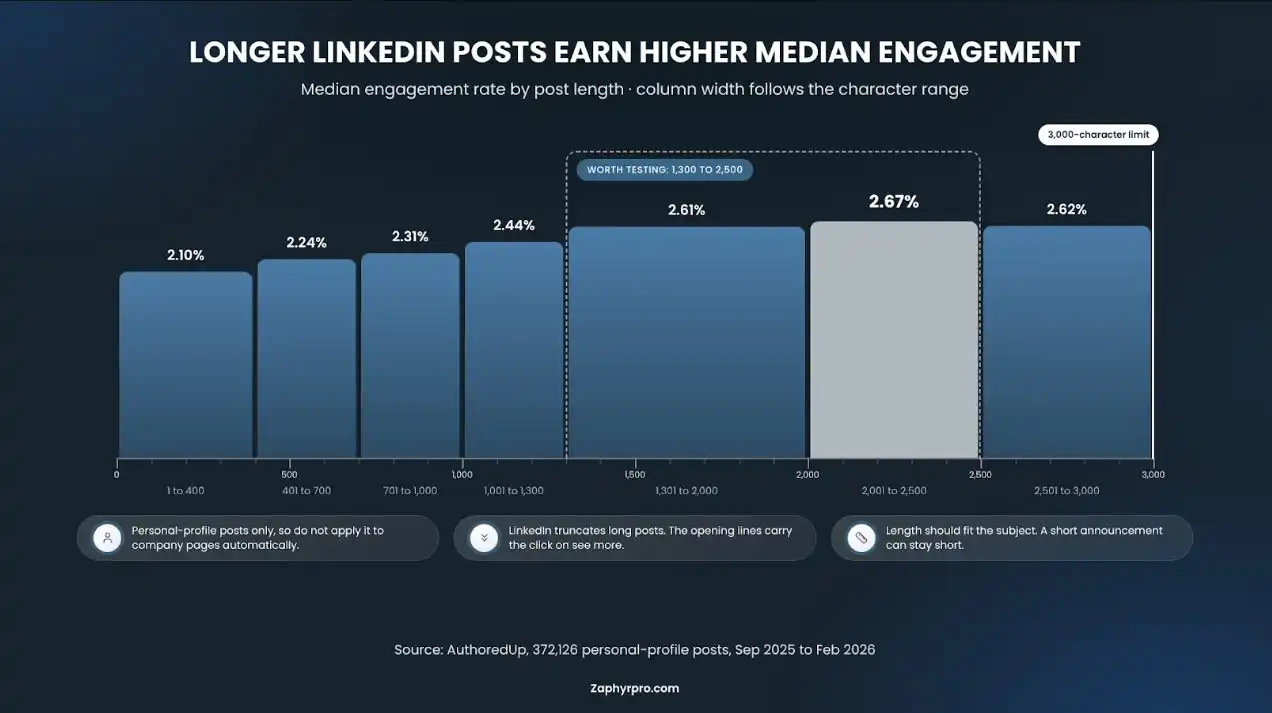
These findings relate to personal-profile posts in AuthoredUp’s dataset, so they should not automatically be applied to company pages. They also do not mean that every post should be expanded to 2,500 characters. A short announcement may communicate its message clearly in a few sentences, while an educational post may need more room to explain the subject properly.
LinkedIn allows up to 3,000 characters in a standard post. The preview also truncates longer posts, with the visible amount varying by device and interface. The first lines should therefore introduce the subject clearly and give readers a reason to open the full post.
The 4-1-1 Rule for LinkedIn Content
The 4-1-1 rule offers a simple way to balance educational content with promotional posts. The rule is commonly credited to Andrew Davis of Tippingpoint Labs and was popularized by Joe Pulizzi of the Content Marketing Institute.
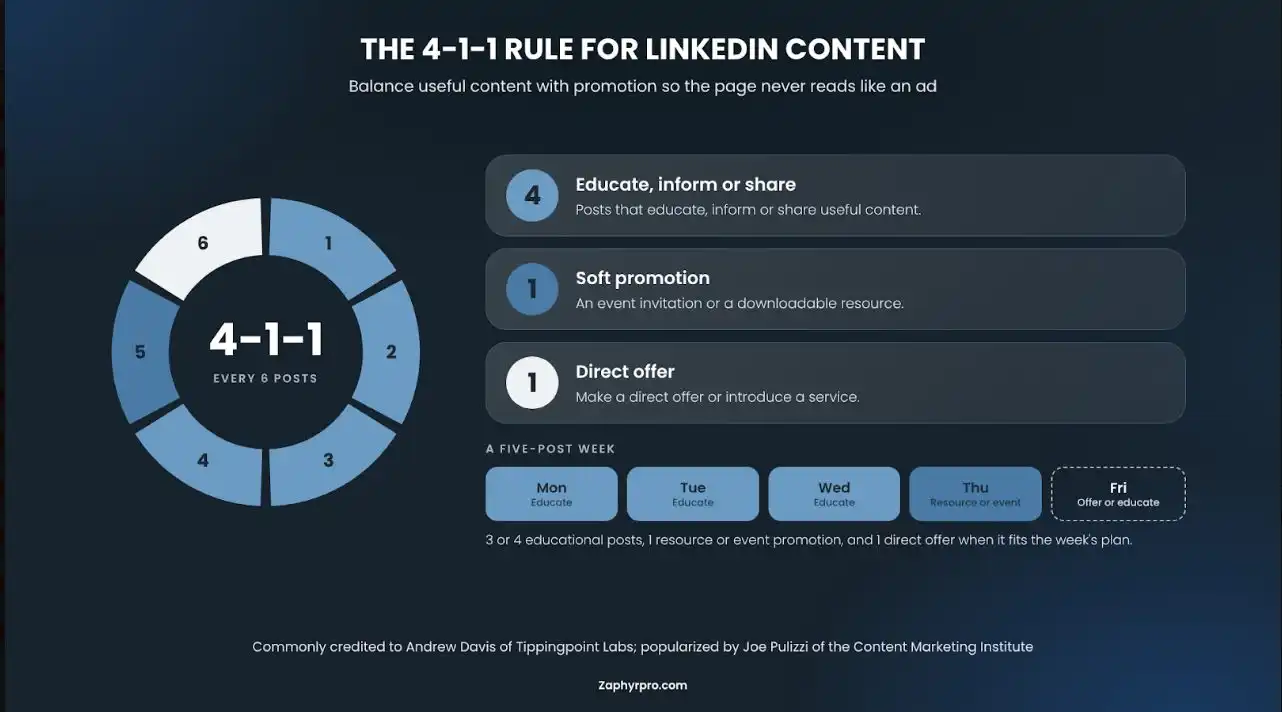
For every six posts:
- Four should educate, inform, or share useful content.
- One should be a soft promotion, such as an event invitation or downloadable resource.
- One can make a direct offer or introduce a service.
For a five-post publishing week, this could mean three or four educational posts, one resource or event promotion, and one direct offer when it fits the week’s content plan.
The point is to avoid turning every post into a sales message. People follow business pages to learn about subjects that interest them, keep up with industry developments, and discover useful ideas. Promotional content has a better place in the calendar when the rest of the publishing schedule gives readers something valuable.
A Weekly B2B LinkedIn Posting Schedule You Can Copy
The following five-post schedule uses the published recommendations as starting points and gives each day a clear content purpose. The times are suggested testing slots, not guaranteed peak hours. Use your audience’s main time zone and adjust the schedule after reviewing your own analytics.
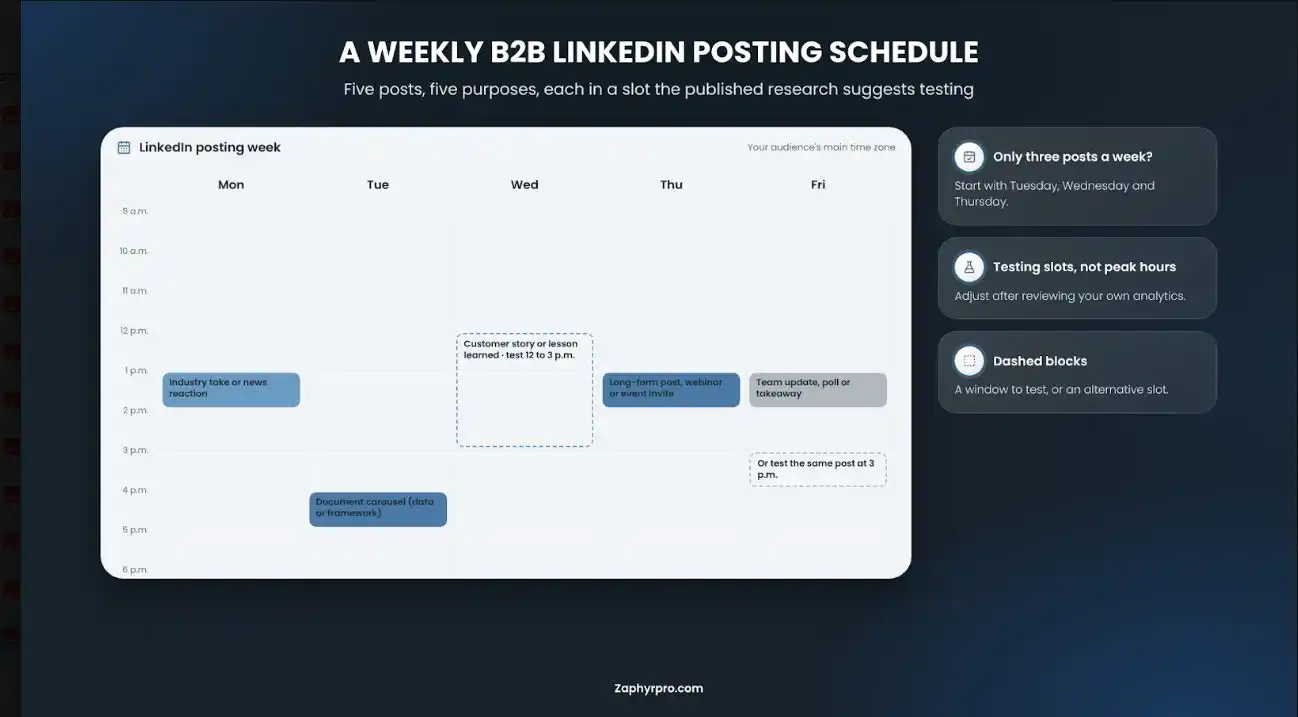
If your team can only publish three times per week, begin with Tuesday, Wednesday, and Thursday. These days appear frequently in the studies and give you a useful spread for testing different content formats.
Three Habits That Make the Schedule Easier to Maintain
- Prepare content in batches. Set aside time to write and review the week’s posts before they are due to go live. Preparing content in advance gives your team more room to check facts, improve the opening lines, and make sure each post supports a clear purpose.
- Make time for the conversation. Check your posts after publishing and respond to comments when you have something useful to add. This also gives your team an opportunity to understand what readers found interesting and what questions they are asking.
- Test links in the post body and comments. If a post needs a source, registration page, or useful resource, compare the results of different link placements and consider the experience you are giving readers.
How to Post and Schedule on LinkedIn
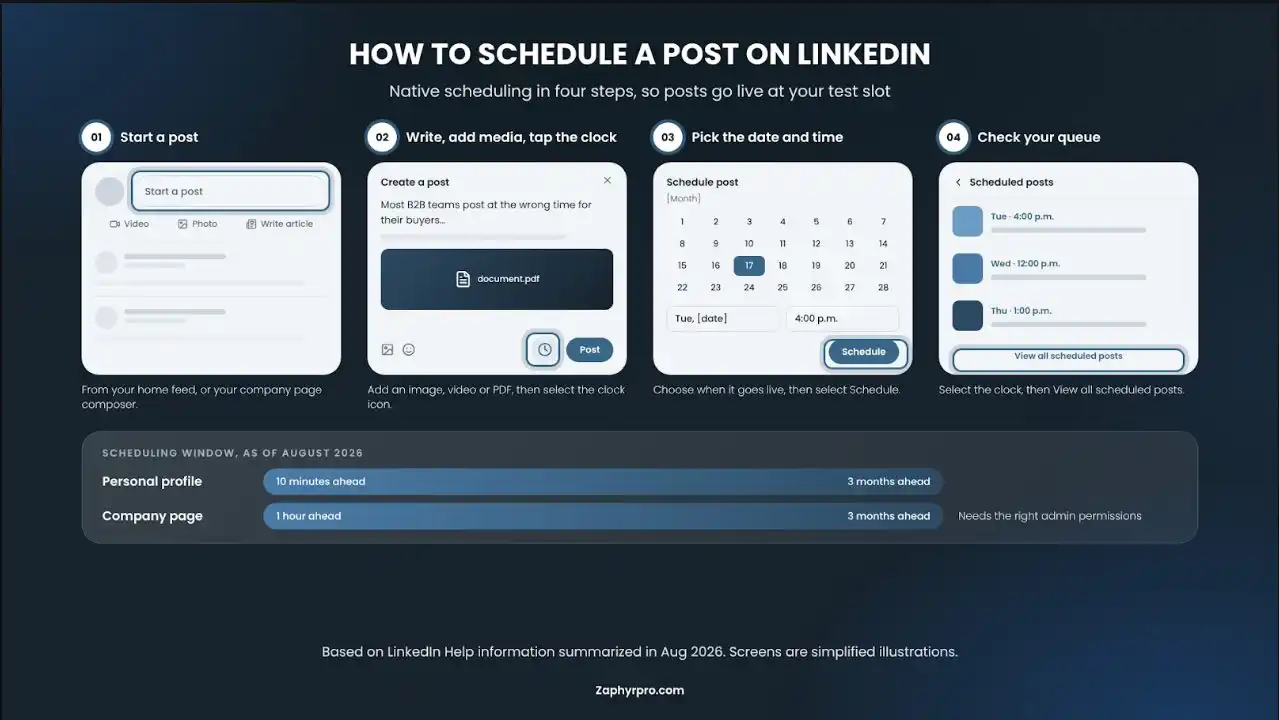
LinkedIn’s native scheduling feature allows users to prepare posts in advance, which makes it easier to maintain a consistent publishing schedule without having to be online at the exact moment a post needs to go live.
- Open LinkedIn and select Start a post from your home feed. If you are publishing through a company page, open the page’s post composer.
- Write your post and add any supporting media, such as an image, video, or PDF document.
- Select the clock icon next to the Post button.
- Choose the date and time when you want the post to be published.
- Review the scheduled time and select Schedule to confirm.
- To review your queue, open the post composer, select the clock icon, and choose View all scheduled posts.
LinkedIn’s scheduling limits and permissions can vary by account type and platform updates. The guidance used in this article, based on LinkedIn Help information summarized as of August 2026, indicates that personal profiles can schedule posts from 10 minutes to three months ahead, while company pages can schedule posts from one hour to three months ahead. Company-page scheduling also depends on having the appropriate administrator permissions.
How to Find Your Own Best Time to Post on LinkedIn: A Four-Week Test
A four-week test can help you compare several publishing slots without changing so many variables that the results become difficult to interpret. For the test to be useful, aim to publish at least three times per week and keep the content mix reasonably consistent.
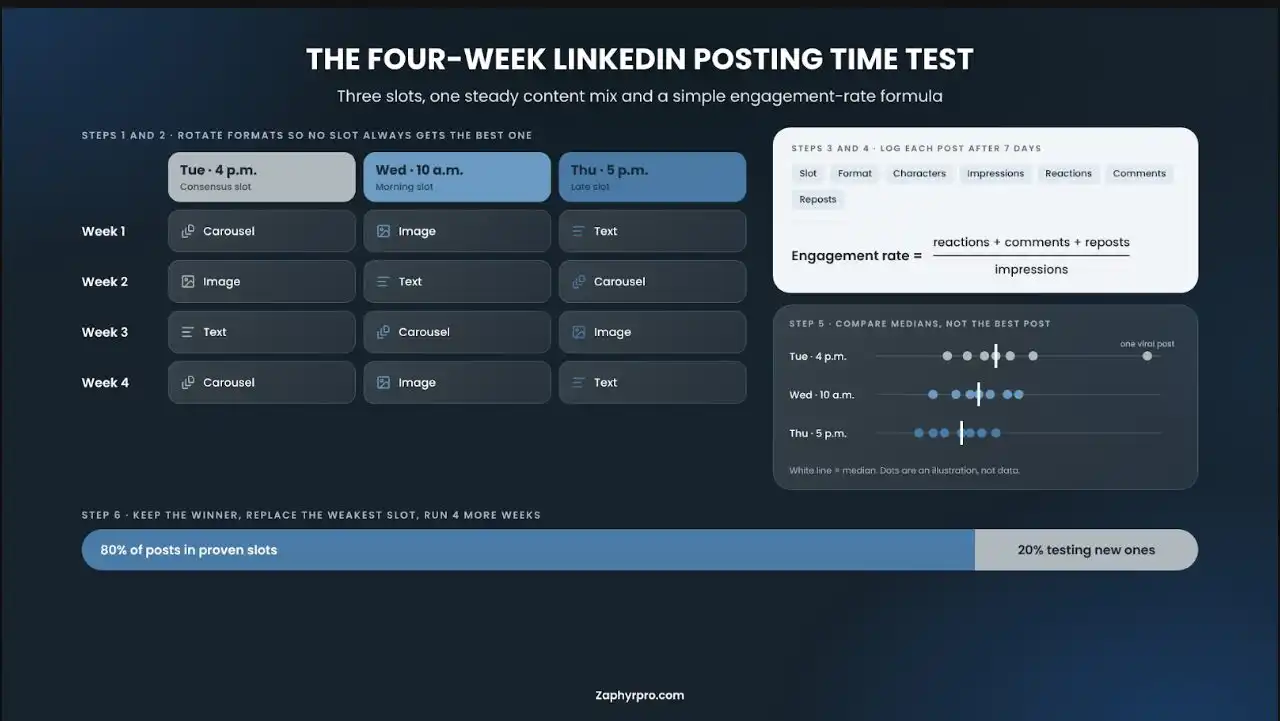
- Pick three slots to test. Use one consensus slot (Tuesday 4 p.m.), one morning slot (Wednesday 10 a.m.) and one late slot (Thursday 5 p.m.), all in your audience’s main time zone.
- Hold everything else steady. Rotate the same mix of formats across the three slots so no slot always gets your best carousel.
- Log each post. Record the slot, format, character count, impressions, reactions, comments and reposts after 7 days, once LinkedIn’s numbers settle.
- Calculate engagement rate per post. Engagement rate = (reactions + comments + reposts) / impressions.
- Compare the medians, not the best post. One viral post can mislead you; the median per slot shows the pattern.
- Keep the winner, replace the loser. Swap the weakest slot for a new candidate from the consensus list and run another 4 weeks.
Use 80% of your posts in proven slots and 20% to test new ones, so your results keep improving without risking your reach.
Why Are Your LinkedIn Posts Not Getting Engagement?
A post can go live at the recommended time and still receive very little attention. If that keeps happening, publishing time may not be the main issue. Before changing your schedule, review the content and the audience you are trying to reach. A few common problems can make it difficult for a post to attract meaningful interaction.
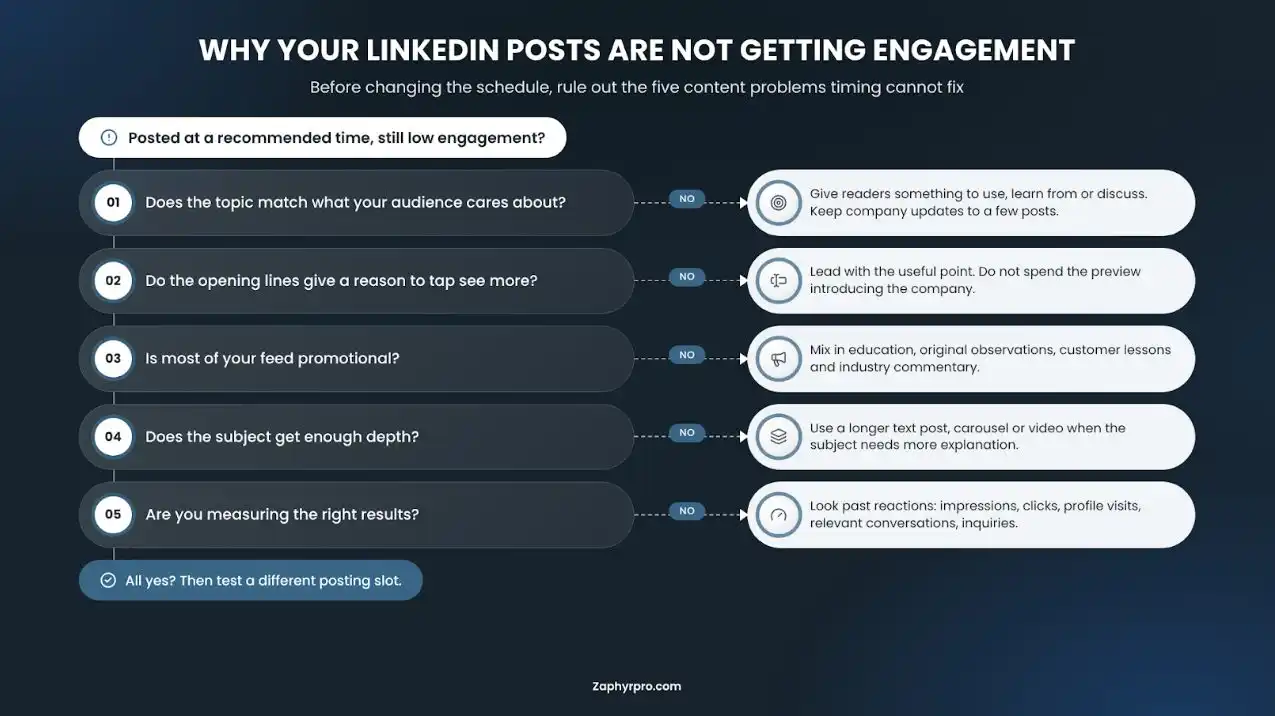
Your Topic Does Not Match Your Audience’s Interests
A post about your company’s latest internal achievement may be important to your team, but it may not answer a question your target audience is asking. Business updates have a place on LinkedIn, although most of your content should give readers something they can use, learn from, or discuss.
The Opening Does Not Give People a Reason to Read
LinkedIn displays only part of a longer post before asking users to select see more. If the opening spends several lines introducing the company or explaining an obvious point, readers may move on before reaching the useful information.
Every Post Promotes a Service
A content calendar filled with product announcements, service descriptions, and sales messages can make a company page feel like a permanent advertisement. Include educational posts, original observations, customer lessons, and industry commentary so promotional messages appear within a broader body of useful content.
You Are Not Giving the Subject Enough Attention
Some subjects need more than a short paragraph to explain properly. If a post introduces a complicated business problem but does not explain its causes, implications, or possible solutions, readers may not find much value in it. Use a longer text post, carousel, or video when the subject needs more explanation. Keep the format connected to the information you want to share.
You Are Measuring the Wrong Results
Reactions can be useful, but they do not tell you everything about a B2B post’s performance. A post that generates comments from relevant decision-makers or brings qualified visitors to your profile may contribute more to your marketing goals than one that receives a large number of casual reactions. Review engagement alongside impressions, clicks, profile visits, relevant conversations, and inquiries. The metrics you prioritize should reflect what the content is supposed to achieve.
Turn LinkedIn Timing Research Into a Publishing Schedule
Consistent LinkedIn activity can help your business stay visible, but visibility alone does not build a sales pipeline. You also need a way to identify relevant decision-makers, reach them with meaningful messages, and follow up without letting promising conversations go cold.
Zaphyre helps businesses do that through LinkedIn automation and outreach services. From prospect research and targeted connection campaigns to personalized messaging and follow-ups, we manage the outreach process so your team can focus on qualified conversations.
Ready to turn LinkedIn activity into qualified conversations?
Contact Zaphyre to discuss your lead generation goals.
Frequently Asked Questions
Tuesday through Thursday afternoons are useful starting points for LinkedIn publishing in 2026. In Zaphyre’s comparison of four major timing studies, Tuesday at 4 p.m. receives the most recommendations, with three out of four studies identifying it as a favorable publishing time. Your own audience analytics should determine whether that slot works for your account.
Tuesday, Wednesday, and Thursday are the strongest starting days for B2B publishing in Zaphyre’s comparison. Wednesday also shows a relatively concentrated range of recommended hours across the four studies. However, the best day can vary depending on your audience and industry.
Neither is universally better. Some research favors morning publishing, while Buffer’s 2026 analysis identifies late afternoon and evening as stronger engagement windows. Tuesday at 4 p.m. receives recommendations from three of the four studies compared in this article, making it a useful time to test.
Posting time can influence the engagement a post receives by changing when it becomes available to your audience. However, timing alone doesn’t determine performance. Content relevance, audience interest, format, and the quality of the conversation also matter.
For most B2B businesses, three to five quality posts per week is a practical starting schedule. Buffer’s research found higher per-post engagement metrics among accounts publishing more frequently than once a week. Businesses should choose a sustainable frequency and measure the results rather than increasing volume without a clear content strategy.
You don’t need to publish every day to maintain a consistent LinkedIn presence. Start with a schedule your team can sustain, such as three posts per week, and focus on publishing useful content regularly. Increase frequency when you can maintain quality and have something relevant to share.
The research compared here leans toward weekday midday and afternoon publishing, although some studies identify early-morning opportunities. Afternoon is a sensible starting point for testing, but your audience’s actual engagement patterns should guide the final decision.
It can. Company pages and personal profiles may attract different audiences and publish different types of content. Use industry benchmarks as a starting point, then evaluate each account separately using its own analytics.
LinkedIn allows up to 3,000 characters per post. However, the most useful length depends on the topic, format, and audience. In the AuthoredUp analysis cited in this article, posts between 2,001 and 2,500 characters recorded the highest median engagement rate among the character-length groups studied. Treat this as a benchmark, not a requirement.
The golden hour is an informal term for the period shortly after a post is published, when creators try to encourage early interactions and respond to comments. LinkedIn has not established a universal official 60-minute or 90-minute golden-hour rule. Being available to participate in relevant conversations after publishing is a more useful habit than treating a specific time window as an algorithmic guarantee.
Start by testing three different publishing windows over four weeks. Compare similar content formats, record impressions and engagement, and calculate the median performance for each time slot. Review clicks and qualified inquiries as well if your objective is B2B lead generation. Keep the strongest-performing windows and continue testing new ones.