
If you’re still building B2B sales pipelines the same way you did a few years ago, you may be spending too much time researching prospects and not enough time starting meaningful conversations.
I’ve seen AI reshape sales prospecting by helping teams identify better-fit buyers, prioritize stronger opportunities, and create more relevant outreach without adding hours of manual work.
In this guide, I’ll show you how B2B teams can use AI for sales prospecting to streamline repetitive tasks, improve lead quality, and scale outreach while preserving the human judgment that earns replies and builds trust.
Key Takeaways
- AI for sales prospecting works best as a connected system for discovering, enriching, prioritizing, personalizing, engaging, and analyzing potential buyers.
- The right AI sales prospecting tools depend on the team’s main bottleneck, whether that is data quality, account research, buyer signals, outreach, or CRM management.
- AI can automate repetitive SDR tasks, but human judgment remains essential for validating insights, handling objections, and building trust.
- Effective workflows begin with a defined trigger, include appropriate human oversight, and end with a measurable business outcome.
- Teams should evaluate AI through qualified meetings, conversion rates, pipeline generated, and time saved rather than outreach volume alone.
- The strongest implementation strategy is to begin with one use case, test it against a baseline, and expand only after accuracy and results are proven.
Get a practical framework to evaluate tools, design workflows, establish governance, and measure the business impact of AI-powered prospecting in your sales organization.
[Download the 2026 AI Sales Prospecting Playbook]
What Is AI for Sales Prospecting?
AI for sales prospecting is the use of artificial intelligence to find potential buyers, research their needs, evaluate their likelihood of purchasing, and support personalized sales engagement. Instead of asking a Sales Development Representative(SDR) to complete every step manually, AI completes the repetitive analysis and presents the rep with clearer opportunities.
This approach can support several parts of the prospecting process:
- Identifying companies that match an ideal customer profile
- Finding relevant decision-makers and buying committee members
- Enriching CRM records with company and contact information
- Monitoring buyer intent and behavioral signals
- Prioritizing accounts based on fit, timing, and engagement
- Researching business changes and potential pain points
- Drafting personalized emails, messages, and talking points
- Updating CRM records after prospecting activity
- Recommending the next action for each account
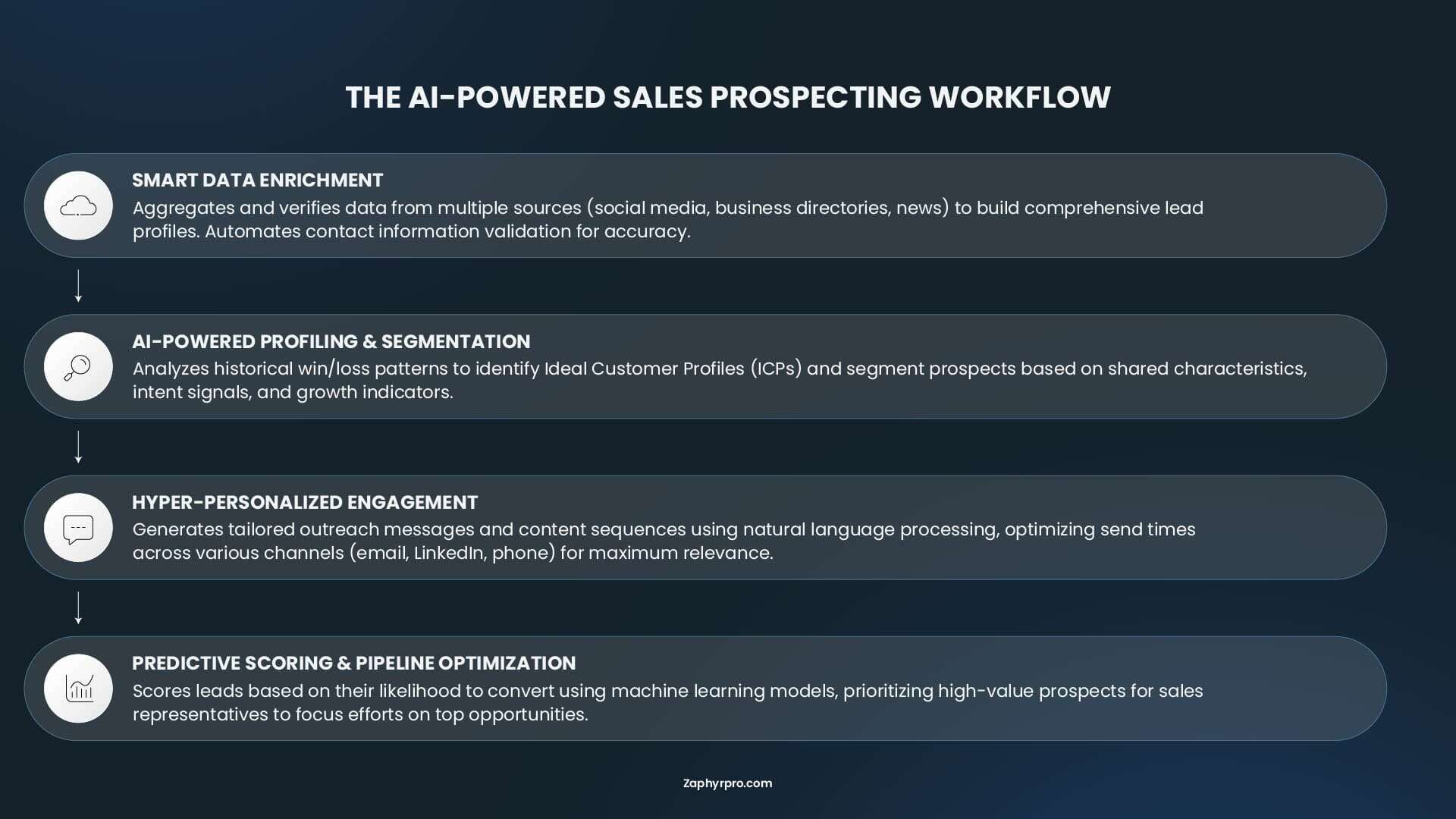
Traditional automated sales prospecting methods usually follow fixed rules. For example, a workflow might add every marketing director at a software company to the same email sequence.
AI-powered prospecting adds reasoning and context. It can compare multiple signals, summarize recent company developments, identify why a prospect may care, and adjust the outreach angle accordingly.
The purpose is not simply to generate a larger contact list. It is to determine which accounts deserve attention, which people matter inside those accounts, why the timing may be relevant, and how the sales team should approach them.
Can AI Replace Manual SDR Work?
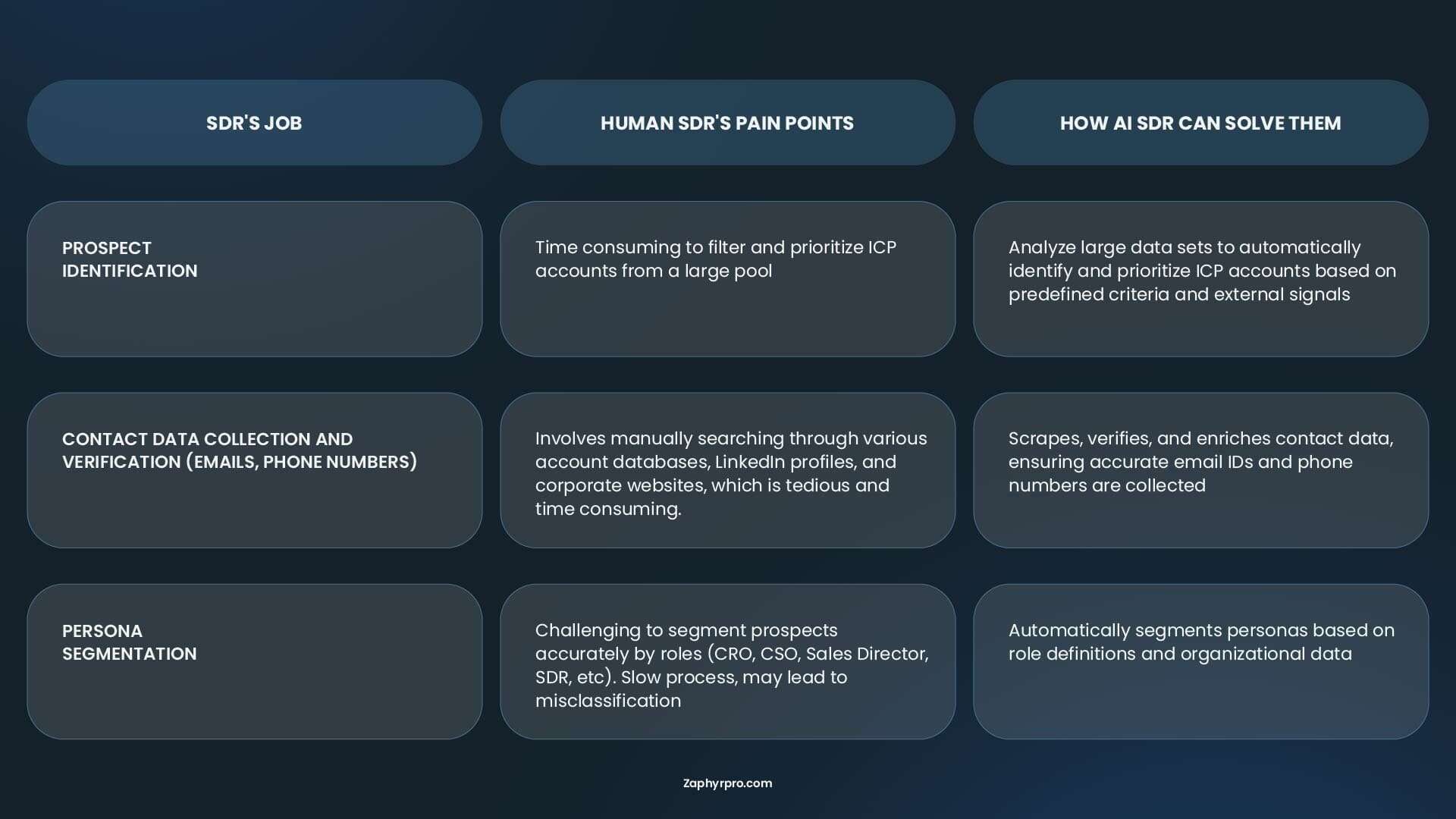
AI can automate many repetitive SDR activities, but it does not replace the judgment, communication skills, and relationship-building required for effective sales development.
The role of AI is to reduce manual work and help SDR teams to focus more time on higher-value activities. AI can support tasks such as account research, list building, data enrichment, lead scoring, CRM updates, workflow management, and creating initial messaging drafts.
However, human SDRs remain essential for activities that require context and judgment, including understanding buyer challenges, validating sales hypotheses, handling objections, adapting positioning, managing complex buying groups, and building trust with prospects.
The more complex or valuable the sales opportunity, the greater the need for human involvement. The future of sales development is not AI replacing SDRs, it is AI helping SDRs operate with better information, stronger prioritization, and more meaningful conversations.
Which Technologies Power AI Prospecting?
Modern AI prospecting platforms combine multiple technologies to help sales teams find, understand, and engage potential buyers more effectively:
- Machine learning detects patterns across customer, company, engagement, and conversion data.
- Predictive analytics estimates which accounts or leads are more likely to convert based on historical behavior.
- Natural language processing interprets company websites, news, emails, call transcripts, job listings, and other text-based information.
- Generative AI creates summaries, account insights, email drafts, messaging angles, and research notes.
- AI agents perform connected tasks across multiple systems, such as researching an account, enriching a contact, drafting outreach, and updating the CRM.
The most effective AI prospecting tools combine data intelligence, automation, content generation, and CRM integration to help sales teams spend less time searching and more time building relationships.
Why Is AI Transforming B2B Sales Prospecting in 2026?
Sales teams are adopting AI because prospecting has become more data-intensive while seller capacity remains limited. Salesforce’s 2026 State of Sales findings show that 87% of sales organizations use AI, while 54% of sellers have already used AI agents.
The shift is not happening because sales teams suddenly want to remove people from the process. It is happening because the amount of information required for effective prospecting has increased.
A seller may need to understand:
- Whether the company matches the ICP
- Which department owns the relevant challenge
- Who participates in the buying decision
- Which technologies the company already uses
- Whether the account is hiring or expanding
- Which executives have recently changed roles
- What the company is discussing publicly
- Whether someone from the account visited the website
- Whether the account has shown product or content engagement
- Which message is most relevant to each stakeholder
Completing that research manually for every account is difficult to sustain. AI compresses the research process. It can review several data sources, identify useful patterns, and give the seller a practical reason to engage.
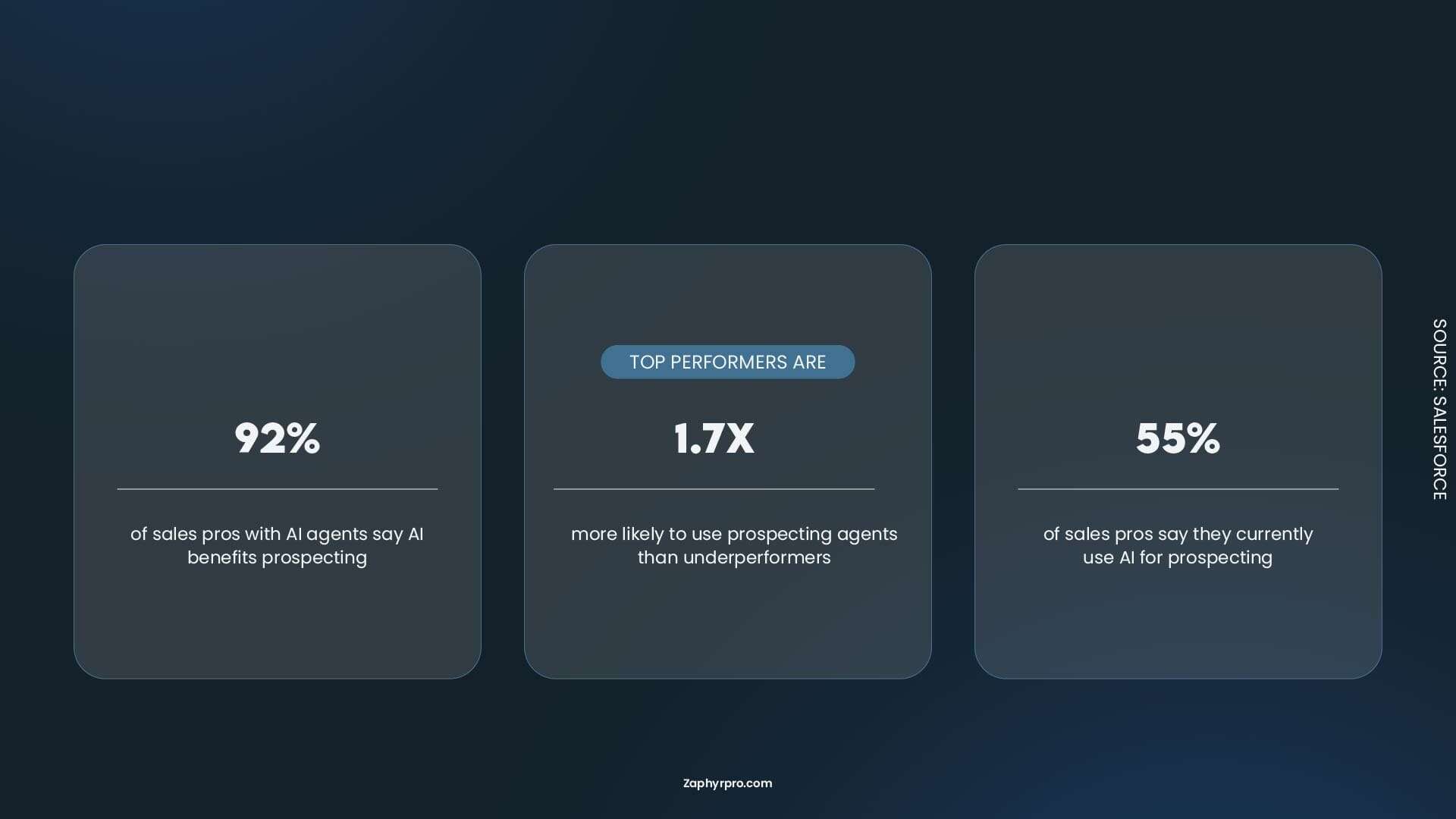
In another instance, Salesforce reports that sellers expect fully implemented agents to reduce prospect research time by 34% and email drafting time by 36%. The same research found that top-performing teams are 1.7 times more likely to use prospecting agents than underperforming teams.
That time can be redirected toward:
- Speaking with qualified prospects
- Preparing for discovery meetings
- Multithreading target accounts
- Handling objections
- Developing opportunities
- Building relationships with decision-makers
Practical Insight: AI transforms prospecting most effectively when it removes administrative work around research, prioritization, drafting, and CRM updates while leaving judgment, relationship-building, discovery, and negotiation with the seller.
What Are the Benefits of AI for Sales Prospecting?
AI prospecting creates value by improving how sales teams allocate their time and attention. LinkedIn’s research with 1,250 B2B sales professionals found that 88% use AI weekly and 56% use it daily. Sellers exceeding their targets were also 2.5 times more likely to use AI daily than those missing targets.
Here are the key ways AI improves sales prospecting:
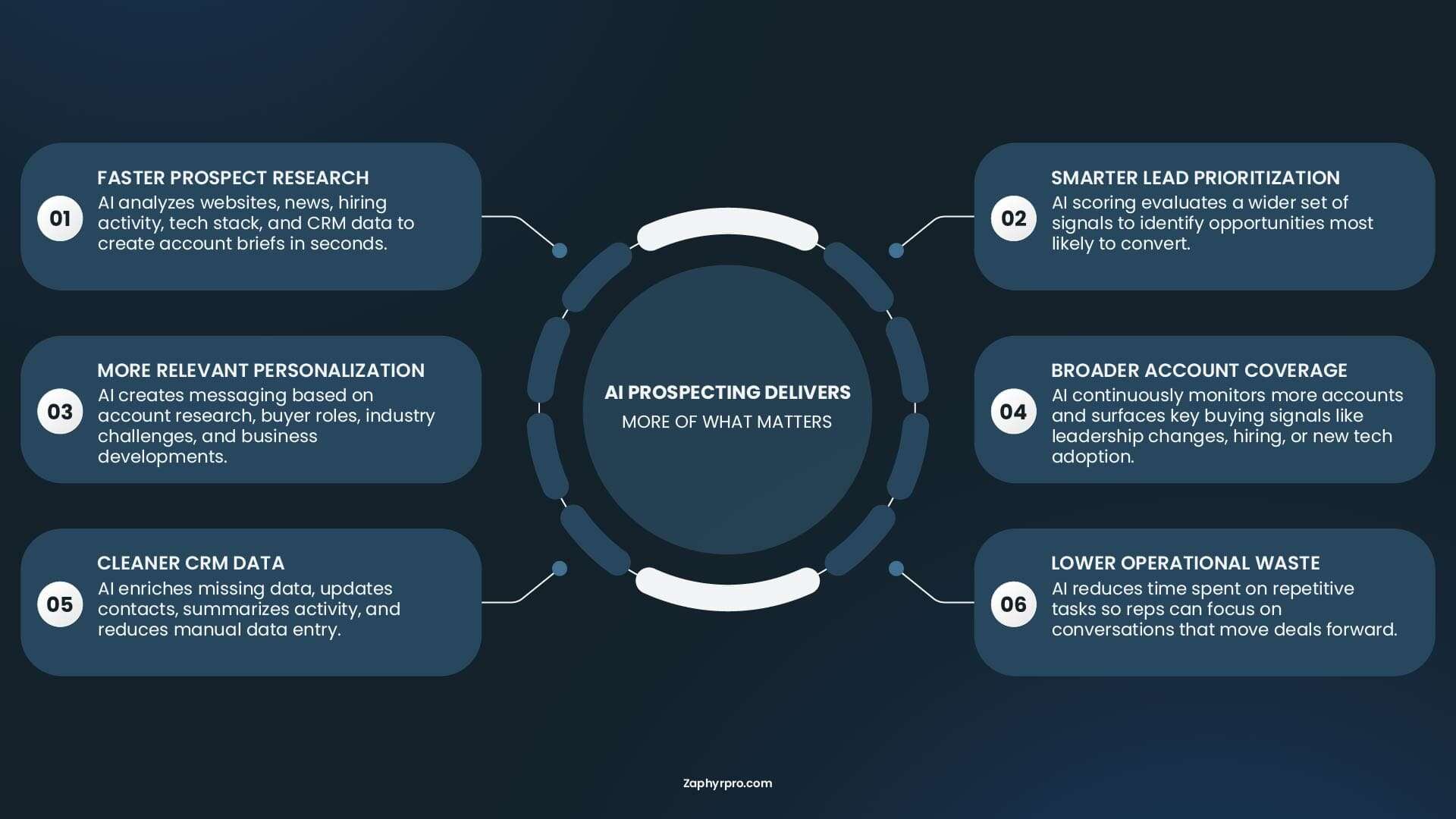
Faster Prospect Research
AI can analyze company websites, industry news, hiring activity, technology usage, executive priorities, and CRM history to create account summaries in seconds. Instead of spending hours collecting information across multiple sources, sales reps can begin with a structured account brief and spend more time evaluating opportunities and building relationships.
Smarter Lead Prioritization
Traditional lead scoring often relies on individual actions, such as email opens, content downloads, or job titles. AI-based scoring evaluates a wider range of signals, including:
- Ideal customer profile (ICP) fit
- Company size and industry
- Technology usage
- Website behavior
- Product engagement
- Hiring trends
- Third-party intent signals
- Previous sales conversations
- CRM history
AI scoring should not replace sales judgment. It should help teams identify which opportunities deserve attention first.
More Relevant Personalization
AI enables sales teams to create messaging based on account research, buyer responsibilities, industry challenges, and recent business developments. The best results come when sellers provide AI with clear inputs, such as:
- Target audience
- Approved value propositions
- Verified research
- Specific buyer challenges
- Brand guidelines
- Examples of effective messaging
AI improves personalization, but human expertise remains essential for creating credible sales conversations.
Broader Account Coverage
Sales teams often have limited time to research every potential account. AI helps expand coverage by monitoring larger account lists and identifying important buying signals, such as leadership changes, hiring activity, or new technology adoption.
For example, Salesforce’s Prospecting Agent uses CRM, web, and third-party signals to help identify relevant accounts and contacts with potential reasons for engagement. The goal is not to automate outreach to every account. The goal is to help sellers discover more opportunities at the right time.
Cleaner CRM Data
Accurate CRM data improves forecasting, routing, reporting, and personalization. AI prospecting tools can help enrich missing information, update contact details, summarize sales activity, and reduce manual data entry. However, teams should establish clear data rules, including which systems control specific fields and how conflicting information is handled.
Lower Operational Waste
AI can reduce time spent on repetitive activities such as manual research, list building, duplicate data entry, and basic account monitoring. However, adopting more AI tools does not automatically create efficiency. A complicated technology stack can increase costs and create workflow problems. The real value of AI should be measured through business outcomes, including:
- Research time per account
- Accounts covered per sales representative
- Positive reply rates
- Qualified meetings generated
- Lead-to-opportunity conversion
- Pipeline created per seller
- Cost per qualified opportunity
How Does AI Sales Prospecting Work?
The strongest AI sales prospecting workflows follow a connected sequence. To make that value practical, I use a five-stage model called the AI Prospecting Flywheel™.
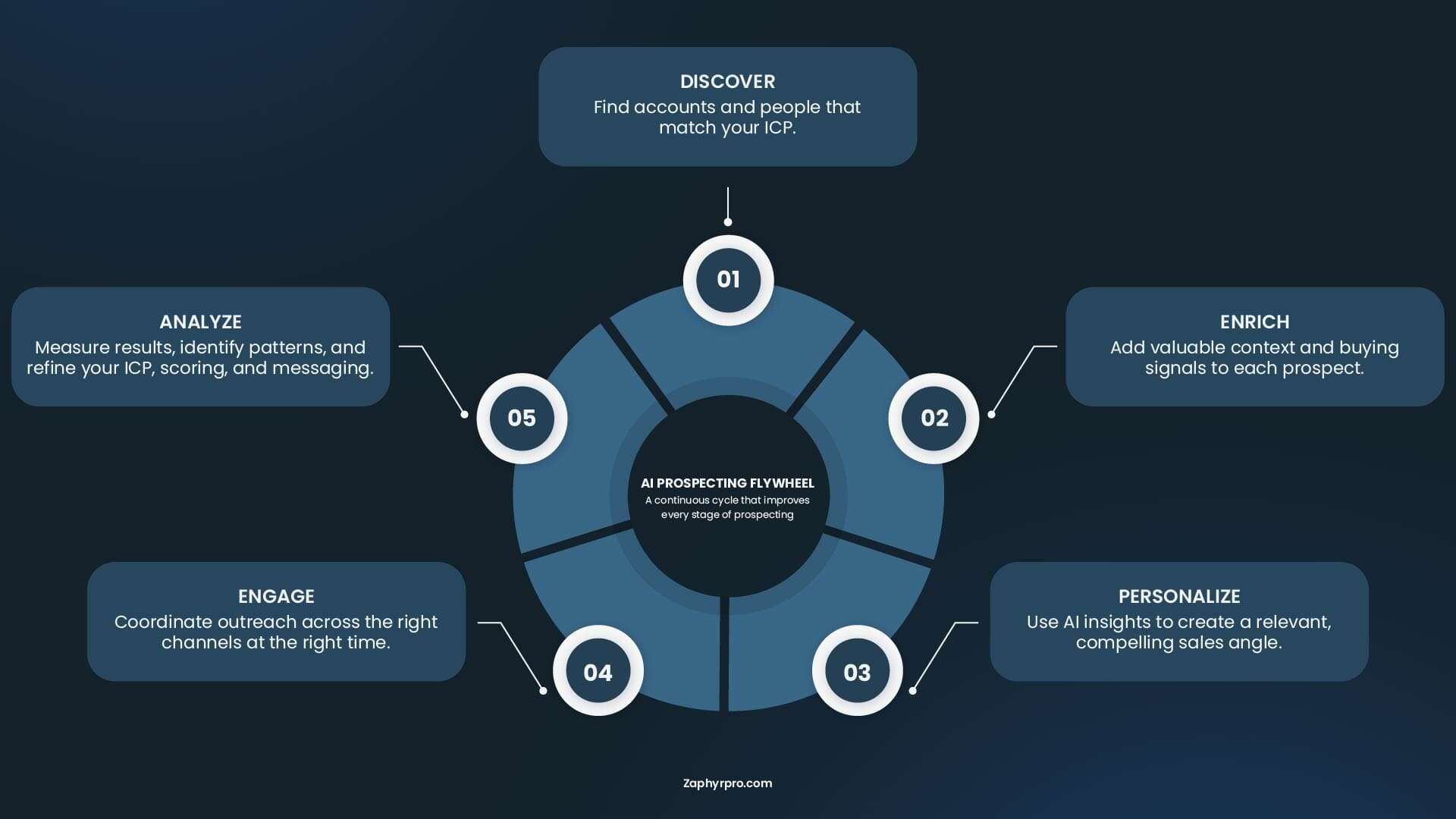
Each stage produces information that improves the next stage. The results then return to the beginning, helping the team refine its targeting and execution.
1. Discover: Find the Right Accounts and People
The first stage identifies companies and contacts that match the ICP. The AI system may analyze:
- Industry
- Employee count
- Revenue range
- Geography
- Business model
- Technology stack
- Hiring activity
- Funding events
- Growth indicators
- Department structure
- Job titles
- Seniority
- Previous customer characteristics
The output should be a focused account and contact universe, not an unfiltered database export.
2. Enrich: Add Context and Buying Signals
The next stage adds information that helps the team evaluate each opportunity.
Useful enrichment may include:
- Verified business email
- Direct phone number
- Company description
- Technologies used
- Department growth
- Recent leadership changes
- Job postings
- Website visits
- Content engagement
- Product usage
- Community activity
- Third-party intent
- CRM activity
- Previous opportunities
Enrichment is not equally reliable across every provider, geography, or data type. Important information should be verified before it influences messaging or routing.
3. Personalize: Create a Relevant Sales Angle
AI then connects prospect information to the seller’s value proposition.
A useful personalization workflow should answer:
- What changed at this account?
- Why might that change matter?
- Which buyer is most likely to care?
- Which business outcome connects to the seller’s solution?
- What evidence supports the message?
- What should the prospect do next?
AI can draft the message, but a rep or approved quality system should review high-value outreach.
4. Engage: Coordinate Outreach Across Channels
The workflow sends or schedules the appropriate sales activity.
Possible channels include:
- Phone
- Website chat
- SMS, where appropriate and permitted
- Retargeting audiences
- Sales tasks
- Direct mail for high-value accounts
The channel should reflect buyer preference, account value, available consent, and the team’s sales process.
The purpose of AI outreach automation is not to contact every prospect everywhere. It is to coordinate relevant activity without creating unnecessary repetition.
5. Analyze: Improve Targeting and Conversion
The final stage measures what happened.
AI can identify patterns across:
- Replies
- Positive replies
- Objections
- Meetings
- No-shows
- Sales-qualified opportunities
- Lost opportunities
- Message themes
- Personas
- Account segments
- Intent signals
- Channel combinations
- Conversion timing
These findings should update the ICP, scoring model, messaging, and workflow rules.
That closes the flywheel.
Unique insight: Many teams automate the engagement stage before improving discovery and enrichment. That produces faster outreach but not necessarily better prospecting. The workflow should become more accurate before it becomes more autonomous. |
AI Prospecting vs. Traditional Prospecting
Traditional prospecting relies heavily on manual research, individual experience, and repetitive workflows. AI prospecting creates a more structured system that helps sellers identify opportunities, prioritize accounts, and engage buyers with better context.
| Prospecting Activity | Traditional Prospecting | AI-Powered Prospecting |
|---|---|---|
|
Account Discovery |
Manual database searches and list building |
ICP-based recommendations using multiple data signals |
|
Contact Selection |
Filters based mainly on title and seniority |
Analysis of personas, buying roles, relationships, and influence |
|
Research |
Multiple manual searches across websites and platforms |
AI-generated account briefs and buyer insights |
|
Lead Qualification |
Static scoring based on limited criteria |
Dynamic scoring using fit, behavior, intent, and historical patterns |
|
Personalization |
Manual emails or generic templates |
Context-driven messaging based on verified account information |
|
Outreach |
Fixed sequences and scheduled follow-ups |
Adaptive workflows based on buyer signals and engagement |
|
CRM Updates |
Manual data entry and activity tracking |
Automated enrichment, summaries, and activity logging |
|
Follow-up |
Seller-managed reminders |
Signal-based tasks and AI-supported recommendations |
|
Optimization |
Periodic performance reviews |
Continuous analysis of outcomes and patterns |
|
Seller’s Role |
Researcher and task executor |
Strategist, reviewer, and relationship owner |
AI prospecting is not the right approach for every sales activity. Human-led research remains valuable for strategic accounts, regulated industries, executive-level communication, and complex buying situations where context and judgment matter most.
The most effective teams use AI for repeatable, data-heavy tasks while increasing human involvement when conversations require deeper expertise, trust, and personalization.
What Are the Best AI Sales Prospecting Tools in 2026?
The best AI sales prospecting tool depends on the role it needs to perform. Some platforms specialize in data, while others focus on intent, workflow orchestration, engagement, CRM intelligence, or autonomous agents.
Here are eight leading categories and platforms to evaluate:
| Tool | Best For | Core Capabilities | Pricing Model | Main Consideration |
|---|---|---|---|---|
|
Professional-network prospecting |
Advanced search, buyer alerts, Account IQ, Lead IQ, Message Assist, relationship insights |
Per-user subscription |
Strong buyer intelligence, but not a complete outbound system |
|
|
Flexible data enrichment and workflow building |
Multi-provider enrichment, signals, Claygent research, custom workflows, sequencing integrations |
Usage-based pricing with free and paid tiers |
Powerful platform, but requires workflow expertise |
|
|
All-in-one prospecting for SMB and mid-market teams |
Contact data, enrichment, intent signals, scoring, sequencing, AI research |
Freemium and per-seat plans |
Broad functionality, but teams must manage data quality and credit usage |
|
|
AI prospecting within Salesforce environments |
Account discovery, research, prioritization, outreach, qualification, CRM actions |
Salesforce add-on or bundled enterprise pricing |
Provides the most value for teams already using Salesforce as their CRM foundation |
|
|
Native prospecting inside HubSpot |
Signal monitoring, contact sourcing, enrichment, personalized outreach |
HubSpot plan and usage dependent |
Best fit for HubSpot users; Prospecting Agent availability may vary as features evolve |
The right platform should strengthen the weakest stage of your prospecting process. If your challenge is inaccurate data, better engagement automation will not solve the problem. If your targeting is unclear, adding another outreach tool may only increase activity without improving results.
Choose the platform that fixes the weakest stage of your process. Do not purchase another engagement tool when your real issue is poor data, weak targeting, or limited buyer signals.
Book a demo to see how the right data, workflows, and human review can be connected around your existing sales process.
Which AI Sales Prospecting Workflows Should B2B Teams Use?
Effective workflows begin with a defined trigger and end with a measurable business result. The AI should not be given an undefined instruction to “find leads.” It should know what qualifies an account, what evidence matters, which action it may take, and when a human must intervene.
Workflow 1: AI-Powered Outbound Prospecting
AI-powered outbound prospecting helps sales teams identify suitable accounts, understand buying signals, and prepare relevant outreach.
Trigger: A company matches the ideal customer profile (ICP) or shows a meaningful business event, such as hiring activity, expansion, leadership changes, or technology adoption.
How it works:
The AI identifies relevant accounts, enriches company and contact data, researches recent developments, evaluates account fit, and creates a personalized outreach approach. High-value messages can then be reviewed by a seller before entering an approved sequence.
Example:
A cybersecurity provider could monitor mid-market companies that recently hired a CISO or expanded into regulated industries. The AI identifies the event, researches potential security needs, and prepares messaging around the likely business change. The SDR reviews the context before outreach.
Key KPIs:
- Valid contact rate
- Positive reply rate
- Qualified meetings
- Opportunity conversion
- Pipeline generated by account segment
Workflow 2: AI-Powered Account-Based Selling
Account-based selling requires deeper research because teams focus on a smaller number of high-value accounts. AI helps sales teams build account intelligence and coordinate engagement across multiple stakeholders.
Trigger: An account enters a target-account list or reaches a specific intent threshold.
How it works:
The AI creates account briefs, maps buying committees, identifies relationships, monitors intent signals, and recommends relevant messaging for different stakeholders. The goal is not to send the same message to multiple executives. It is to create a connected account strategy.
For example, a CFO may focus on business impact, an operations leader may prioritize efficiency, and an IT leader may evaluate security and integration requirements. AI helps adapt messaging while maintaining a consistent account narrative.
Workflow 3: AI-Powered Inbound Lead Qualification
AI can help teams evaluate inbound interest faster while preventing sales representatives from spending time on low-fit leads.
Trigger: A visitor submits a form, starts a trial, requests information, or interacts with a high-intent page.
How it works:
The AI enriches lead information, compares the company against ICP requirements, analyzes engagement signals, answers basic questions using approved information, and routes qualified opportunities to the right sales representative.
Lower-intent leads can enter a nurture process instead of immediately entering the sales pipeline. The goal is a faster response without assuming every interaction represents buying intent.
Workflow 4: AI Follow-Up Automation
AI follow-up workflows help sales teams maintain momentum when qualified opportunities become inactive.
Trigger: A lead or opportunity has no activity after a defined period.
How it works:
The AI reviews previous conversations, identifies the last agreed action, checks for relevant account changes, and drafts a context-based follow-up message.
For strategic opportunities, human approval should remain part of the process. Effective follow-ups should provide value. A strong message may reference a business change, address a previous concern, share a relevant resource, or confirm whether priorities have changed.
What Are the Best B2B Use Cases for AI Prospecting?
AI follow-up workflows help sales teams maintain momentum when qualified opportunities become inactive.
Trigger: A lead or opportunity has no activity after a defined period.
How it works:
The AI reviews previous conversations, identifies the last agreed action, checks for relevant account changes, and drafts a context-based follow-up message.
For strategic opportunities, human approval should remain part of the process. Effective follow-ups should provide value. A strong message may reference a business change, address a previous concern, share a relevant resource, or confirm whether priorities have changed.
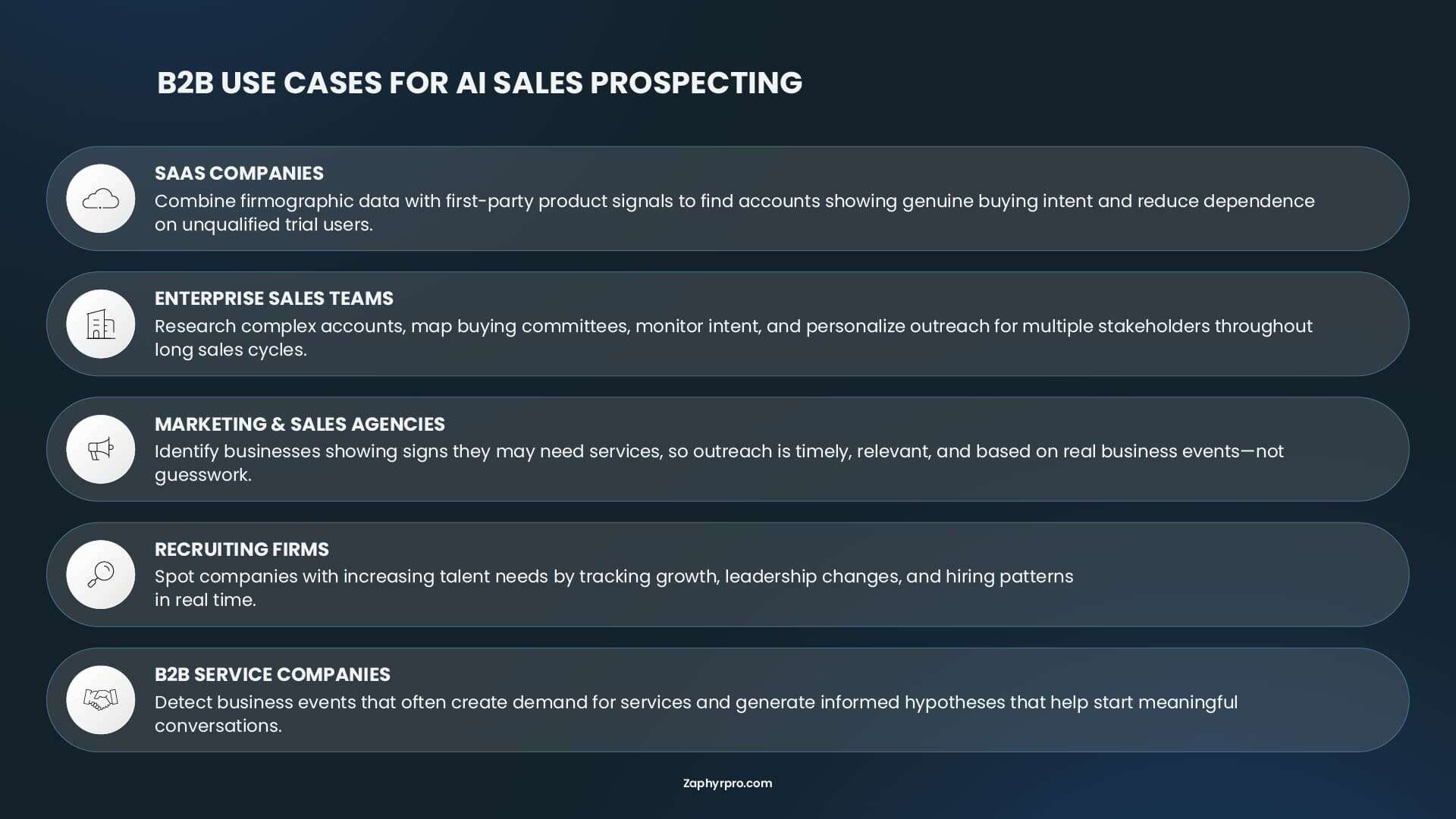
SaaS Companies
SaaS companies can use AI to combine firmographic data with first-party product signals to identify accounts showing genuine buying intent. Rather than treating every trial user as a qualified lead, AI analyzes patterns such as product adoption, feature usage, pricing-page visits, and company growth to identify organizations that are more likely to convert.
A SaaS platform may prioritize an account when multiple employees begin using the product, adoption expands across departments, and a decision-maker visits the pricing page, indicating broader purchase intent.
Enterprise Sales Teams
Enterprise sales cycles involve multiple stakeholders and longer buying journeys. AI helps account teams research target organizations, map buying committees, monitor intent signals, and personalize messaging for different decision-makers while maintaining a consistent account strategy. Because enterprise opportunities have higher value and greater reputational risk, sales representatives should validate AI-generated insights before engaging key stakeholders.
Marketing and Sales Agencies
Agencies can use AI to identify businesses showing signs that their services may be needed. Instead of manually researching hundreds of companies, AI continuously monitors business events that often precede buying decisions.
A digital agency might receive alerts when a company launches a rebrand, expands into a new market, hires marketing leaders, or experiences declining website performance, giving the sales team a timely reason to start a conversation.
Recruiting Firms
Recruiting agencies can monitor hiring activity, leadership changes, funding announcements, and organizational growth to identify companies with increasing talent needs. AI can summarize these signals, identify likely hiring managers, and recommend relevant outreach based on recruiting challenges.
B2B Service Companies
Consultancies, managed service providers, financial services firms, and other professional service organizations can use AI to detect business events that often create demand for their expertise, such as mergers, compliance changes, technology investments, or geographic expansion. AI should use these signals to generate informed hypotheses rather than making unsupported assumptions about a company’s needs.
How Do You Build an AI Sales Prospecting Strategy?
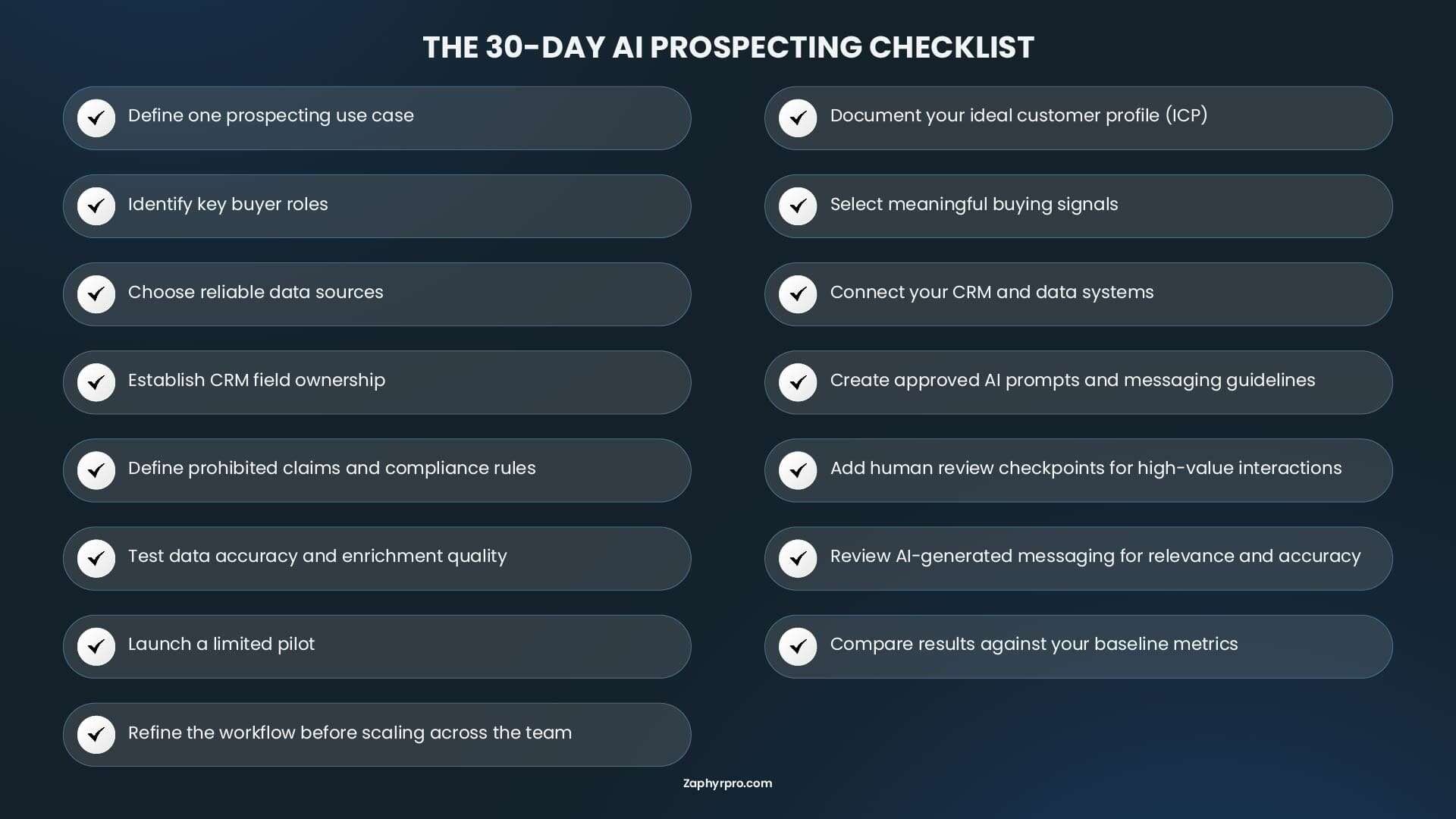
Successful AI prospecting starts with solving one specific business problem, not automating the entire sales process at once. LinkedIn automation recommends focusing on one practical AI use case before expanding adoption across the organization.
A phased 30-day rollout gives teams time to validate data, workflows, and results before scaling:
Week 1: Define Your Ideal Customer Profile (ICP)
Start by selecting a single prospecting use case, such as finding new target accounts, qualifying inbound leads, researching named accounts, or personalizing outbound outreach.
Next, document the characteristics of your ideal customer, including target industries, company size, buyer roles, qualification criteria, and buying signals. The objective is to create a clear definition of what a qualified prospect looks like before introducing automation.
Week 2: Choose the Right Data and AI Tools
Select tools based on the capabilities your workflow requires rather than the number of features they offer. At a minimum, ensure your solution can support:
- Account and contact discovery
- Data enrichment
- Buyer intent and signal monitoring
- AI-assisted research and messaging
- CRM integration
- Performance reporting
Smaller teams may succeed with an all-in-one platform, while larger RevOps teams often combine specialized tools.
Week 3: Build and Validate the Workflow
Before launching at scale, test the workflow using a small sample of accounts. Review whether account recommendations are relevant, contact information is accurate, AI-generated research is reliable, messages reflect your brand, and CRM records are updated correctly. Human review should remain part of the approval process for important accounts and outbound communications.
Week 4: Launch a Measured Pilot
Deploy the workflow with a limited audience and compare its performance against your existing prospecting process. Measure business outcomes such as research time, contact accuracy, reply rates, qualified meetings, pipeline generation, and user adoption. Success should be evaluated by the quality of opportunities created, not simply by the volume of emails or leads generated.
How Should You Measure AI Prospecting ROI?
The success of AI prospecting should be measured by business outcomes, not by the number of emails sent or leads generated. While AI can improve productivity, its real value lies in helping sales teams create more qualified pipelines with less manual effort.
Before implementing AI, establish a baseline so you can compare performance over time. Focus on four categories of metrics:
Productivity Metrics
Measure how AI improves operational efficiency by tracking:
- Research time per account
- Prospect lists built per rep
- CRM update time
- Qualified contacts identified per sales representative
Quality Metrics
Evaluate whether AI is helping your team target the right prospects by monitoring:
- Valid contact rate
- Ideal customer profile (ICP) match rate
- Sales-accepted leads
- Positive reply rate
- Qualified meeting rate
Revenue Metrics
The ultimate goal is revenue growth, so track:
- Pipeline generated per sales representative
- Opportunity value
- Win rate
- Sales cycle length
- Customer acquisition cost (CAC)
Cost Metrics
Include all costs associated with your AI prospecting program, such as software subscriptions, data providers, AI usage, integrations, implementation, training, and ongoing administration.
One practical metric is:
Cost per Qualified Meeting = Total prospecting costs ÷ Qualified meetings generated
You can also calculate Pipeline ROI by comparing the qualified pipeline attributed to AI-enabled workflows against the total cost of running those workflows.
Most importantly, establish clear attribution rules before launching your program. AI often supports multiple stages of the sales process, so defining which activities contribute to pipeline creation will produce more reliable ROI measurements.
What Are the Common Challenges of AI Sales Prospecting?
Although AI adoption continues to grow, successful implementation depends on more than choosing the right tools. The biggest challenges usually involve data quality, governance, and user adoption, not the AI itself.
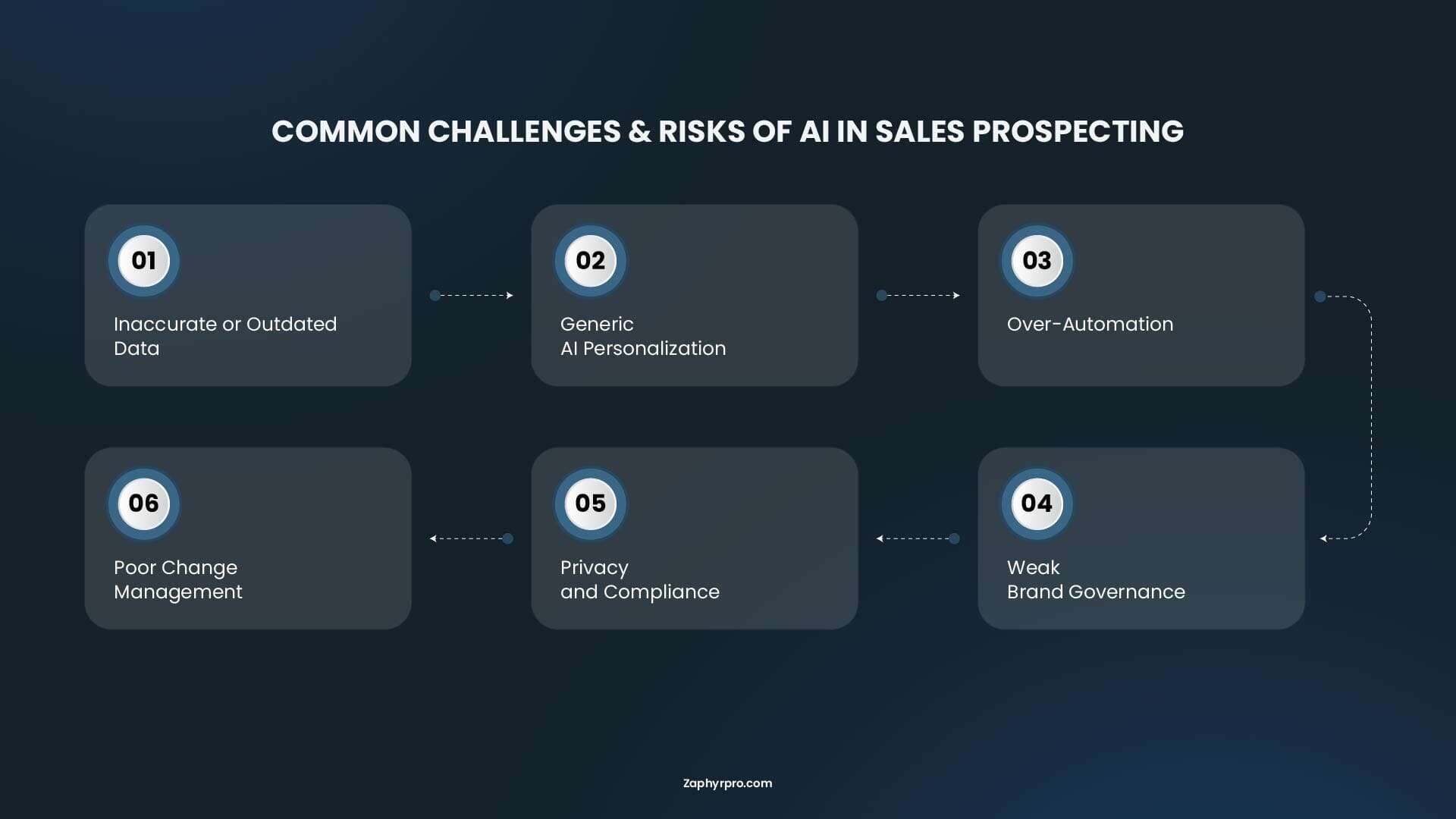
- Inaccurate or Outdated Data: AI recommendations are only as reliable as the data they analyze. Outdated contact details, duplicate records, incorrect company information, and inconsistent CRM data can reduce targeting accuracy and personalization.
- Generic AI Personalization: AI can produce well-written messages that still feel generic if they are based on weak research or incomplete prompts. A better approach is to verify account information first, define the buyer’s likely challenge, and then use AI to draft messaging based only on approved facts.
- Over-Automation: Not every sales activity should be automated. While AI can handle repetitive tasks such as research, enrichment, and initial drafting, strategic outreach and high-value accounts still require human judgment. The level of automation should reflect factors such as account value, data confidence, industry requirements, and message sensitivity.
- Weak Brand Governance: Without clear guidelines, AI-generated messaging can become inconsistent across sales teams. Establish approved prompts, value propositions, brand voice guidelines, proof points, and compliance rules so AI-generated content remains accurate and aligned with your organization’s messaging.
- Privacy and Compliance: AI prospecting often relies on customer data, behavioral signals, and third-party information. Organizations should understand where data originates, how it is processed, who can access it, and how regional privacy regulations apply before scaling automated workflows.
- Poor Change Management: Even well-designed AI workflows can fail if sales teams do not trust or adopt them. Involve sellers early, explain how AI-generated recommendations are created, encourage feedback, and position AI as a decision-support tool rather than a replacement for human expertise.
The most successful AI prospecting programs combine automation with strong governance, reliable data, and experienced sales professionals who remain responsible for customer relationships and final decisions.
What Is the Future of AI Sales Prospecting?
The future of AI sales prospecting is moving beyond individual AI assistants toward connected systems that can analyze signals, recommend actions, and support entire prospecting workflows. Salesforce predicts that AI agents will become a major part of sales operations in the coming years, making agent-driven workflows an important trend for B2B teams.
- AI Agents Will Handle More Connected Workflows: Future AI agents will move beyond creating simple email drafts. They will increasingly support end-to-end prospecting activities, including monitoring account changes, researching companies, identifying relevant buyers, preparing outreach recommendations, updating CRM records, and supporting follow-up actions.
- Prospecting Will Become More Signal-Based: Traditional static lead lists will become less valuable as AI enables teams to monitor real-time buying signals. These signals may include website activity, product usage, hiring changes, leadership moves, funding events, technology adoption, content engagement, and customer expansion activity.
- Personalization Will Depend on Evidence: As AI-generated outreach becomes more common, generic personalization will become easier for buyers to recognize and ignore. The strongest sales messages will connect verified business changes with relevant buyer challenges. AI will improve personalization, but relevance will depend on the quality of the underlying research.
- Sales Teams Will Interact With Data Through AI Interfaces: A salesperson may ask which accounts in their territory recently expanded hiring, adopted new technology, or showed engagement signals. The AI system could then provide relevant accounts, supporting evidence, recommended contacts, and suggested next actions.
- Human Judgment Will Become a Competitive Advantage: As AI makes prospecting faster and easier, quality control will become more important. The teams that succeed will be those that combine automation with strong judgment, accurate data, responsible outreach, and a clear understanding of buyer needs.
Build a Prospecting System, Not Just a Larger Tool Stack
AI for sales prospecting can help B2B teams research accounts faster, recognize buyer signals, prioritize better opportunities, and create more relevant outreach. But the technology alone does not guarantee a stronger pipeline.
The quality of the result depends on the system around it. That includes the ICP, data sources, scoring logic, prompts, messaging, CRM structure, approval rules, and performance metrics.
I recommend starting with one high-friction task, establishing a baseline, and testing the workflow on a controlled segment. Once the process produces accurate data and qualified conversations, you can expand it across more accounts, channels, and use cases.
The objective is not to remove people from B2B prospecting. It is to remove the repetitive work that prevents them from understanding buyers and having meaningful conversations.
See how Zaphyre can support your team’s targeting, research, personalization, engagement, and pipeline generation.
Frequently Asked Questions
AI for sales prospecting uses machine learning, generative AI, predictive analytics, and automation to identify, research, prioritize, and engage B2B prospects. Salesforce reported in 2026 that 87% of sales organizations already use AI for activities such as prospecting, scoring, forecasting, or email drafting.
The best tool depends on the workflow. LinkedIn Sales Navigator supports professional-network research, Clay supports custom enrichment, Apollo provides broad all-in-one functionality, 6sense supports enterprise intent, and Salesforce or HubSpot agents work well for teams already centered on those CRMs.
AI can automate research, enrichment, prioritization, drafting, qualification, and CRM updates. However, strategic outreach still benefits from human review. LinkedIn’s research indicates that AI performs best when it supports relationship-building and informed seller execution rather than attempting to replace them.
Salesforce’s 2026 research found that sellers expect fully implemented agents to reduce prospect research time by 34% and email drafting time by 36%. Actual savings will depend on data quality, workflow complexity, integration, adoption, and how much human review the organization requires.
Yes. Small teams can begin with a narrow workflow such as account research, CRM enrichment, or personalized email drafting. Apollo, Clay, LinkedIn Sales Navigator, and HubSpot provide entry points for smaller teams, while more complex enterprise platforms may require additional implementation and administration.
AI lead generation focuses on attracting or identifying potential buyers. AI sales prospecting goes further by researching, qualifying, prioritizing, and engaging those buyers. Prospecting connects account discovery with practical sales actions, including personalized messaging, follow-up tasks, qualification, and CRM updates.