
A B2B buyer used to start with a search, scan ten blue links, and click the ones that looked credible. Today, that same buyer might ask ChatGPT to compare vendors, read a Google AI Overview on the way to a meeting, and only then decide which websites deserve a visit.
That shift has created a pile of acronyms: SEO, AEO, and GEO. I lead SEO at Zaphyre, and clients ask me the same question almost every week: are these three different jobs, or one job with new names?
The honest answer is a bit of both. In this guide, I’ll explain what each term means, where they overlap, how they differ, and how I’d prioritize them for a B2B team. I’ll also share AI citation data from a B2B client, so you can see what the results look like in practice.
Key Takeaways
- SEO helps your pages rank and earn clicks. AEO helps your content become the direct answer. GEO helps your content become a source that AI tools cite.
- All three rest on the same foundation: crawlable, indexable, trustworthy pages. Google states that its AI features need no special optimization beyond standard SEO best practices.
- Clicks are shrinking where AI summaries appear. Pew Research found that users clicked a traditional result in 8% of visits with an AI summary, versus 15% without one.
- AI citations are now measurable. Bing Webmaster Tools reports citations, cited pages, and the grounding queries AI systems used to find your content.
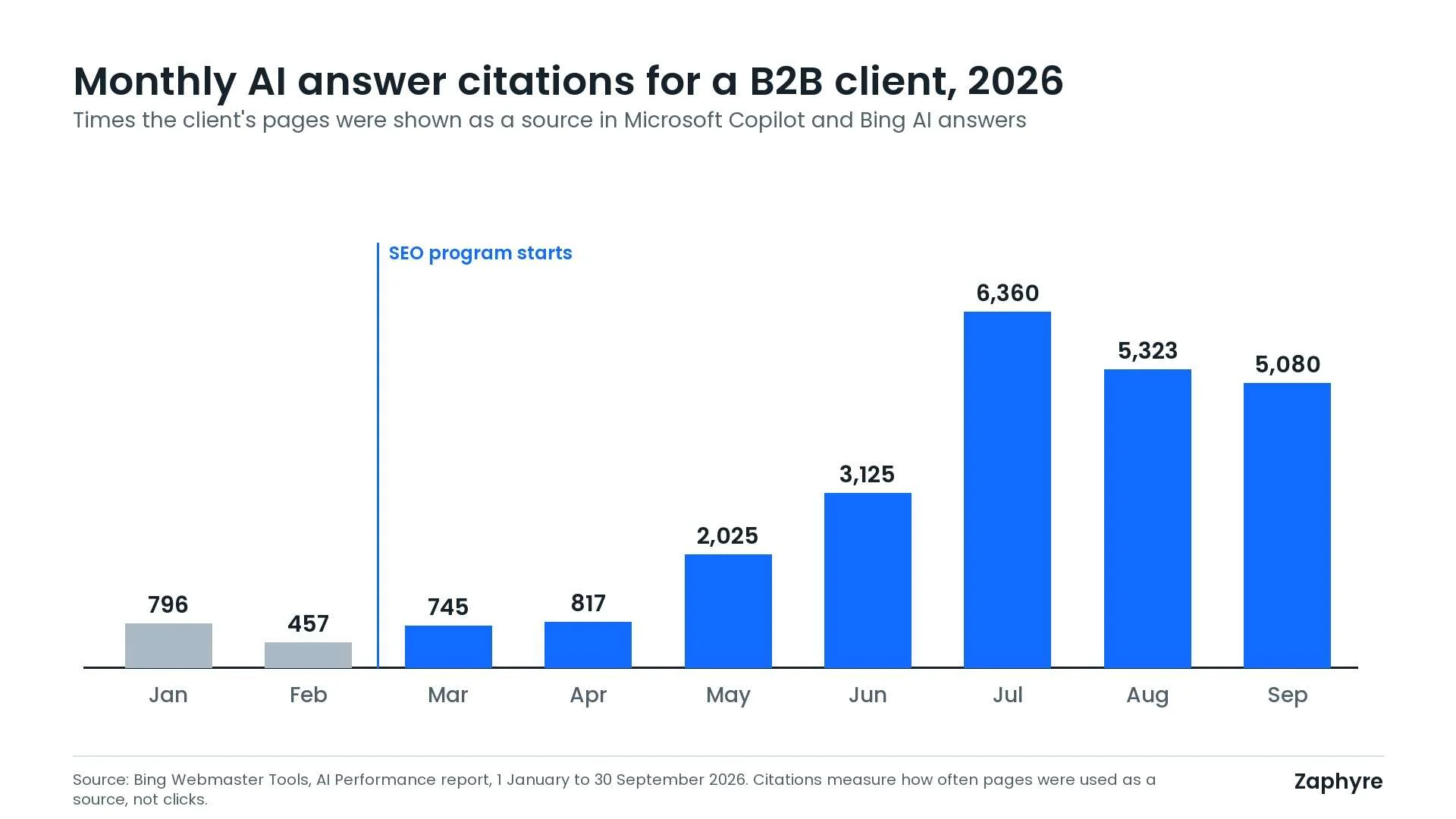
- For one B2B client, monthly AI citations grew from 745 in March 2026 to 5,080 in September 2026, during a program built around buyer’s guides and duplicate-URL cleanup.
- Don’t run three separate programs. Fix the foundation first, then add answer-first structure, then add proof and authority.
Want the full playbook? Read our guide, Getting Found in the Age of AI Search, for a step-by-step approach to AI search visibility.
What Is SEO?
Search engine optimization (SEO) is the practice of improving your website so search engines can crawl it, understand it, and rank it for the queries your buyers use. The goal is visibility and clicks: when someone searches, your page appears, and they choose it.
SEO covers three broad areas:
- Technical SEO: crawlability, indexation, site speed, mobile usability, and structured data.
- Content: pages that match search intent and answer the question thoroughly.
- Authority: links, brand mentions, and trust signals such as authorship and reviews.
Everything else in this guide builds on that base.
What Is AEO (Answer Engine Optimization)?
Answer engine optimization (AEO) is the practice of structuring your content so search and AI systems can lift a clear, direct answer from it. The goal is to be the answer, not just a link in a list.
AEO has its roots in featured snippets, People Also Ask boxes, and voice search. Today it also includes the AI summaries that appear above results, such as Google’s AI Overviews.
In practice, AEO comes down to a few habits:
- Use question-style headings that match how buyers phrase their searches.
- Answer the question in the first one or two sentences, then add context.
- Use lists, tables, and short paragraphs that are easy to extract.
- Add FAQ sections with short, complete answers.
If you’ve read our guide to zero-click searches, AEO is the practical response to that trend.
What Is GEO (Generative Engine Optimization)?
Generative engine optimization (GEO) is the practice of making your content more likely to be used and cited by generative AI tools such as ChatGPT, Perplexity, Microsoft Copilot, and Google’s AI Mode. Instead of competing for a position in a list, you compete to be one of the sources an AI system draws on when it writes an answer.
The term comes from a research paper, GEO: Generative Engine Optimization, by Pranjal Aggarwal and colleagues, accepted at KDD 2024. The authors reported that GEO methods can boost visibility in generative engine responses by up to 40%. That is a ceiling for the best-performing methods in a controlled study, not a promise for your website.
In my experience, the idea behind it holds up: AI systems favor content that gives them something concrete to cite. GEO usually leans on:
- Statistics and quotations with named sources.
- Original data and first-hand examples.
- Clear entities: who you are, what you sell, and who wrote the page.
- Comparison and buyer’s guide content that answers evaluation questions.
- Mentions and reviews beyond your own website.
AEO vs GEO vs SEO: What Is the Difference?
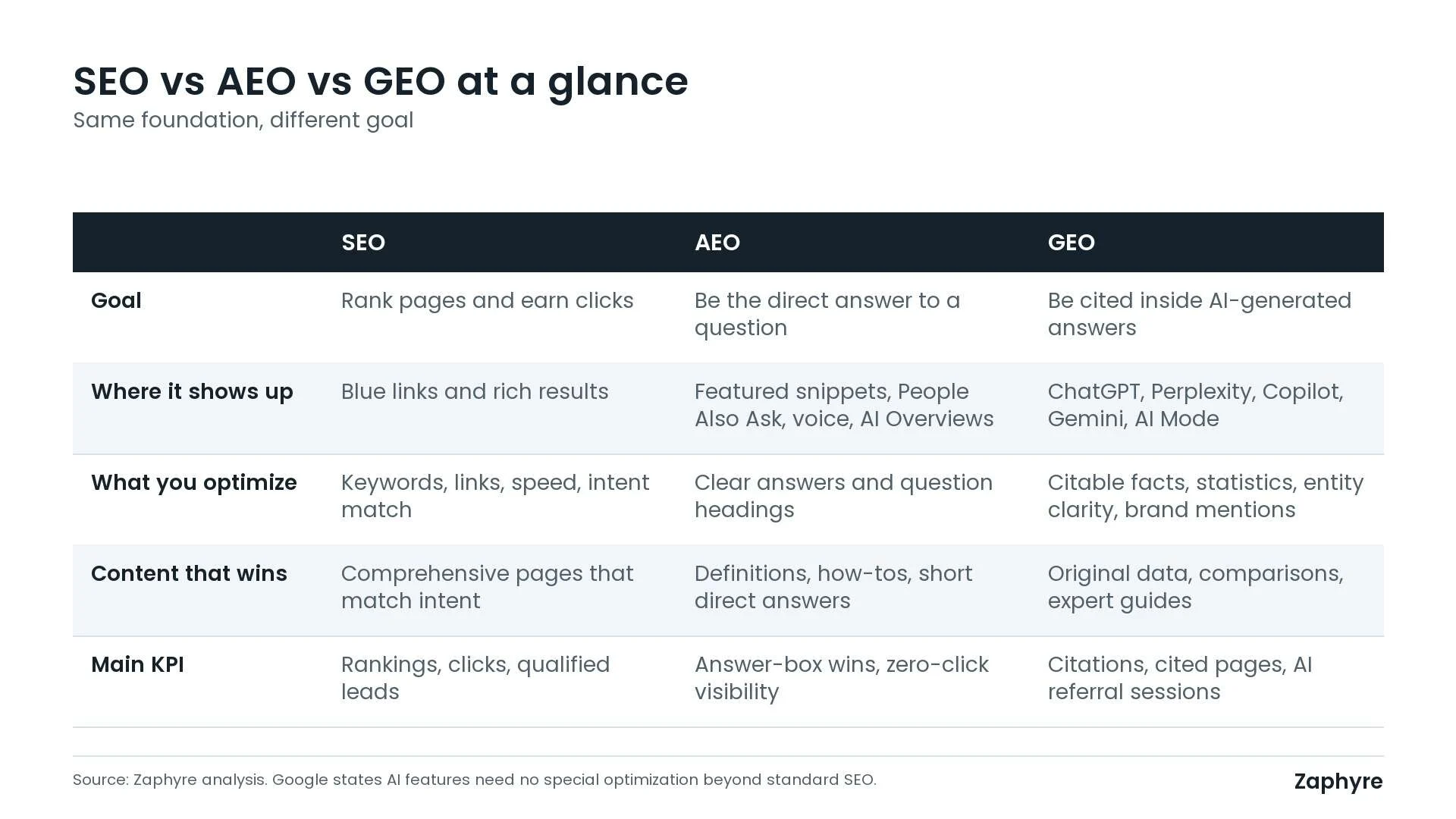
The three terms describe different outcomes. SEO is about being found, AEO is about being the answer, and GEO is about being the source an AI system chooses to cite.
- Goal: SEO earns rankings and clicks. AEO earns the direct answer. GEO earns citations in AI-generated responses.
- Where it shows up: SEO works in classic results. AEO works in featured snippets, People Also Ask, and AI summaries. GEO works in tools such as ChatGPT, Perplexity, and Copilot.
- What you optimize: SEO focuses on keywords, links, and speed. AEO focuses on clear answers and structure. GEO focuses on citable facts, entities, and brand mentions.
- How you measure it: rankings and clicks for SEO, answer-box wins for AEO, and citations for GEO.
Do AEO and GEO Replace SEO?
No. They sit on top of it. Google’s own guidance on AI features and your website says a page can appear as a supporting link in AI Overviews and AI Mode only if it is indexed and eligible to appear in Search with a snippet. It lists no additional technical requirements and no special optimizations, and says standard SEO best practices still apply.
That matches what I see in client data. The pages AI tools cite are usually pages that were already indexable, clear, and useful. AEO and GEO change how you structure and support those pages, not whether you need them.
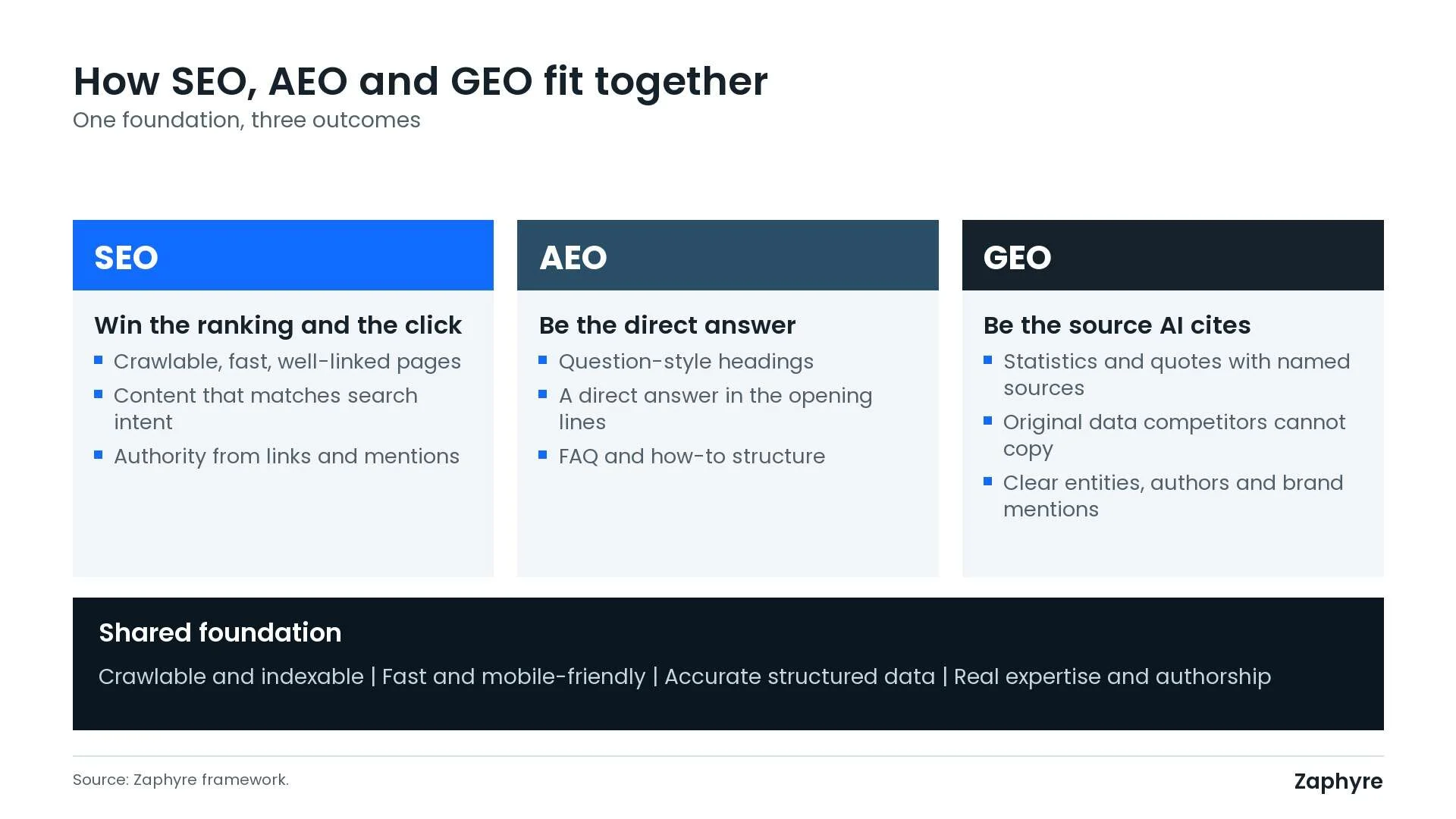
Think of it as one foundation with three outcomes. If the foundation is weak, no amount of AEO or GEO work will fix it. If the foundation is strong, small structural changes can unlock a lot of extra visibility.
What Are the Most Common Myths About AEO and GEO?
Because the topic is new, plenty of advice circulates without evidence. These are the myths I hear most often from B2B teams.
Myth 1: GEO Replaces SEO
Reality: Google’s guidance says a page must be indexed and eligible to appear in Search with a snippet to be used as a supporting link in its AI features, and it lists no extra requirements. The pages AI tools cite are usually pages that already performed well on SEO basics. GEO adds to that work. It does not replace it.
Myth 2: You Need Special Markup or Files for AI Search
Reality: For Google’s AI features, Google says you do not need new schema.org markup or special AI-specific files. Keep structured data accurate and consistent with the visible page. For other AI systems, the documented requirement is access: OpenAI asks you to allow OAI-SearchBot, and Perplexity recommends allowing PerplexityBot if you want your site to appear in its results.
Myth 3: AI Search Means Nobody Clicks Anymore
Reality: Clicks fall when an AI summary appears, but they do not disappear. In Pew’s data, users still clicked a traditional result in 8% of visits that included an AI summary. And the visitors who do arrive from AI assistants can be highly engaged, as our client data showed. The practical answer is to measure visibility, not only clicks.
Myth 4: More AI-Written Content Means More Citations
Reality: In my experience, volume without original value gives AI systems nothing worth citing. The pages that earned citations for our client were a small number of in-depth buyer’s guides, not hundreds of thin articles. Two guides produced 51.6% of page-level citations.
Why Does This Matter for B2B Teams in 2026?
Because the click is getting harder to earn, and buyer research is happening earlier in the journey.
Fewer Clicks Where AI Summaries Appear
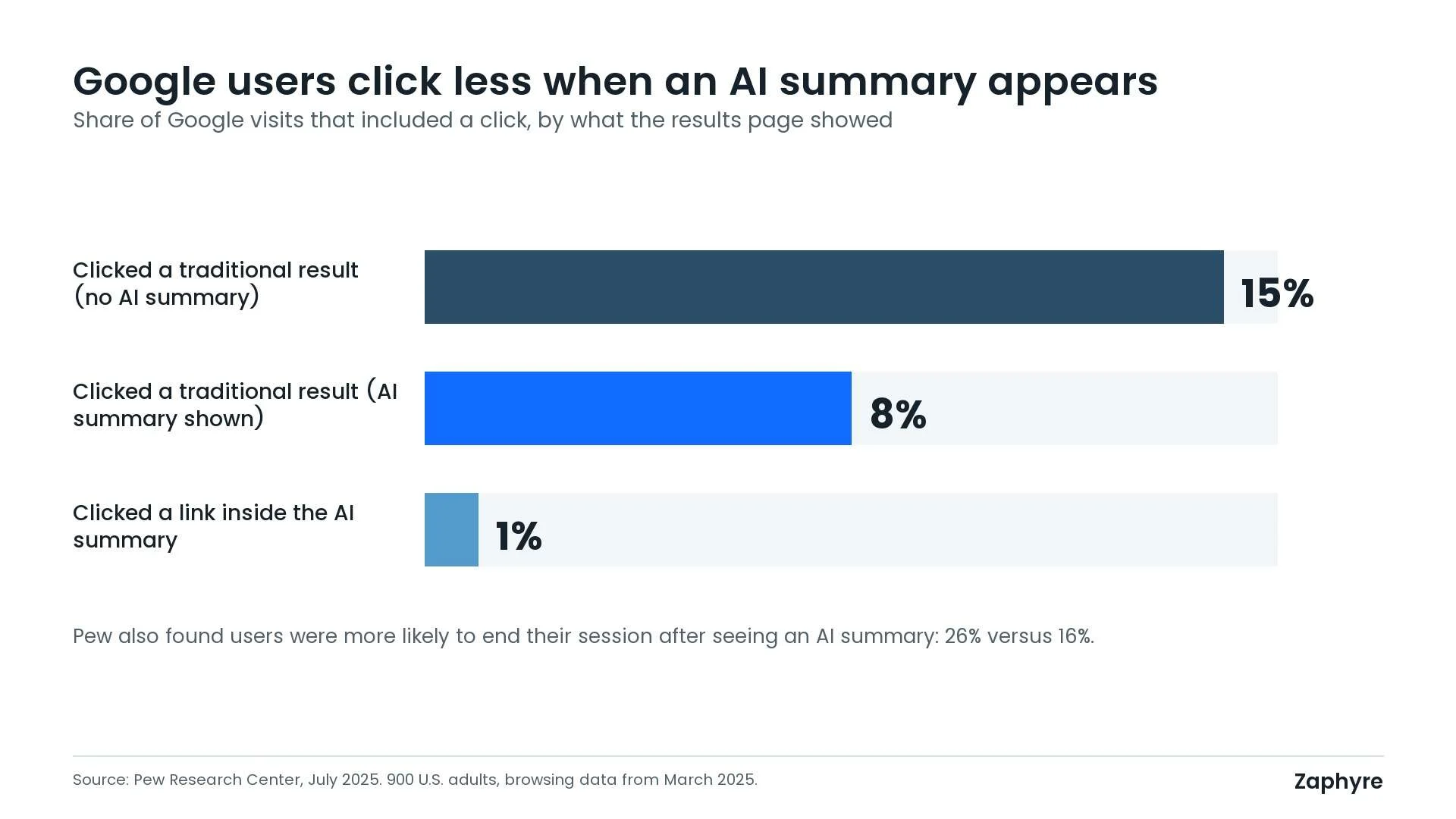
Pew Research Center tracked the browsing of 900 U.S. adults in March 2025. Users clicked a traditional search result in 8% of visits when an AI summary appeared, compared with 15% when one didn’t. They clicked a link inside the AI summary in just 1% of visits. Pew’s analysis also found users were more likely to end their session after seeing a summary: 26% versus 16%.
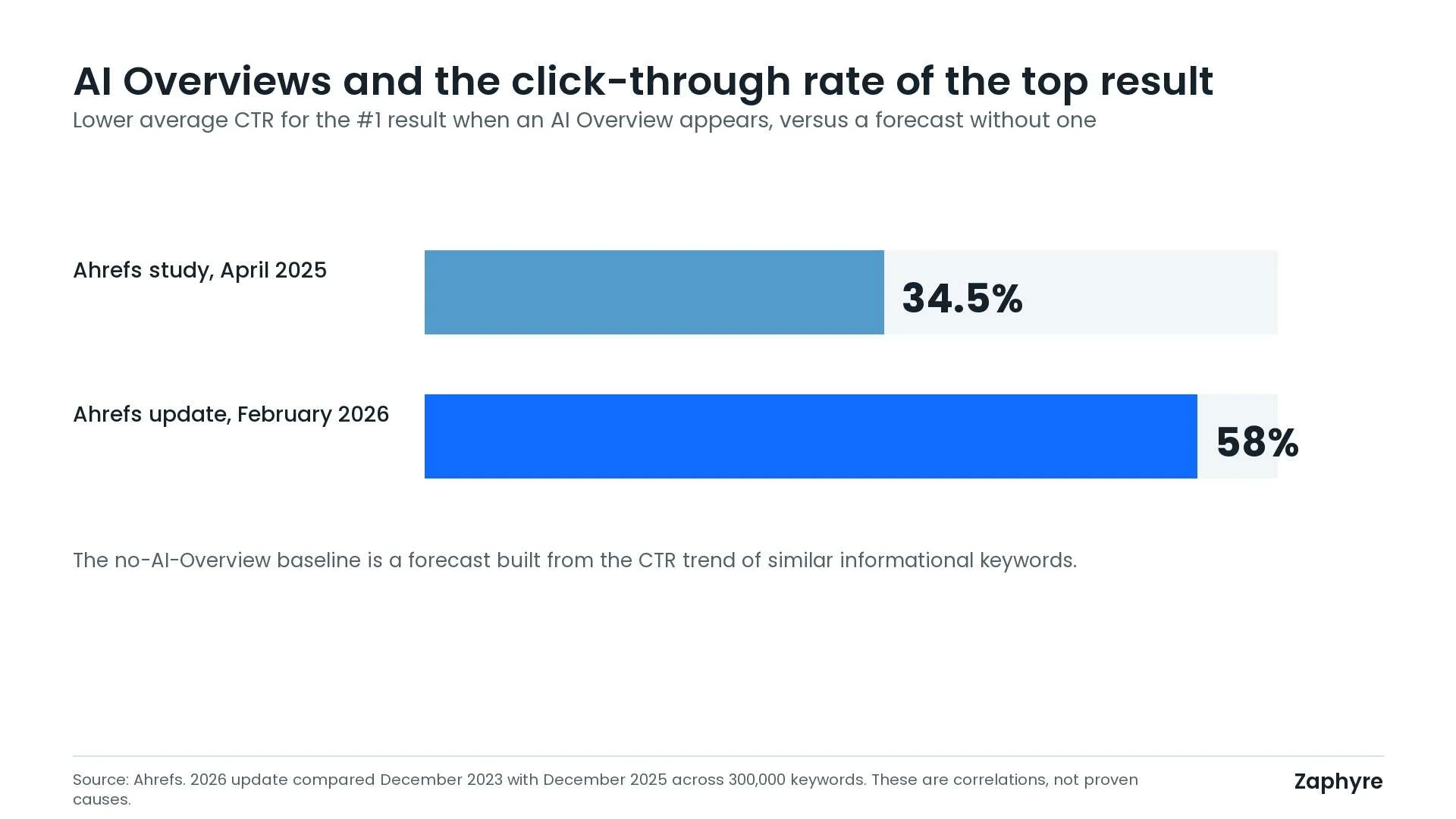
Ahrefs reached a similar conclusion from Search Console data. Its April 2025 study found that AI Overviews correlated with a 34.5% lower average click-through rate for the top result. Its February 2026 update, which compared December 2023 with December 2025 across 300,000 keywords, put that figure at 58%. Both are correlations, and the no-AI-Overview baseline is a forecast, but the direction is consistent.
Higher Intent Where Visitors Do Arrive
Semrush’s 2025 analysis found that the average AI search visitor was worth 4.4 times the average traditional organic visitor, based on conversion rate. Other analyses report different multipliers, so treat it as directional.
Our client data points the same way, although the volumes are small. On one B2B client’s site in August 2026, AI assistant sessions had an 85.2% engagement rate in Google Analytics 4, compared with 29.1% for direct traffic. That was only 27 sessions, so I would not call it a benchmark, but it shows the kind of visitor AI answers can send.
Buyers Shortlist Earlier
In B2B, the shortlist often forms before anyone visits a vendor website. If AI tools don’t mention or cite you at that stage, you may never be considered. That is why GEO is worth planning for even while most of your traffic still comes from classic search.
What Does the Data Show? Results From a B2B Client
At Zaphyre, we track AI citations for B2B clients alongside rankings and leads. One client gives a clear picture. The figures below come from the AI Performance report in Bing Webmaster Tools, which Microsoft launched in public preview in February 2026. It shows how often a site’s pages are cited as sources in Microsoft Copilot and Bing’s AI-generated summaries.
Citations were 796 in January, 457 in February, and 745 in March, the month our SEO program started. They reached 2,025 in May, 6,360 in July, and 5,080 in September. From March 1 to October 3, 2026, the client earned more than 24,000 citations. As of September 9, Ahrefs also showed the client inside 11 Google AI Overviews.
A few details matter if you want to use numbers like these responsibly:
- Citations are not clicks. The report shows how often pages were used as a source, not how many people visited.
- Coverage is limited. It covers Microsoft Copilot and Bing AI summaries. It does not measure ChatGPT directly.
- Other gains happened too. The client’s search impressions rose 69% between March and September, so we can’t fully separate AI-focused work from general SEO progress. That is the point: the same foundation drove both.
- Reporting has gaps. Bing recorded near-zero citations on several days in August even though rankings and impressions were steady, which suggests a reporting pattern rather than a visibility drop.
The distribution was striking. Two buyer’s guides accounted for 51.6% of page-level citations, and about half of all citations came from comparison-style queries using words such as best, top, vs, or compare. We unpack what that means for content strategy in our guide on how to get cited by ChatGPT.
How Should B2B Teams Prioritize AEO, GEO, and SEO?
Start with where you are, not with the newest acronym. This table shows how I decide:
| If this is true | Prioritize | First move |
|---|---|---|
| Key pages are not indexed, load slowly, or rank beyond page two | SEO | Fix crawling, indexation, speed, and on-page basics before anything else. |
| You rank on page one but rarely win snippets or answer boxes | AEO | Add question headings, direct answers, and FAQ sections to the pages that already rank. |
| You rank well, but AI tools do not cite or mention you | GEO | Add sourced statistics, comparison content, clear authorship, and third-party mentions. |
| You publish a lot, but nothing performs | SEO and content strategy | Consolidate overlapping pages and align content with buyer intent. See our guide to the B2B blog strategy KPI trap. |
For most B2B teams, the order is the same:
Step 1: Build the Foundation
Make sure your important pages are crawlable, indexable, fast, and free of duplicates. Our guides to mobile SEO best practices and mobile-first indexing cover the technical basics.
Step 2: Make Pages Answer First
Rework your highest-value pages so they open with a direct answer, use question-style headings, and include a short summary and FAQ.
Step 3: Add Proof and Authority
Back claims with named sources, add first-hand data, show real authors, and build mentions beyond your site. This is where GEO gains come from.
What Does a 90-Day Roadmap Look Like?
A 90-day plan keeps the work focused and measurable. Each phase builds on the one before it.
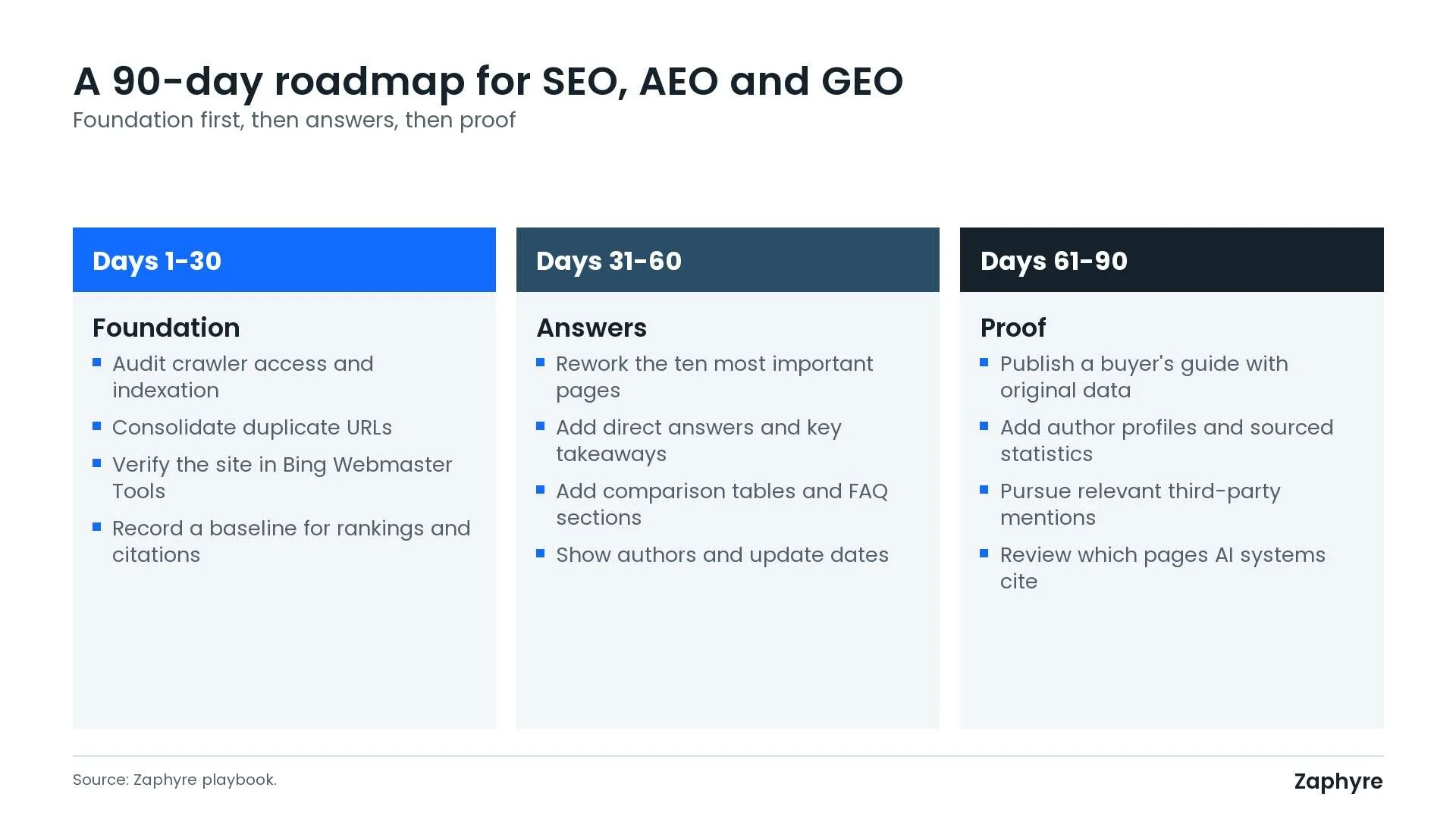
- Days 1 to 30, Foundation: audit crawler access and indexation, consolidate duplicate URLs, verify your site in Bing Webmaster Tools, and record a baseline for rankings, citations, and AI referral sessions.
- Days 31 to 60, Answers: rework your ten most important pages with direct answers, key takeaways, comparison tables, and FAQ sections.
- Days 61 to 90, Proof: publish one in-depth buyer’s guide with original data, add author profiles, pursue relevant third-party mentions, and review which pages AI systems begin to cite.
Which Content Types Serve SEO, AEO, and GEO Best?
Not every page type pulls equal weight across the three channels. This table reflects my judgment from client work, not a ranking from a published study.
| Content type | SEO | AEO | GEO |
|---|---|---|---|
| Buyer’s guide (best [category] for [use case]) | Strong | Good | Strong |
| Comparison page ([A] vs [B]) | Strong | Good | Strong |
| Definition or explainer (what is [concept]) | Strong | Strong | Good |
| How-to guide | Strong | Strong | Good |
| Original research or data study | Good | Limited | Strong |
| Case study | Limited | Limited | Good |
| FAQ sections inside key pages | Good | Strong | Good |
The pattern is simple. Definitions and how-tos win the direct answer. Buyer’s guides and comparisons win the citation when a buyer is evaluating options. Original data helps you stand out in both.
What Does an Answer-First Rewrite Look Like?
Here is a typical before and after for a B2B service page. The topic is outsourced SEO, but the pattern works for any service.
| Element | Before | After |
|---|---|---|
| Heading | Our SEO Services | What Does an Outsourced SEO Team Do? |
| Opening | Welcome to our SEO page. We have years of experience helping companies grow, and our passionate team is committed to results. | An outsourced SEO team handles technical audits, content strategy, on-page optimization, and link building for your company, so your in-house team can focus on sales and product. Most engagements start with a technical audit, then move to content and authority. |
| Proof | Trusted by leading brands. | In one 2026 engagement, search impressions rose 69% in six months, and monthly AI citations grew from 745 to 5,080. |
| Closing | Contact us today. | Book a meeting to review your site, your competitors, and the first 90 days of work. |
The rewrite answers the question first, says who the service is for, and replaces a vague claim with a number. That is what makes it easy to quote, whether in a snippet, an AI Overview, or a ChatGPT answer.
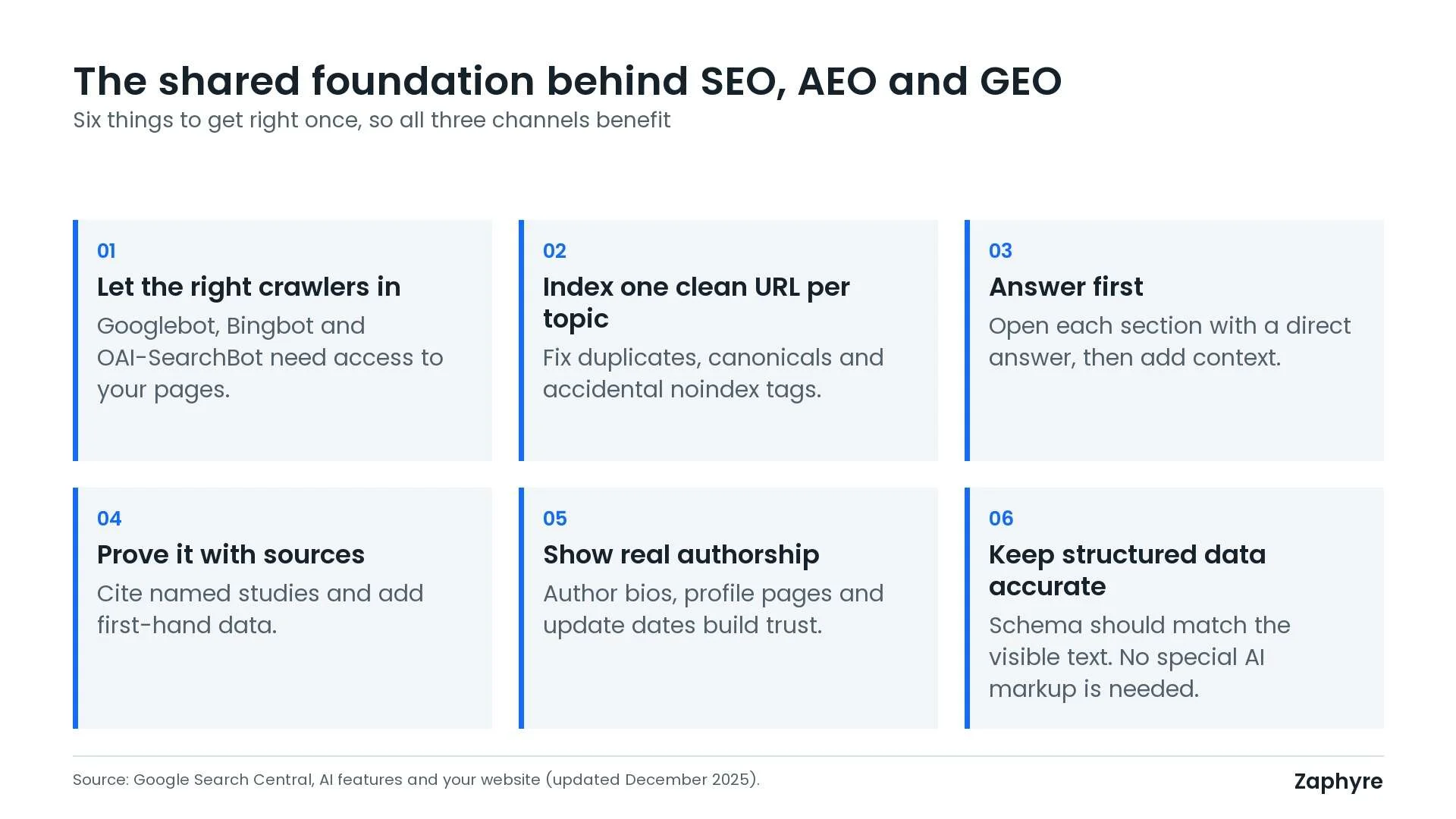
The Shared Foundation: Six Things to Do Once
These six habits support SEO, AEO, and GEO at the same time. Doing them once saves you from running three separate programs.
1. Let the Right Crawlers In
Check robots.txt, your CDN, and your firewall rules. Googlebot and Bingbot support classic and AI search surfaces. OpenAI documents OAI-SearchBot as the crawler for ChatGPT search and says that blocking it keeps your site out of ChatGPT search answers, while blocking GPTBot only opts you out of model training.
2. Index One Clean URL Per Topic
Duplicate URLs split your signals. For one client, 44 pages were showing up in Search Console at two addresses in July. After consolidation, 28 remained, and two merged guides gained 54% and 77% more impressions on a single URL.
3. Answer First
Open each section with a direct, complete answer, then add context. This helps AEO because answers are easy to lift, and it helps GEO because AI systems can quote a clean passage.
4. Prove It With Sources
Name the study, the organization, and the year. Link to the primary source. Add your own data wherever you have it, because first-hand numbers are the hardest thing for competitors to copy.
5. Show Real Authorship
Add author bios, profile pages, and update dates. Readers and AI systems both need to know who stands behind a claim. You will find mine at the end of this article.
6. Keep Structured Data Accurate
Google says you don’t need new schema.org markup or special AI-specific files for its AI features. Keep structured data consistent with the visible text, and use it to clarify who wrote the page, what the organization is, and what the page covers.
How Do You Measure SEO, AEO, and GEO?
Each channel answers a different question, so each needs its own metrics. Put them in one report so the foundation work stays visible.
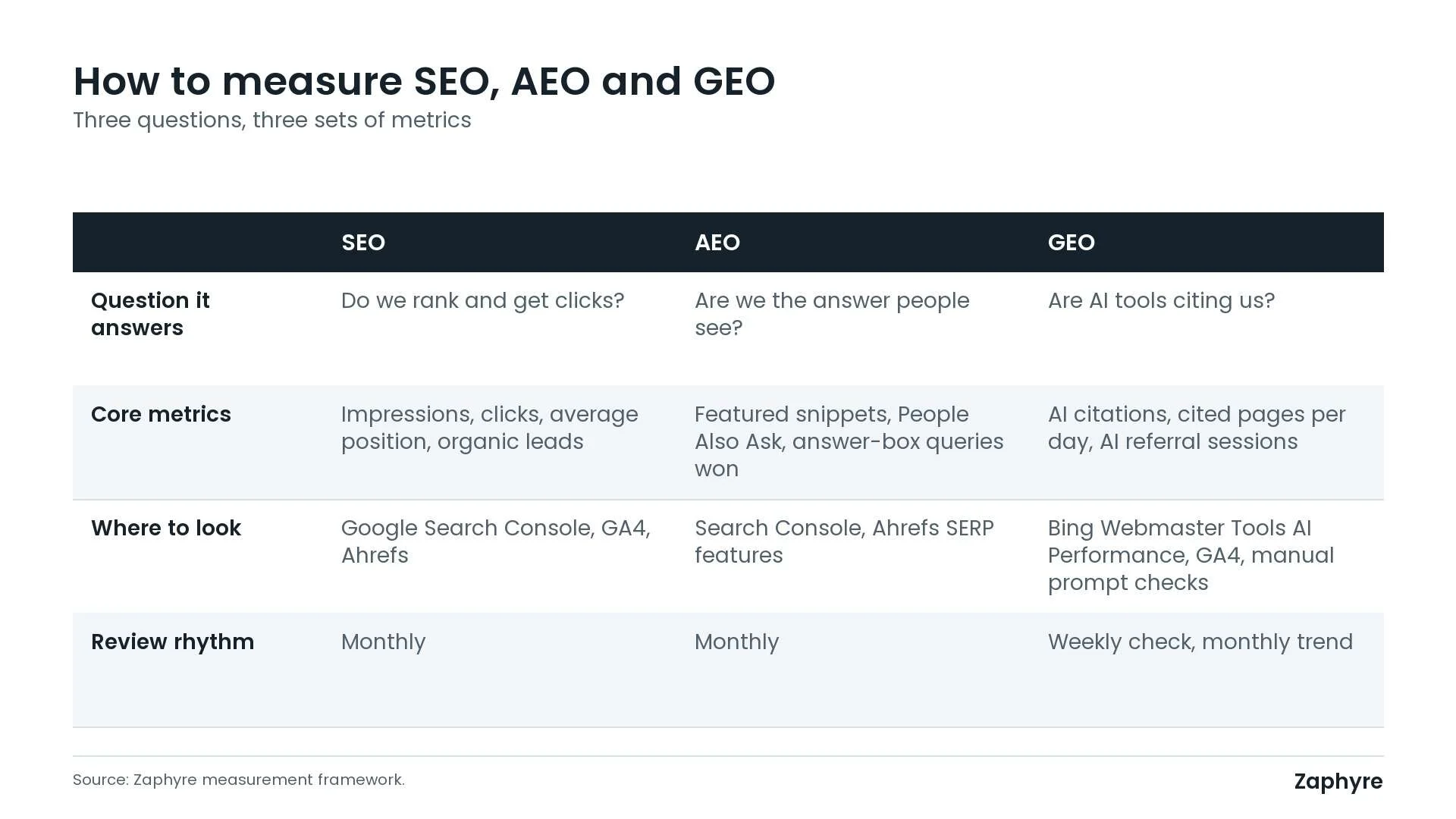
- SEO: impressions, clicks, average position, and organic leads from Google Search Console and GA4.
- AEO: featured snippets, People Also Ask placements, and answer-box queries you win, tracked in Search Console and tools such as Ahrefs or Semrush.
- GEO: total citations, average cited pages, page-level citations, and grounding queries in Bing Webmaster Tools; AI referral sessions in GA4; and manual prompt checks in ChatGPT, Perplexity, and Gemini.
One caution on grounding queries: they show how AI systems retrieved your content, not the exact questions users typed. Use them to spot topics, not to count searches.
What Mistakes Should You Avoid?
- Treating GEO as a trick. There is no shortcut that replaces useful, sourced, well-structured content.
- Blocking AI crawlers by accident. A broad robots.txt rule or firewall setting can quietly remove you from AI search.
- Publishing thin AI-written pages. Volume without original value gives AI systems nothing worth citing.
- Ignoring the click. Clicks are shrinking, but classic search still drives most B2B discovery. Keep both in view.
- Running three disconnected programs. AEO and GEO work best when they build on the same foundation as SEO.
- Measuring only traffic. Citations and impressions show visibility that never becomes a click.
What Should You Do Next?
- This week: audit crawler access and indexation on your ten most important pages.
- This month: rework those pages with direct answers, key takeaways, sourced statistics, and an FAQ.
- This quarter: publish one buyer’s guide with original data, verify your site in Bing Webmaster Tools, and start tracking citations alongside rankings.
If you want a hand with that, our SEO and AEO service covers the full stack, from technical fixes to AI search visibility.
Build One Search System, Not Three Separate Programs
SEO, AEO, and GEO are not competing priorities. They are layers of the same system, and they work best when one team owns all of them. That is how we work as an Execution Service Partner: one accountable team, one foundation, and one set of metrics tied to pipeline.
Ready to get found in AI search?
See how Zaphyre can support your technical SEO, answer-first content, and AI search visibility.
Frequently Asked Questions
AEO structures content so search and AI systems can lift a direct answer from it, including featured snippets and AI summaries. GEO aims to get your content cited or mentioned inside answers generated by AI tools such as ChatGPT, Perplexity, and Copilot. AEO is about being the answer. GEO is about being the source.
No, but AEO is part of modern SEO. SEO covers everything that helps you rank and earn clicks. AEO focuses on one outcome within that: being the direct answer. The technical and content foundation is shared.
No. Google states that appearing in its AI features requires pages to be indexed and eligible to show in Search, with no extra requirements. GEO builds on a strong SEO foundation rather than replacing it.
In practice, no. If your pages cannot be crawled, indexed, and understood, neither search engines nor AI systems can use them. Fix the foundation first.
Use the AI Performance report in Bing Webmaster Tools for citations, cited pages, and grounding queries across Microsoft Copilot and Bing AI summaries. Add GA4 AI referral sessions and manual prompt checks in ChatGPT, Perplexity, and Gemini. Remember that citations are not clicks.
Start with crawlability, indexation, and duplicate pages. Then rework your highest-value pages to answer first. Finally, add sourced data, authorship, and comparison content. That sequence works for most teams.